A Witness to History
In Nissan we were redeemed [from Egypt], and in Nissan we will be redeemed in the future.
Talmud Rosh Hashana 11b
The redemption from all the empires [Egyptian, Babylonian, Persian, Greek, Roman] is in the month of Nissan.
B’nei Yissachar, Nissan discourse 1
With love You led the people You redeemed
With might You led to them to Your holy shrine
Nations heard and shuddered, terror gripped those who dwell in Philistia
Edom’s chiefs then panicked, Moab’s heroes were seized with trembling
Canaan’s residents melted away
Fear and dread fell upon them
at the greatness of Your Arm, They are still as stone
Until Your people crossed [the River Nile], G-d, until the people You gained crossed over [the Euphrates]…Song at the Sea, 7th of Passover Torah reading, Exodus 15:13-16
G-d will dry up the gulf [lit. destroy the tongue] of the Egyptian sea, with His mighty wind He will shake His hand over the [Euphrates] river and divide it into seven streams.
Isaiah 11:15, last day of Passover haftorah
A river flowed out of Eden to water the garden. From there it divided and become four major rivers… The name of the third river is the Tigris… the fourth river is the Euphrates.
Genesis 2:10-4
All the rivers are below [and originate from] the three rivers, and the three rivers are below [and originate from] the Euphrates…which is the original river (flowing out of Eden); The Euphrates is the most prestigious and the source of all rivers, and its growth causes all other rivers to grow.
Talmud Bechorot 55a-b, and Rashi and Tosfos
On that day G-d made a covenant with Abram, saying: “To your descendants I have given this land, from the Egyptian river, as far as the great river, the river Euphrates.”
Genesis 15:18. See Deuteronomy 1:7. 11:24. Joshua 1:4
Well, the Euphrates is in the news yet again. Yes, the same Euphrates where it all began in the Garden of Eden is now smack in the middle of the battles of our day in the modern 21st century. It’s quite fascinating to see how retracing the roots of an ancient river can illuminate the defining events of our times.
As we enter the new Hebrew lunar month of Nissan and battle rages over the Euphrates, it’s hard for a Talmud student to ignore an otherwise obscure Talmudic passage which suddenly takes on immediate relevance in light of today’s events.
In the month of Nissan another Euphrates ‘coincidence’ jumps out at you: The parting of the Re(e)d Sea on the seventh day of Passover is a prelude to the parting of the Euphrates in the future, as we read in both the Torah reading of that day and in the haftorah of the last day of Passover.
Until Your people crossed [the River Nile], G-d, until the people You gained crossed over [the Euphrates]. G-d will dry up the gulf of the Egyptian sea, with His mighty wind He will shake His hand over the [Euphrates] river and divide it into seven streams.
In the tractate Bechorot the Talmud discusses the nature of the Euphrates river: Do the waters of this river swell from its own internal springs, or from rainfall. One of the differences is whether a mikveh [a ritual bath] was built in the month of Nissan. If the Euphrates swells because of the rains, then after the rainy winter season, which ends with the onset of spring (Nissan time), a mikveh needs to be built because the Euphrates cannot be used to immerse oneself, since the rainwater may make up the bulk of the river and running rainwater cannot be used for ritual immersion. If however, the Euphrates feeds itself, then its can be used all year round as a purifying force.
This may seem completely obscure, cryptic and even irrelevant to those that have never studied Talmud or are unfamiliar with its method. But remember two things: The Talmud is a comprehensive legal document that lays the foundations of law that regulates all aspects of life. Indeed, the Talmud is the basis for a large part of our modern legal and constitutional systems.
Even more important is the fact that behind/within this large ‘body’ of law lies a soul. Every detail in Torah carries profound spiritual and psychological messages that illuminate the inner recesses of our psyches and the cosmos at large.
The deeper relevance of the Talmud at hand can be appreciated through the lens of current events, and in turn, the Talmud can help us understand and analyze the nature of the Euphrates battles of today.
The Euphrates is a paradoxical river. On one hand we find many references to its glory and power. The Euphrates waters the Garden of Eden. It flows from the supernal Eden – the source of the deepest mysteries of existence, and it is the source root of all rivers. In the future the Euphrates will part, making way for the ingathering of all the exiled people.
Yet, the Euphrates is also the river where the people wept after being exiled to Babylon. And because “you have not merited you were exiled to Babylon and are drinking from the waters of the Euphrates, whose waters are filthy and smelly” (as the Midrash states, Pesichta of Eicha Rabba 19). (see last week’s article, By the Rivers of Babylon).
So, which one is it?
To understand this let us go back and visit Abraham, ‘father of all nations.’ Abraham is promised:
“To your descendants I have given this land, from the Egyptian river, as far as the great river, the river Euphrates.”
This promise follows Abraham’s mysterious vision:
“As the sun was setting, a deep sleep fell upon Abram; and a deep dark dread fell upon him. [G-d] said to Abram: ‘Know for sure that your descendants will be foreigners in a land that is not theirs for 400 years. They will be enslaved and oppressed. But I will finally bring judgment against the nation who enslaves them, and they will then leave with great wealth…’ The sun set, and it became very dark. A smoking furnace and a flaming torch passed between the halves of the animals. On that day G-d made a covenant with Abram, saying: ‘To your descendants I have given this land (The Land of Israel), from the river of Egypt to the great river, the River Euphrates’.”(Genesis 15:1-21)
What was the “deep dark dread” that befell Abraham? The Midrash explains that Abraham was shown the future great empires that would control the world and bring terror to it, each in their own way: the Babylonian, Persian, Greek, Roman and Ishmaelite empires. (see article titled Abraham’s Vision),
The great Kabbalist, Rabbi Isaac Luria (known as the holy Arizal) explains that these empires – that extend over the entire span of history – represent the different stages of refinement (birur) that we achieve throughout the generations. Everything in our material existence contains ‘great wealth’ of Divine ‘sparks,’ i.e. spiritual energy, and we are charged with the mission to redeem and elevate these sparks, and thereby refine the material universe and transform it into its true purpose: a vehicle for spiritual expression.
Beginning with the enslavement by the Egyptian empire – the archetype and root (‘head’) of all the exiles and empires – each subsequent empire symbolizes another stage of refinement in integrating G-dliness into the material world. The process concludes with the refinement of the last two powers, Edom (Esau) and Ishmael, which leads to the Messianic age – a world where there is no more destruction and terror and all children of Abraham serve the One G-d of Abraham in peace and harmony.
On one hand, Abraham experiences a “deep dark dread” seeing the tragic behavior of all the great empires throughout history, and how his children would suffer as a result. On the other hand, this vision empowered Abraham and by extension, all his children with appreciating the deeper forces at work behind the scenes, and that all these events are part of a larger process, with a light at the end of the tunnel.
Ultimately, Abraham knew that his children would achieve ‘great wealth’ as they would discover and redeem the powerful ‘sparks’ embedded in the darkest places. And that his descendants would receive the land:
“From the river of Egypt to the great river, the River Euphrates.”
Not just a river, but a ‘great river.’ Because, of all rivers, the Euphrates combines both dimensions: the depths of darkness, and precisely in this darkness lies the greatest ‘sparks.’
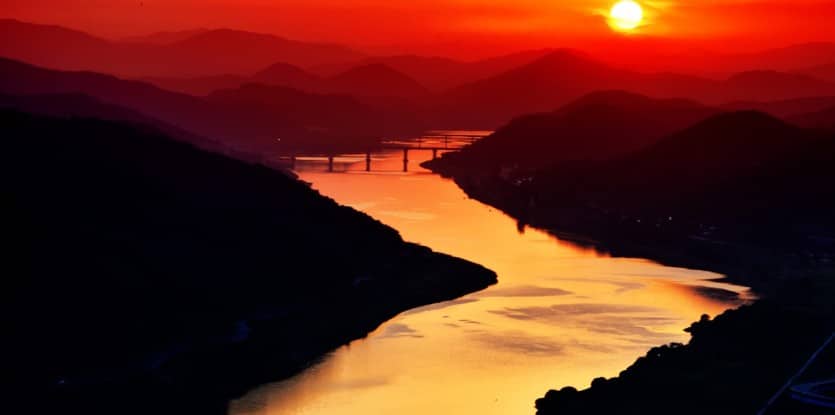
After all is said and done, the Euphrates is a silent witness to history. This river has seen the heights to which man can climb and the depths to which man can fall. All the way from the beginning, the Euphrates flowed from a mysterious place called Eden to ‘water the garden’ – a most glorious garden in which Adam and Eve, the flowers of creation, were to beautify with their efforts to “serve and to protect.” The Garden of Eden is the quintessential place on Earth, the place that was to reflect the greatest that man can achieve, the place where heaven meets earth – Paradise.
The river was then to become tragic witness to Mans’ first great fall, when Adam and Eve ate from the Tree of Knowledge, lost their innocence and began the decline into human misery and the long tragic history of existential loneliness.
The Euphrates reappears again in G-d’s promise to Abraham, which tells Abraham and his children that all is not lost. The river connecting Eden and the universe is here with us through thick and thin. Yes, at this river in Babylon Abraham’s children would weep, but at this river they should also rejoice.
Perhaps this is the deeper soul meaning behind the Talmud’s two opinions as to the nature of the Euphrates. The opinion that the river’s replenishment is dependent on rain emphasizes the ‘lower’ dimension of the river, because rain is connected to effort from below:
“A mist rose up from the earth.” (Genesis 2:6)
Hence, this river cannot always purify and sanctify. The other opinion that the Euphrates replenishes itself, from its own source, reflects the ‘higher’ dimension of the river, one that is always connected to Eden and can therefore always purify.[1]
The real challenge comes in the month of Nissan – the month we are now entering – when the Euphrates is filled with rainwater that fell in the rainy winter season. Will the river serve as a purifier or not?
Perhaps that is up to us.
The Euphrates provides us, yet again, with a few more dots that connect the patterns of history, and the deeper significance of the battles being waged today. The significance being: Reconnecting our lives – our material, sad and corrupt lives – with the Euphrates River flowing out of Eden, the source of all existence [more on the mysterious Eden in an upcoming article]. The river Euphrates captures the agony and ecstasy of history – and our responsibility to bridge the secular and the sacred, which in the final analysis is the only permanent solution to humankind’s struggles.
The Euphrates reminds us that life can be a ‘deep dark dread.’ Yet it also always reminds us that even as the ‘sun sets’ the deepest sparks of ‘great wealth’ lay embedded in the ‘deep dark dread.” And we are charged with the mission to ‘split’ the archetypal Euphrates in our lives – to separate between the negative and positive aspects of the river and walk through it. In other words: to divide between the secular and the sacred, and then to integrate them.
We are told that just as the splitting of the Red Sea took place in this month of Nissan, so too the Euphrates will finally split in this month allowing the exiles to return home.
“On that day G-d will stretch forth His hand a second time to bring back the remnant of His people, from Assyria, from Egypt, from Pathros, from Cush, from Elam, from Shinar, from Chamath, and from the islands of the sea.” (Isaiah 11:11)
Read on in Isaiah and let me know how you interpret it:
“They will fly against the Philistines toward the west; together they will plunder the children of the east. They will put forth their hand against Edom and Moab, and the Ammonites will obey them.”
Will this be the year when the Euphrates finally parts?
No doubt that it’s up to us.
[1] These two elements of the Euphrates [what comes from above and what is initiated by man below] are specifically mentioned in Berochot 59b, in connection to reciting a blessing when you see the Euphrates. The Talmud qualifies this by saying that the blessing is recited only on the part of the Euphrates that is there from creation (as it was in the Garden of Eden), but not the section of the river altered by man. See also Shulchan Aruch Orach Chaim 228:2.
——-
Some source material on the Euphrates according to Chassidus:
Likkutei Torah Tzav, Maamar V’Hainif (16d). Siddur im Dach 289a. Shaar HaEmunah ch. 52 and on. Hemshech V’Hechrim 5631.
Regarding the two paradoxical elements of the river see: Ohr HaTorah Lech Lecho vol. 4 682b. Maamar Lech Lecho 5738.