

The Pouring of the Water was held on all seven days [of Sukkot]… How was the Pouring of the Water done? A golden pitcher, holding three lugim,[1] was filled from the Shiloach Spring. When they arrived at the Water Gate,[2] the shofar was sounded… [The priest] ascended the ramp [of the altar] and turned to his left… where there were two bowls of silver… with small holes [in their bottom], one wider and the other narrower so that both should empty at the same time[3]—the western one was for the water and the eastern one for wine…
The pourer was told, “Raise your hands” (so that all could see him pouring the water), because… once there was a Sadducee who spilled the water on his feet, and the entire people pelted him with their etrogim…
Talmud, Sukkah 42b; 48a-b.
When the Holy Temple stood in Jerusalem, the “Pouring of the Water” (nisuch hamayim) was an important feature of the festival of Sukkot. Throughout the year, the daily offerings were accompanied by the pouring of wine on the altar; on Sukkot, water was poured in addition to the wine. The drawing of water for this purpose was preceded by all-night celebrations in the Temple courtyard, with instrument-playing Levites, torch-juggling sages, and huge oil-burning lamps that illuminated the entire city. The singing and dancing went on until daybreak, when a procession would make its way to the valley below the Temple to “draw water with joy”[4] from the Shiloach Spring. “For all the days of the water drawing,” recalled Rabbi Joshua ben Chanania, “our eyes saw no sleep.” And the Talmud declares: “One who did not see the joy of the water-drawing celebrations, has not seen joy in his life.”[5]
The Sadducees, however, opposed the Sukkot water pouring ceremony. The Sadducees were a Jewish sect who denied the oral tradition (torah she’baal peh) received by Moses at Sinai and handed down through the generations, arguing that they had the right to interpret the Torah according to their own understanding. Unlike the pouring of the wine, which is explicitly commanded by the Torah,[6] the pouring of the water on Sukkot is alluded to by three extra letters in the verses (Numbers 29:19, 29 and 33) where the Torah speaks of the libations to accompany the Sukkot offerings: according to the traditional interpretation of the Torah, these letters are combined to form the word mayim (water). The Sadducees, who rejected the Sinaitic tradition, were of the opinion that only wine was to be poured on the altar on Sukkot, just like every day of the year.
During the Second Temple Era, there were times in which the Sadducees amassed political power and even gained the High Priesthood—the highest spiritual office in Israel. Thus it came to pass that one Sukkot, the honor of pouring the water on the altar was given to a Sadducee priest who, instead of pouring the water into its prescribed bowl in the southwest corner of the altar, spilled it on his feet to demonstrate his opposition to the practice. The assembled crowd expressed its outrage by pelting him with the etrogim which, this being Sukkot, they held in their hands.[7]
The Taste of Water
There are two basic components in man’s service of the Creator. First, there is what the Talmud calls the “acceptance of the yoke of the sovereignty of Heaven” (kabbalat ol malchut shamayim), which is the basis and foundation of Torah: without such acceptance, the very concept of a mitzvah (divine commandment) has no meaning.[8]
But G-d gave us more than a body and a nervous system, which is all we would require if our purpose in life were a “robotic” obedience in the performance of mitzvot. He created us with a searching mind and a feeling heart because He desired that these, too, should form an integral part of our service of Him.[9] In the words of the Torah,
“See, I have taught you statutes and laws… for this is your wisdom and understanding before the nations”[10]; “You shall know today, and imbibe in your heart, that the L-rd is G-d”[11]; “Know the G-d of your fathers and serve Him with a whole heart and desirous soul”[12]; “You shall love G-d… with all your heart”[13]; “Serve G-d with joy.”[14]
He wants us to know, understand, appreciate, love, desire and enjoy our mission in life.
In the language of Kabbalah and Chassidism, these two components are referred to as the “water” and “wine” of life. Water—tasteless, scentless, colorless and a most basic requisite of life—is the intellectually and emotionally vacuous “acceptance of the yoke of Heaven.” Wine—pleasing to the eye, nose and palate, intoxicating to the brain, and exhilarating to the heart—is the sensually gratifying aspect of Torah: man’s understanding and experience of his relationship with G-d and the inner significance of the mitzvot.
And yet, on Sukkot, water is a most “tasty” element in our service of G-d—a cause for great joy, the likes of which was not equaled by any other joy in the world. To understand this, we must first examine what Halachah (Torah law) has to say about the “taste” of water.
The law states that “it is forbidden to derive pleasure from this world without a berachah,”[15] a blessing of praise and thanks to G-d. Thus, even the smallest amount of food or drink,[16] or food or drink that is consumed for non-nutritional purposes (e.g. for health reasons), requires a berachah, since a person derives pleasure from its taste. Water, however, has no taste, so it does not require a berachah unless “one drinks water out of thirst,” in which case, explains the Talmud, a person derives pleasure from this otherwise tasteless liquid.[17]
To a thirsty man, a cup of water is tastier than the most sumptuous wine. In the spiritual sense, this means that when a soul experiences a “thirst” for G-d—when it recognizes how vital is its connection to G-d for its very existence—the prosaic “water” of commitment is a feast for the senses. For the soul that thirsts for G-d, its simple commitment to G-d is more exhilarating than the most profound page of Talmud, the most sublime Kabbalistic secret, the most ecstatic flight of prayer, the most intense spiritual experience. To such a soul, the “water” it draws from its deepest self to pour onto the altar of its divine service is a greater source of joy than the flesh and wine offered upon its altar or the incense wafting through its Temple.
Why Sukkot?
Rosh Hashanah is the “head” of the Jewish year—a time devoted to the most fundamental component of our relationship with G-d. On Rosh Hashanah we crown G-d as our king and reiterate our “acceptance of the yoke of the sovereignty of Heaven.”[18] But on Rosh Hashanah the joy of the thirsting soul in its elemental water is subdued by the awe that pervades the occasion, as the entirety of creation trembles in anticipation of the annual renewal of the divine sovereignty. Sukkot is the celebration of this joy, the revelation of what was implicit fourteen days earlier on Rosh Hashanah.
(Thus Chassidic teaching explains the verse, “Blow the shofar on the new moon, in concealment to the day of our festival.”[19] The Jewish calendar is a lunar calendar, which means that its months follow the phases of the moon. Moon and month are born, grow, mature and dwindle together—each month begins on the night of the new moon, progresses as the moon grows in the night sky, and reaches its apex on the fifteenth of the month, the night of the full moon. This is why so many of the festivals and special days of the Jewish year fall on the fifteenth of the month, this being the day on which the particular month’s special quality is most expressed and manifest. In the month of Tishrei, Rosh Hashanah coincides with the birth of the new moon on the first of the month, while Sukkot begins on the 15th. Hence, “Blow the shofar,” proclaiming our acceptance of the sovereignty of Heaven, “on the new moon,” Rosh Hashanah; this, however, remains “in concealment to [—until] the day of our festival,” Sukkot,[20] when it erupts in a seven day fest of joy.)
Anatomical Statement
The Sadducees opposed the Pouring of the Water on Sukkot.
The Sadducees refused to accept the divinely-ordained interpretation of Torah transmitted to Moses at Sinai and handed down through the generations. While recognizing the divine origin of Torah, they regarded it as a series of laws open to personal interpretation—an interpretation subject only to the interpreter’s understanding and feelings. In other words, there is no true commitment, no true submission to the divine authority. The Sadducee might acknowledge the need for “blind” obedience to Torah on the part of the masses, for not every man is capable of interpreting these laws himself. He might acknowledge the need for such obedience on the part of even the wisest of men, for no man can expect to understand everything. But this is a necessity rather than the ideal, which would be a fulfillment of Torah based on the observer’s understanding and appreciation. So there is no joy in submission to the divine will, no taste to the water of commitment. For the Sadducee does not thirst for this water—to him, the Torah is not the essence of life, but a spiritual luxury, a tasty meal for the mind and heart. If he must obey its laws, it is only to enable him to savor their intellectual flavor and emotional aroma. Only wine flows on the altar of his service of G-d.
Thus the Sadducee priest poured the water on his feet. He was not condemning the phenomenon of “water” in serving G-d; he was regulating it to the feet—to the ‘foot-soldiers” of the nation, or to the lower extremities of the human form. Water might be necessary, perhaps even laudable, in certain individuals and in certain circumstances, but it is hardly the fluid to grace the altar in the year’s most joyous celebration of man’s relationship with G-d.
A Hail of Fruit
The people responded by pelting him with their etrogim.
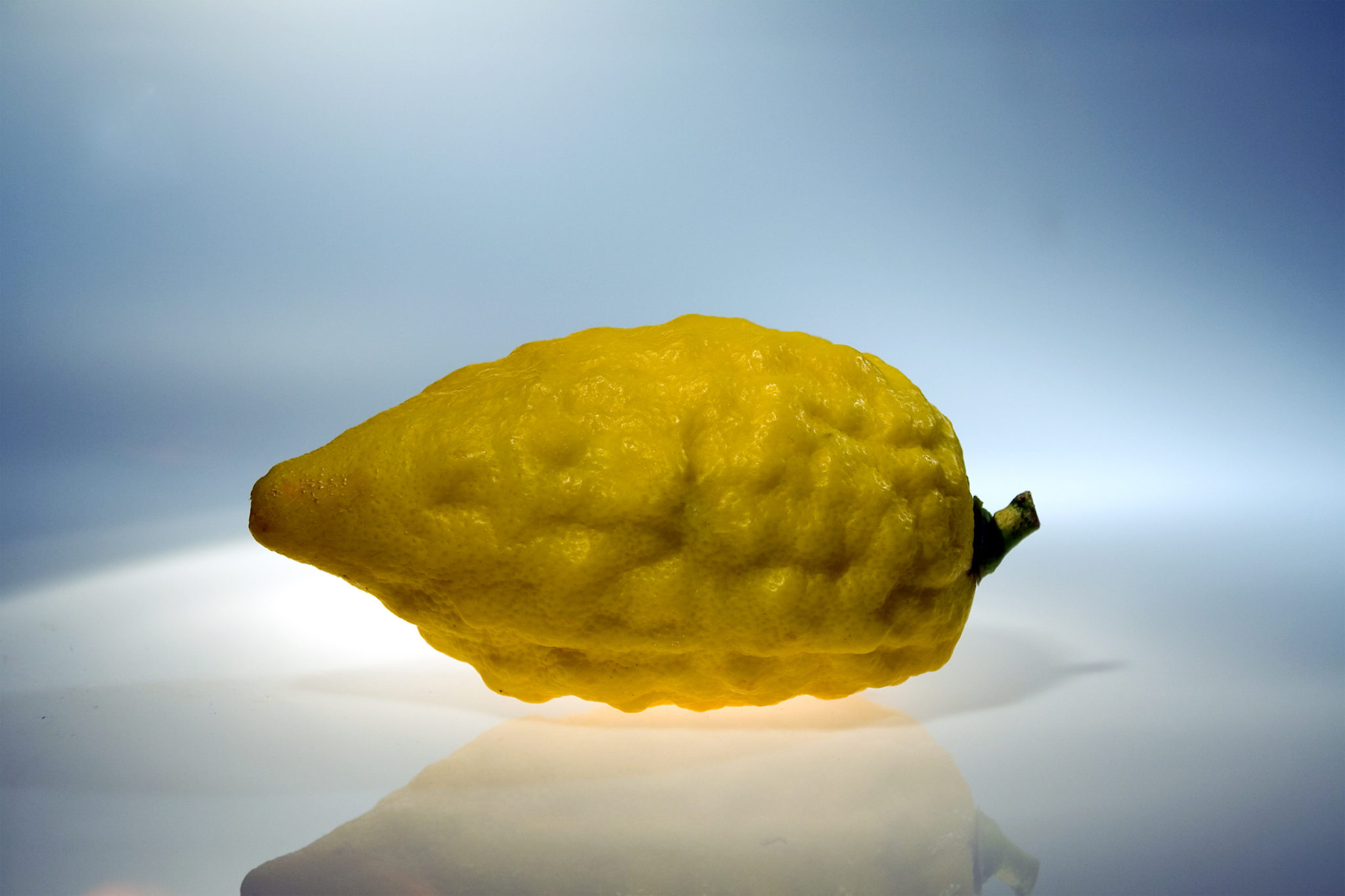
The Midrash tells us that the “Four Kinds” taken on Sukkot—the etrog (citron), the lulav (palm frond), the hadas (myrtle branch) and aravah (willow branch)—represent four types of individuals. The etrog, which has both a taste and a fragrant smell, represents the perfect individual who is both knowledgeable in Torah and proficient in the observance of mitzvot. The lulav is the branch of the date palm, whose fruit has a taste but no smell,[21] representing those accomplished in Torah though less so in regard to the mitzvot. The hadas—tasteless but aromatic—represents the type who, though lacking in Torah knowledge, has many mitzvot to his credit. Finally, the tasteless, scentless aravah represents the individual who lacks both Torah and mitzvot.[22]
On a deeper level, the “Four Kinds” represent four “characters” within every individual, each with its own domain in his psyche and its appropriate place in his life. In this sense, “Torah” is the intellectual appreciation of the divine wisdom, and “mitzvot” are the love and awe of G-d experienced in the observance of the commandments.[23] Thus, the lulav is the “intellectual” in man who does not allow feeling to cloud the purity of knowledge and comprehension; the hadas is the emotional self, who sets experience as the highest ideal, even at the expense of the intellect; the etrog is the force that strives for perfection, for the ultimate harmony between mind and heart; and the aravah is the capacity for acceptance and commitment, for setting aside intellect and feeling to commit oneself absolutely to a higher ideal.[24]
When the Sadducee priest spilled the water on his feet, the “entire people pelted him with their etrogim.” We reject what you represent, the people were saying, not only with the odorless and tasteless aravah in us, not only with our intellectual or emotional personas, but also with the synthesis of wisdom and feeling that defines what is highest and most perfect in man. For also—and especially—the etrog within us recognizes the water of life, that “mindless” and “unfeeling” commitment to our Creator, as our ultimate source of joy.
Based on an address by the Rebbe, Sukkot 5715 (1954)[25]
Adapted from the teachings of the Rebbe by Yanki Tauber
[1]. Approximately one liter.
[2]. One of the gates leading into the courtyard of the Holy Temple, so named because the procession that carried the water for the Pouring of the Water on Sukkot passed through this gate.
[3]. Wine, being denser than water, would flow more slowly if the openings were the same size. When these bowls emptied, the wine and water would run over the top of the altar.
[4]. Isaiah 12:3.
[5]. Talmud, Sukkah 51a-b; 53a.
[6]. Numbers 15:1-12; et al.
[7]. In those days it was the custom to carry the “Four Kinds” all day (see Talmud, Sukkah 41b).
[8]. Talmud, Berachot 13a. See Mechilta on Exodus 20:3 (quoted in A Blast in Three Dimensions (note 8), WIR, vol. VIII, no. 1. See also Totalitarianism Today, ibid., and Day One, ibid., no. 2).
[9]. “All that G-d created in His world, He created solely for His glory” (Ethics of the Fathers 6:11). Thus it cannot be said that serving G-d is a matter of “blind” obedience while our intellectual and emotional selves exist for other, “secular,” purposes.
[10]. Deuteronomy 4:5-6.
[11]. Ibid., verse 39.
[12]. I Chronicles 28:9.
[13]. Deuteronomy 6:5.
[14]. Psalms 100:2; cf. Deuteronomy 28:47.
[15]. Rashi and Tosafot, Sukkah 26b; Rosh on Berachot 35a; Tur, Orach Chaim 210.
[16]. In contrast with the berachah after eating, which is recited only when a person has been sated by the food.
[17]. Talmud, Berachot 44b-45a; Tosfot, ibid., s.v. DeChanaktei Umtza; Mishneh Torah, Laws of Berachot 8:1; Shulchan Aruch and commentaries, Orach Chaim 204:7-8.
[18]. See references cited in note 8 above.
[19]. Psalms 81:4.
[20]. “The festival” (chag) always refers to the festival of Sukkot.
[21]. For the reason we take the branches of the date palm rather than its fruit, see Likkutei Sichot, vol. IV, p. 1164.
[22]. Midrash Rabbah, Vayikra 30:11.
[23]. In his Tanya (ch. 4), Rabbi Schneur Zalman of Liadi explains that the mind is the tool with which man has been equipped to apprehend the divine wisdom of Torah, while the emotions of the heart are the motivators and facilitators of mitzvah observance.
[24]. See One Twig and One Leaf, to be published in next week’s issue of Week In Review.
[25]. Likkutei Sichot, vol. II, pp. 426-432.





[…] set-up, the service is provided via greater than eighty Bureau offices, which are marked as water pouring ceremony. Each of these offices is accountable for the monitoring of river phases and rainfall within the […]
[…] water. When you are conscious, food poisoning from filthy water is among the leading resources of water softener reviews among tourists and people. By discovering a simple lightweight water cleansing answer therefore, […]