
Light
On all these eight days of Chanukah, these lights are holy; we are not allowed to make use of them—just to see them.
Haneirot Halalu prayer
They call us the “people of the Book” because of our legendary devotion to it. By law, we are required to pursue it every spare moment of the day and night. When a child is born, we wish his parents, “May you merit to raise him to Torah.” For four thousand years, the study of Torah has been the life’s occupation of the Jew and his highest mark of achievement.
There are many dimensions to Torah and many levels of Torah study; generally speaking, these fall under three basic categories: a) Torah as a guide to life; b) Torah as a means of connecting to G-d; c) Torah as an end in itself.
The Act of Learning
On the first level, we study Torah so that we should “know the path in which to walk and the deeds that should be done.”[1] The Torah is G-d’s “blueprint for creation,”[2] His instructions on how life is to be lived in the world He created. On this level, we study Torah for the same reason that one who purchases a complicated piece of machinery reads the manual provided by the manufacturer—the consumer can always try to operate the thing on his own, but chances are that he’ll ruin it that way, and he certainly won’t get the most out of it. Our sages speak of this aspect of Torah when they say, “The mitzvot were given to refine the human being,”[3] and “The Torah was given to make peace in the world.”[4]
The Torah, however, is not only a guide to life—it is also a vehicle of union with G-d. As Rabbi Schneur Zalman of Liadi writes in his Tanya, “When a person understands and comprehends, truly and thoroughly, a certain law in the Talmud, for example, his mind grasps and encloses it and—at the same time—is also enveloped within it.[5] Now this particular law is the wisdom and will of G-d, for it was His will that when, for example, Reuben pleads in one way and Simon in another, the verdict between them shall be such and such. And even if such a litigation never was and never will present itself for judgment in connection with such disputes and claims, nevertheless, since it has been the will and wisdom of G-d that in the event of one person pleading this way and the other pleading that way the verdict shall be such and such, it follows that when a person knows and comprehends this law… he has thus comprehended, grasped and enclosed in his mind the will and wisdom of G-d… and enveloped his mind within them.
“This is a wonderful union, the likes of which there is none other, and which has no parallel anywhere in the material world, whereby complete oneness and unity, from every side and angle, is attained.”[6]
Finally, there exists yet a third level of Torah study—Torah lishmah, “Torah for its own sake.” On the first two levels, the study of Torah serves as a means to an end, whether the end of mastering the art of life and perfecting the world, or the more transcendent end of connecting to G-d. But the highest level of Torah study is Torah study as an end in itself: learning whose sole purpose is to engage in the act of learning Torah.
Light in Three Dimensions
“A mitzvah is a lamp,” says King Solomon in Proverbs, “and Torah, light.”[7] Light is a metaphor for Torah, and light, too, assumes these three forms: light as a tool of life, light as a means of connection to a higher place, and light as light.
These three states of light are illustrated by three mitzvot observed by the kindling of lights: the lighting of Shabbat candles, the lighting of the menorah in the Holy Temple, and the kindling of the Chanukah lights.
The purpose of the Shabbat candles is shalom bayit, “peace in the home”—to create a pleasant and tranquil atmosphere in the home in honor of Shabbat.[8] Thus Maimonides rules: “If a person has [only enough money for] either a candle for his home or [wine or bread] for kiddush, a candle for the home comes first, for the sake of peace in the home. For … the entire Torah was given to make peace in the world.”[9] The Shabbat candles thus represent the Torah’s role as a guide to a life of harmony and perfection.
The lights kindled in the Holy Temple served a higher purpose. The Temple was the “house of G-d” where the harmony and perfection of the Divine were manifest in all their glory. Does such a place—asks the Talmud—require illumination? But the lights of the Temple’s menorah, answers the Talmud, served as “a testimony to the entire world that the divine presence rests in Israel.”[10]
The lights of the Temple represent the Torah as it reaches beyond its role as the perfecter of creation to unite heaven and earth and connect man to G-d.
But then there are the lights of Chanukah. While a certain function is attributed to them—the “publicizing of the miracle”[11] this does not define their essence. This is evidenced by the fact that when circumstances prevent the possibility of exposing the Chanukah menorah to the public eye, “One may place it on his table, and this suffices” for a complete fulfillment of the mitzvah[12] (in contrast to the Shabbat candles, over which no blessing may be recited if they do not serve their function of adding illumination to the home).[13]
Hence the law forbids all use of the Chanukah menorah’s light for any purpose whatsoever—they are there “just to see them.” This is the quintessential light of Torah: light as an end in itself; light as light.[14]
Based on the Rebbe’s talks on Chanukah 5720 (1959-1960)[15].
The Lamp
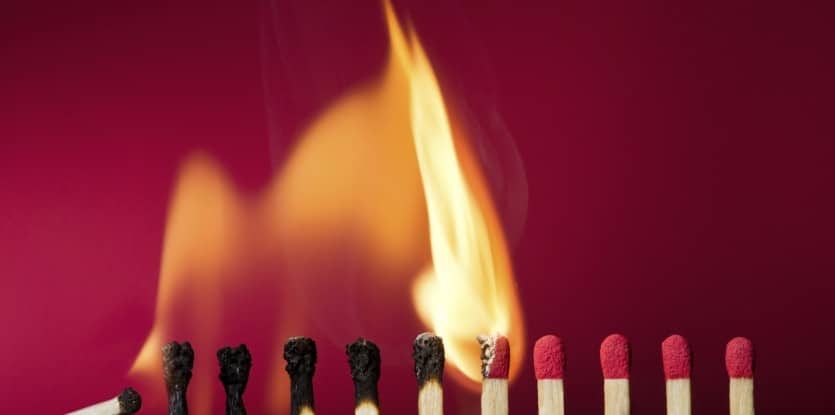
Few sights are as warming to the soul as the sight of a burning flame. Though a physical phenomenon, the flame—luminous, pure, ethereal—is everything the physical is not; hence its appeal to man, a spiritual being entrapped in a material world.But the flame is more than a symbol of spirituality. The flame is our own mirror, in which we see reflected the strivings of our deepest self. In the words of the Proverbist, “The soul of man is a lamp of G-d.”[16]
The flame surges upwards, as if to tear free from the wick and lose itself in the great expanses of energy that gird the heavens. But even as it strains heavenward, the flame is already pulling back, tightening its grip on the wick and drinking thirstily of the oil in the lamp—oil that sustains its continued existence as an individual flame. And it is this tension of conflicting energies, this vacillation from being to dissolution and back again, that produces light.
We, too, yearn for transcendence, yearn to tear free of the entanglements of material life and achieve a self-nullifying reunion with our Creator and Source. At the same time, however, we are also driven by a will to be, a will to live a physical life and make our mark upon a physical world. In the lamp of G-d that is man, these polar drives converge in a flame that illuminates its surroundings with a G-dly light.
The Ingredients
A lamp consists of oil, a wick, and a vessel containing them so that the oil is fed through the wick to a burning flame.
Oil and wick are both combustible substances, but neither could produce light on its own with the efficiency and stability of the lamp. The wick, if ignited, would flare briefly and die, utterly consumed. As for the oil, one would find it quite difficult to ignite at all. But when wick and oil are brought together in the lamp, they produce a controlled and steady light.
The soul of man is a lamp of G-d whose purpose in life is to illuminate the world with divine light. G-d provided us with the “fuel” that generates His light—the Torah and its commandments (mitzvot), which embody His wisdom and will and convey His luminous truth.
The divine oil requires a “wick” to channel its substance and convert it into an illuminating flame. The Torah is the divine wisdom; but for the divine wisdom to be manifest in our world, there must be physical minds that study it and comprehend it, physical mouths that debate it and teach it, and physical media that publish it and disseminate it. The mitzvot are the divine will; but for the divine will to be manifest in our world, there must be a physical body that actualizes it, and physical materials (animal hide for tefillin, wool for tzitzit, money for charity) with which it is actualized.
And just as the divine oil cannot produce light without a material wick, neither can a wick without oil. A life without Torah and mitzvot, however aflame with the desire to come close to G-d, is incapable of sustaining its flame. It might generate flashes of ecstatic spiritual experience, but lacking oil of genuine divine substance, these quickly die out and fail to introduce any enduring light into the world.
To realize its role as a “lamp of G-d,” a human life must be a lamp that combines a physical existence (the “wick”) with the divine ideas and deeds of Torah (the “oil”). When the wick is saturated with oil and feeds its spiritual yearnings with a steady supply of the same, the resultant flame is both luminous and sustainable, preserving the existence and productivity of the wick and illuminating the corner of the world in which it has been placed.
The Pendulum of Life
The “wick” is both prison and liberator for the flame, both tether and lifeline. It holds the soul in its distinctiveness from the divine whole, in its apartness from its Creator. And yet, it is this distinctiveness and apartness, this incarnation in a physical life, which allows us to connect to G-d in the deepest and most meaningful way—by fulfilling His will.
So when divine command, physical body and human life come together as oil, wick and lamp, the result is a flame: a relationship with G-d that is characterized by two conflicting drives, by a yearning to come close coupled with a commitment to draw back. The materiality of life evokes in the soul a desire to tear free of it and fuse with the Divine. But the closer the soul is drawn to G-d, all the more does it recognize that it can only fulfill His will as a distinct and physical being. So while the corporeality of the wick triggers the flame’s upward surge, the divine will implicit in the oil sustains its commitment to existence and life.
Actual Lamps
Every mitzvah is oil for the soul. With every act that constitutes a fulfillment of the divine will, our lives are rendered into burning lamps, alight with a flame that vacillate from heaven to earth and back again, illuminating the world in the process.
Every mitzvah generates light—whether it involves giving a coin to charity, binding tefillin on our arms and heads, or eating matzah on Passover. Certain mitzvot, however, not only transform us into metaphorical lamps, but also assume the actual form of a lamp. A real, physical lamp, with physical oil, a physical wick, and a physical flame that produces physical light.
Thus we have the mitzvah to kindle the menorah in the Holy Temple and produce a literal representation of the divine light that emanated from there to the entire world.
Every Friday evening, the Jewish woman invites the light of Shabbat into her home by kindling the Shabbat candles—another mitzvah whose function is reflected in its form.
And once a year comes Chanukah, the festival of lights. For eight days, a nightly growing number of flames are kindled in the doorways and windows of our homes, so that the light generated by our lives as “lamps of G-d” should spill outdoors and illuminate the street.
Based on two letters by the Rebbe, dated 25 Adar II, 5711 (April 2, 1951) and Chanukah 5731 (1970), and on his talks on various occasions [17].
Adapted from the teachings of the Lubavitcher Rebbe by Yanki Tauber.
—————————————
[1] Cf. Exodus 18:20.
[2] Midrash Rabbah, Bereishit 1:2.
[3] Ibid., 44:1
[4] Sifri, cited in Mishneh Torah, Laws of Chanukah 4:14.
[5] I.e., the phenomenon of being “fully immersed” in an idea.
[6] Tanya, ch. 5.
[7] Proverbs 6:23.
[8] Talmud and Rashi, Shabbat 23b and 25b.
[9] Mishneh Torah, ibid.
[10] Talmud, ibid. 22b.
[11] Ibid., 23b.
[12] Ibid.
[13] See Shulchan Aruch HaRav, Orach Chaim 263:10, and sources cited there.
[14] There does exist one condition for the fulfillment of the mitzvah—their light must be able to be seen—for this is integral to the very definition of “light.” For example, one cannot make a blessing on a menorah whose lights are more than 20 cubits (approximately 30 feet) above the ground, since ”the eye does not notice them” above this height.
[15] Likkutei Sichot, vol. III, pp. 810-818.
[16] Proverbs 20:27.
[17] Likkutei Sichot, vol. XII, p. 149; ibid., vol. V, pp. 445-446; et al. See also Torah Ohr, Mikeitz 33c; Shaarei Orah, Shaar HaChanukah, s.v. Ki Atah Neri; Igrot Kodesh, vol. IV, p. 228.





Simple and excellent presentation. I see how the theme can be common for all religions. Just to quote one from Hindu Vaishnavism, one of the saints sang euphemistically I light the lamp with the earth as the receptacle, the ocean as the oil, the Sun as the flame and worship thee