
Turnus Rufus asked Rabbi Akiva: “If G-d honors the Shabbat, then He should not blow winds on it, He should not cause rain to fall on it, He should not cause the grass to grow on it!” Replied Rabbi Akiva: “If two people live in one courtyard, unless they both contribute to an eiruv, would they be permitted to carry in the yard? But if one person lives in a courtyard, he has free reign in the entire yard. The same is true of G-d: since there is no other authority besides Him, since the entire world is His, He has free reign in the entire world.”
Midrash Rabbah, Bereishit 11:6
On the face of it, Rabbi Akiva’s reply does not seem to truly answer the Roman emperor’s question. While it is true that a person is permitted to move things from place to place within a “private domain” on Shabbat, regarding all the other forms of forbidden labor, there is no difference between such a domain or some other place. For example, it is no less a violation of the Shabbat to water a garden than it is to water an open field. So if G-d’s “causing rain to fall” might be regarded as a violation of Shabbat, why would the fact that the entire world is His exclusive domain make this activity any more “permissible” for Him?
The Eiruv
On Shabbat, it is forbidden to transfer an object from a “private domain” to a “public domain” or vice versa. A “private domain” is an enclosed area, such as a home, a fenced yard, etc.; a “public domain” is an open public thoroughfare, such as a street or plaza.
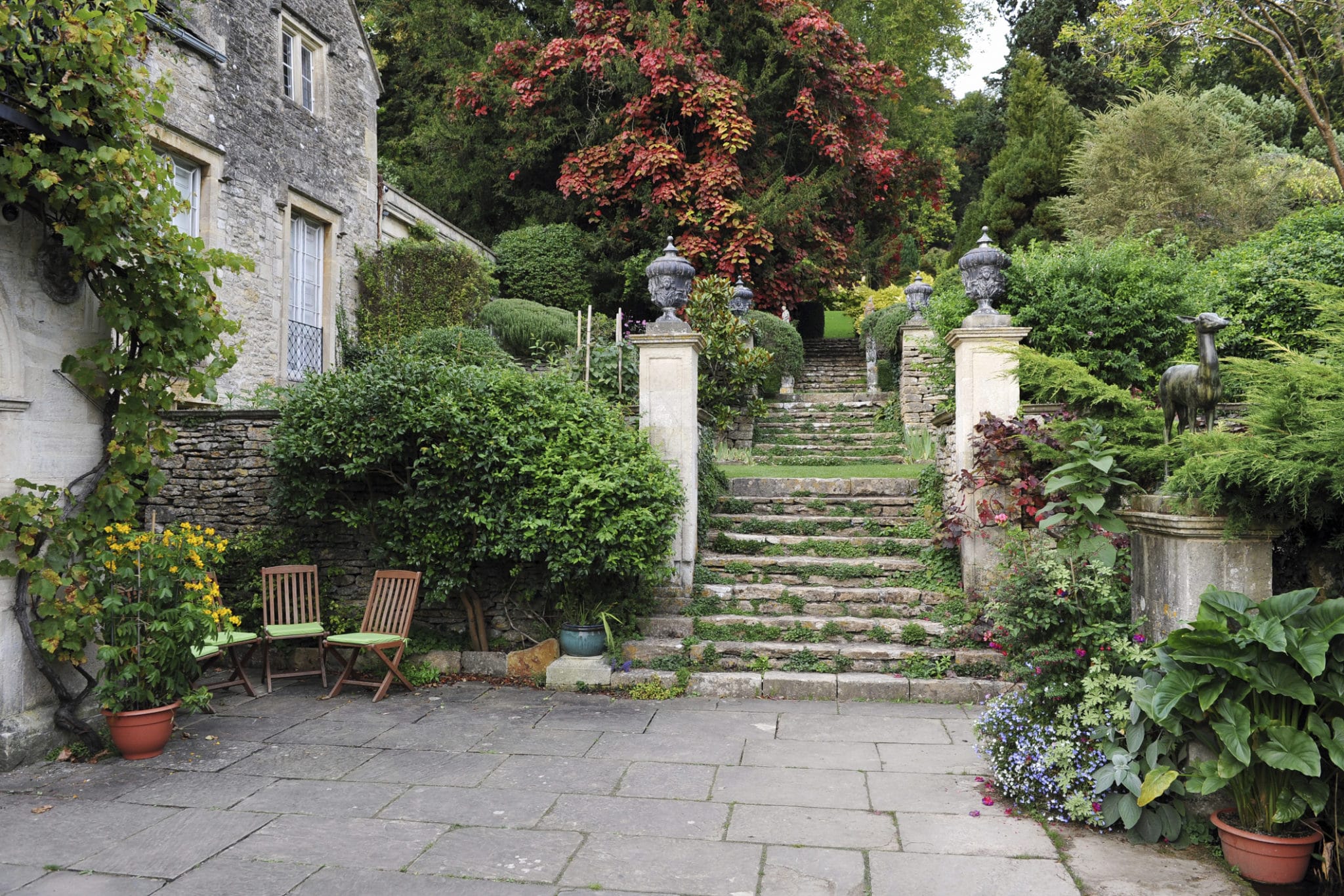
The laws of Shabbat also define another category: areas that are technically a “private domain” but whose function resembles that of a “public domain.” For example, an enclosed courtyard shared by several homes, or the lobby and hallways of an apartment building. Here, too, it is forbidden (by rabbinical ordinance) to transfer articles between “domains.” It is such a domain that Rabbi Akiva is referring to when he speaks of “two people living in one courtyard.”
There is, however, a procedure which makes it permissible to borrow a cup of sugar from the neighbor down the hall on Shabbat, or to take along a house key or baby carriage on a stroll to the park. This procedure, whose detailed laws take up an entire tractate in the Talmud, is called the eiruv.
How is an eiruv made? First of all, if the area is not already enclosed, it must be physically defined as a singular entity; a thin wire running along the tops of poles will transform a street, a neighborhood, even an entire city, into a halachically “private domain.” Then, something must be done to deal with its resemblance to a “public domain.” This is achieved by taking a loaf of bread, designating it as the common property of all the residents of the enclosed area, and keeping it in one of the homes or apartments. Because they all have a (potential) meal awaiting them in one place, the residents of this “domain” are now legally considered a single household. Hence the halachic term eiruv, which means “combining” or “intermixing”: the various sub-domains in this physically enclosed area have been integrated into a single “private” province.
What exactly is an eiruv? Is it a legal gimmick formulated by some ingenious Talmudic lawyer? Are we “outsmarting” G-d? If the divine law intended that we should not carry from domain to domain, why are we devising ways of “getting off on a technicality”?
But the eiruv is no mere loophole. Not only does Torah law sanction its use, but it declares that “It is a mitzvah to pursue [the arrangement of] both a courtyard eiruv and one for the street.”[1] Indeed, on a deeper level, the effecting of an eiruv relates to the very essence and function of Shabbat.
Work Defined
“For six days shall work be done,” commands the Torah, “but the seventh day shall be to you a holy day, a sabbath of rest to G-d.”[2] But what, exactly, constitutes “work”? The Hebrew word employed by the Torah,melachah, actually means “creative work.” Thus, writing a single word is amelachah, while dragging a heavy sofa from one end of the room to the other is not. Specifically, the Talmud[3] enumerates 39 categories of “creative work” that are forbidden on Shabbat, such as “sowing,” “baking,” “tanning hides,” “weaving,” “writing,” “building,” “igniting a fire,” and the like.[4]
This is in keeping with the function that the Torah attributes to Shabbat: “It is an eternal sign between Me and the children of Israel, that in six days G-d made the heavens and the earth, and on the seventh day He rested and He was refreshed.”[5] Obviously, G-d did not sweat and toil to create the world, and the “rest” and “refreshment” He experienced on the seventh day were not relief from exertion. Rather, for six days G-d created, and on the seventh day He ceased to create. So when we attest to G-d’s creation of the universe by emulating His work/rest cycle in our own lives, the “work” we cease from on the seventh day of the week is defined not by the degree of physical effort it extracts from us, but by its creativity: for six days we engage in creative involvement with the world, laboring to transform it into “a home for G-d,”[6] while Shabbat is a day of disengagement from the material and cessation of all physically transformative activity.
This difference between Shabbat and the other days of the week is expressed not only in what we do or do not do on Shabbat, but also in the way we do the things that we do.
A prime example is the manner in which we regard physical pleasure on Shabbat. During the week, we seek to remake our physical drives and resources into a “Sanctuary” that serves and expresses the divine. For example, when we eat, we do so with the intention of utilizing the energy we derive from the food to serve G-d. In this way, the material substance of the food and the physical act of eating are transformed into the energy expended in helping the needy, into the fervor of prayer, into the acumen of the mind studying the divine wisdom in Torah. Transformed, that is, into an instrument of the divine will. Eating for no purpose other than for the sake of physical pleasure is not a constructive—much less a holy—act. Instead of sublimating the material, it has the very opposite effect: it sinks the person deeper into the morass of self, even further distancing him, and the material environment he occupies, from their divine purpose and function.
Such is our approach to material life for the first six days of the week. On Shabbat, however, pleasure for the sake of pleasure is a mitzvah, a fulfillment of G-d’s will. There is no need for the physical to be developed and transformed into something that serves a “higher” purpose. Deriving pleasure from the material world is itself an act of holiness, a way of experiencing and bringing to light the divine nature of G-d’s creation.
In other words, during the week, we struggle to change the world: to divest it of its corporeality and direct it toward a higher goal. But on Shabbat we cease from the effort to transform the material reality; instead, we relate to the world as it is, to the divine essence implicit in our existence.
What happens on Shabbat to effect this drastic change in how we relate to the world? To understand this, we must again look at the nature of G-d’s “work” and “rest” in the seven days of creation.
Projection and Withdrawal
Chassidic teaching[7] likens G-d’s “rest” on Shabbat to what an artist experiences upon the completion of a work of art. While he labors, the artist’s prowess and vitality are invested in his work; he may actually feel drained of the energy that is flowing from his own soul into his creation. But when he completes his work, this tremendous projection of mind and talent ceases; he now experiences the “return” of his creative powers and their re-inclusion into his own being.
The same may be applied to G-d: for six days of the week (every week, for creation is an ongoing cycle of divine involvement with our existence to grant it being and life) G-d projects His creative powers into our existence. On Shabbat, G-d ceases this outward flow, withdrawing back into Himself. This concept is alluded to by the Hebrew word vayinafash (“and He was refreshed”) in the verse quoted above (“in six days G-d made the heavens and the earth, and the seventh day He rested and He was refreshed”).Vayinafash literally means “and His soul returned to him.”[8]
There is, however, an important difference between G-d’s withdrawal and that of our hypothetical artist. When the artist pulls back his creative powers, he leaves the completed work behind—his creation is now an entity wholly separate from himself, no longer dependent upon his involvement. When G-d withdraws, He takes His work back with Him. For while the artist’s work is the result of his projection, G-d’s work is the projection itself. G-d does not take pre-existing paints and canvas, and work His creative energy upon them; what we experience as reality is G-d’s creative energy.
In other words, when the Torah tells us that “G-d said, ‘Let there be light,’ and there was light,” this does not mean that G-d’s words caused something else—the thing we call light—to come into being. It means that what we experience as light is actually the divine words “Let there be light.” By describing creation as G-d’s “speech,” the Torah is giving us its definition of reality. Speech is the projection of one’s ideas outside of oneself (as opposed to thought, which is a wholly internal articulation). What is the world? The world is G-d speaking—G-d’s continuous outward projection of His creative powers.
At least, that’s what the world is for six days a week. On Shabbat, G-d withdraws this projection back into an uncommunicating self. The world is no longer divine speech but divine thought. It is no longer an existence “outside” of G-d.
This is why the world is “holier” on Shabbat. Were G-d’s work to be “left behind” when He withdraws His creative energies, then the very opposite would be true—the world would now be further removed from G-d. But Shabbat is not G-d’s withdrawal from creation, but G-d’s withdrawal ofcreation. Shabbat is a “holy” day because, on Shabbat, the created existence is re-absorbed in its divine source.
Hence the different ways in which we relate to reality in the course of the week. For the first six days of the week, we labor to change the world into a “home for G-d.” True, the world is not an existence separate from G-d, and it is certainly not independent of Him—all it is is His “spoken words.”[9] Nevertheless, G-d relates to the created existence as anoutward projection of His creative powers, and this is what allows it to perceive itself as something “outside” of the divine reality. So for six days we struggle to divest the world of the illusion and delusion of selfhood. We seek to demonstrate how things do not exist for their own sake, but to serve a higher truth.
On Shabbat, however, G-d ceases to speak the world. He now “thinks” it, relating to it as something that is wholly absorbed within His reality. In our own lives, our focus shifts accordingly: instead of seeking to change the world, we seek to reveal how the world, as it is, is one with its Creator.
Transfer and Transformation
In light of the above, we can understand the deeper significance of themelachah of transferring things between “private” and “public” domains.
At first glance, the melachah of “transferring from domain to domain” on Shabbat—the last on the Talmud’s list—hardly seems to qualify as amelachah. The other 38 categories of work are all tangibly creativeendeavors: activities which visibly change something in a constructive manner. But the change effected by transferring an object from domain to domain is far more subtle—all that one has changed is the thing’s place. Or, to put it another way, there has been no actual change in the thing, only a change in the thing’s potential—its potential use, originally private, has now been made public (or vice versa).
For this reason, our sages refer to “transferring” as a “weakmelachah.”[10] Nevertheless, the very first laws to be discussed in the Talmudic tractate Shabbat are the laws which define the various “domains” and the prohibition of transferring objects between them. For in truth, the prohibition to transfer from domain to domain lies at the very heart of what Shabbat is all about.
When we look at the world during the first six days of the week, we see two distinct “domains.” On the one hand, there are the objects and resources which we have enlisted to serve G-d, thereby transforming them into a “home” for Him—His own “private domain” where everything submits to His singular reality. On the other hand, we have the “street,” the world “out there”—a “public,” diverse and pluralistic domain which regards itself as separate, or even independent, from its divine source.
Six days a week, it is indeed our duty to “transfer from domain to domain.” We strive to bring things from the “public domain” into that sacred corner of our lives that is consecrated as G-d’s private realm (e.g., a coin given to charity, a piece of animal hide made into a pair of tefillin). We also seek to take from this “private domain” out into the “street,” to instill its holiness into the still “public” areas of the material existence (e.g., running a business in accordance with the ethics of Torah).
On Shabbat, however, there is only one reality: creation as the private domain of G-d. And the entire point of Shabbat is to express this truth in our daily lives. Any attempt to transform reality—even for the sake of serving G-d—is a violation of Shabbat, for it means that one is dealing with the world as if it were something outside of G-d.
In other words, all of the 39 melachot are, in essence, a form of the prohibition to “transfer from domain to domain” on Shabbat. By doing creative work on Shabbat, a person perpetuates the lie of a “public” world on this divinely private day.[11]
On a deeper level, it is the law of the eiruv, rather than the laws pertaining to truly public domains, which expresses the essence of Shabbat. For even during the six workdays of the week, there is no such thing as a truly “public domain”—only a “private domain” which presents a public face and appearance. Ultimately, there is no corner of the universe that is outside of the exclusive province of G-d—only areas in which the surface reality obscures this truth. Thus it can be said that our world is comparable to the essentially-private-but-seemingly-public “courtyard” in which it is forbidden to carry things about on Shabbat without an eiruv.
This explains Rabbi Akiva’s reply to Turnus Rufus. Of course G-d observes the weekly day of rest: on Shabbat He ceases to speak the world, thereby altering the very nature of reality. But while we inhabit a “multi-occupant courtyard” which has the appearance of a “public domain,” and in which it is therefore forbidden to “transfer” on Shabbat, G-d is the exclusive occupant of His courtyard. From His perspective, there is no such thing as a “public domain,” or even a “public-seeming domain.” So for Him, effecting changes within our world does not violate the Shabbat. Everything He “moves about” in our world is a movement within His exclusive domain; any “change” wrought by Him in our world on Shabbat is neither a “transformation” nor a “transfer,” since the entirety of existence is now wholly absorbed within His all-inclusive reality.
Effecting the Eiruv
The ultimate function of Shabbat is to establish an eiruv in our “multi-occupant courtyard”: to integrate the diverse forces and realities of our world as a singular, harmonious expression of the divine truth; to make the exclusivity of G-d’s “ownership” as real in our lives as it is from G-d’s own perspective.
Our present-day experience of Shabbat is only a “taste” of the era of Moshiach—“the day that is wholly Shabbat and rest for life everlasting.”[12]Each Shabbat, we assume a mode of being that reveals the innate “privacy” of G-d’s world. But this is mostly a reality manifest only in our individual lives and communities; the world without still shows a face of plurality and disconnection from its source. For while it is Shabbat in the weekly cycle, we are still in the six “workday” millennia of history.
With the advent of the seventh millennium, “The world will be filled with the knowledge of G-d as the waters cover the sea,”[13] readily perceiving itself as wholly submerged within the divine reality.
Based on the Rebbe’s talks on Av 20, 5722 (August 20, 1962)[14] and on other occasions.
Adapted from the teachings of the Rebbe by Yanki Tauber.
[1]. Shulchan Aruch, Orach Chaim 395.
[2]. Exodus 35:2.
[3]. Talmud, Shabbat 73a.
[4]. I.e., the 39 types of constructive work that were employed in the construction of the “Sanctuary” (mishkan), which the Torah describes immediately following its commandment not to perform work on Shabbat.
[5]. Exodus 31:17.
[6]. That is, the work of making a “Sanctuary” for G-d so that He may “dwell” in our world (Exodus 25:8, as per Midrash Tanchuma, Nasso 16, and Tanya, ch. 36); see note 4 above.
[7]. Torah Ohr, Beshalach 65c.
[8]. See Rashi’s commentary on verse.
[9]. See Havdalah in issue #29 of Week In Review.
[10]. See Tosafot on Talmud, Shabbat 96b and Eruvin 17b.
[11]. This is the deeper significance of the Hebrew term chillul Shabbat, “desecration of the Shabbat.” The root challal (“to desecrate”) also means “void” or “hollow”: by doing work on Shabbat, one injects a bubble of emptiness into G-d’s private domain, creating—in the realm of his own perception and behavior—an area that is devoid of G-d’s all-pervading reality.
[12]. Shabbat addendum to Grace After Meals.
[13]. Isaiah 11:9.
[14]. Likkutei Sichot, vol. XI, p. 68 ff.