Tag: G-d’s love

  • The Face of G-d

    The Face of G-d

    Intimate Secrets

    There is something about this week’s Torah chapter that has always touched me in a very powerful way.

    It contains perhaps the most intimate description you will ever find of a human being’s interaction with G-d. “G-d speaks to Moses face to face, just as a person speaks to a close friend” (Exodus 33:12). It may be the closest we will ever come to seeing a human being’s intimacy with G-d.

    Moses had climbed Sinai to receive the Divine mandate called the Torah. Meanwhile the Jews down below, fearing that Moses would not return, build the Golden Calf. Moses descends with the Two Tablets containing the Ten Commandments. Upon seeing the people’s travesty, Moses shatters the tablets at the foot of the mountain.

    Moses then returns to the mountain beseeching G-d for atonement. And here is where a most fascinating discussion ensues. With reservations not to sound too irreverent, the conversation between Moses and G-d is not simply one of creature and Creator, of servant and Master, of subject and Ruler; it is a conversation of love, intimate, even romantic.

    Every aspect of this dialogue contains myriad of lessons how to face difficult situations and how to confront G-d, lessons that can be applied to mending all types of relationships.

    Indeed, this week’s conversation between Moses and G-d teaches us the true nature of a healthy relationship, whether it is between you and G-d or between you and your beloved.

    Moses begins immediately with total acknowledgment of the crime. “The people have committed a terrible sin by making a golden idol.”

    Lesson #1: Total disclosure. Trust is built not on perfection but on accountability. When a mistake or a crime has occurred against your loved one, you don’t go into denial or cover-up of the crime. You don’t begin with excuses and explanations. You state plain and clear that a wrong has been committed.

    Next Moses says: “Now, if you would, please forgive their sin.” After I have fully acknowledged their sin with no excuses, you can trust them to be accountable, and thus be worthy of your forgiveness.

    Lesson #2: Courage to heal. Moses did not shrink away with guilt or fear after such a grave sin was transgressed. Once a serious grievance has occurred many people simply give up and feel hopeless. The opposite extreme of denial is resignation: the crime is so intense that it overcomes you with guilt and shame to the point of giving up. After acknowledgement must come the strength and conviction to heal.

    Then Moses adds: “If not [and You don’t forgive them], You can erase me from the book that You have written.”

    Lesson #3: Total dedication and sacrifice. As a true selfless leader Moses did not disassociate from the sinful people – something that he could have easily done being that he was not to blame for their sin. G-d even gave him the opportunity to build a new nation. However, in his great love for the people and total conviction that G-d loved the people, Moses does not take the easy course of running off. He stands up to G-d and brazenly states: “If You destroy them destroy me as well”!

    Oh, how we could use such a leader today…

    You would think that the communication ends at that point. If someone tried to convince you to pardon your betraying spouse the way Moses tried to convince G-d to forgive the Jews’ betrayal, would you continue the conversation?

    But no. Not only does the conversation continue, it intensifies into one of the – if not the – most intimate conversations you will ever hear in your life.

    G-d at first refuses to forgive the people. Moses then raises the ante:

    “You told me to bring these people [to the Promised Land]…You also said that You know me by name and that I have found favor [‘chain’] in Your eyes. Now if I have indeed found favor in Your eyes, allow me to know Your ways, so that I will know how to [continue] finding favor in Your eyes, and to ensure that this nation is Your people… Your presence [should]…accompany us.”

    This elicits G-d’s response: “Since you have found favor in My eyes and I know you by name, I will also fulfill this request of yours.”

    But Moses is not pacified; he wants and begs for more: “Please show me Your Glory.” To which G-d replies: “I will make all My good pass before you, and reveal the Divine Name in your presence…”

    G-d then explains: “You cannot see My Presence, because a man cannot see me and exist. [But] I have a special place where you can stand on the rocky mountain. When My Glory passes by, I will place you in a crevice in the mountain, placing My hand over you until I pass by. I will then remove My hand and you will see My ‘back,’ and My face you will not see.”

    G-d then tells Moses to carve another set of tablets upon which G-d would inscribe the same words that were on the first tablets. “be ready in the morning to climb Mount Sinai and stand waiting for Me on the mountain peak. No man may climb up with you, and no one else may appear on the entire mountain. Even the cattle and sheep may not graze near the mountain.”

    G-d then revealed Himself as He “descended in a cloud and He stood there with him. He called out in G-d’s name. G-d passed by before [Moses] and proclaimed [the thirteen Divine attributes of compassion]: G-d, G-d, Omnipotent, merciful and kind, slow to anger, with tremendous love and truth…”

    As he hears the thirteen Divine attributes Moses bows his head and prostates himself, and says: If You are indeed pleased with me, O G-d, please go among us… Forgive our sins and errors and make us Your own.”

    G-d then makes a covenant “before all your people and will do miracles that have never before been brought into existence in all the universe, among any nation… Be very careful… do not bow down to any other god, for G-d is known to demand exclusive worship.”

    The end of the story is that after 80 days of prayer Moses does prevail and G-d grants complete pardon of the people on Yom Kippur, which thereafter becomes the holiest day of the year.

    As cryptic as this conversation between Moses and G-d may be, several things are clear: The tone and language resounds with profound intimacy. If you did not know that this was a conversation between man and G-d it could very well be a romantic dialogue of love. Moses did indeed have a romance with G-d.

    Another obvious fact is that Moses is not satisfied with just gaining Divine pardon; Moses uses this challenge as an opportunity to “dig” into G-d’s unique personality and G-d’s mysterious ways. Moses wants to go as far as he can to experience G-d’s Essence.

    You would think that under the circumstances, with the people clearly guilty of a terrible crime, Moses would want to secure G-d’s forgiveness and get “out of there” as soon as possible. But no. Moses is absolutely confident in G-d’s love of the people, and is not satisfied with mere “damage control.” He realizes that the betrayal offers an unprecedented opportunity to access the deepest dimensions of G-d’s “being” so that we the people could forever after have an infinitely more profound relationship with G-d, one that would never break, one that could transcend every difficulty and thus provide us with eternal hope and confidence.

    This provides us with several more vital lessons in relationship management.

    Lesson #4: Grow and grow. A betrayal of trust must not suffice with regaining trust; it must become a catalyst to deepen the relationship. Getting back to square one is simply not enough; that would not redeem the pain and loss. Every challenge must lead us to a more profound love than the one we began with. We must use the opportunity to discover deeper bonds – bonds that could withstand the broken trust, because they reflect a love deeper than the betrayal.

    Lesson #5: Never ever give up. True love is unconditional and eternal. When you are sure that you love your beloved and your beloved loves you, you never stop trying to repair any rift between the two. [Obviously, this should not be confused with obsession or infatuation, which may not always reflect a healthy, unconditional love. One may need an objective voice to help determine if the love is of the healthy or unhealthy sort]. Moses knew that G-d was not bound by any rules that would limit His love for the people. He knew that what he needs was to be absolutely honest in his plea for forgiveness, and he would prevail.

    Lesson #6: Reciprocity. When you see that your beloved intimately knows your name [knowledge, “daas,” in Hebrew is related to intimacy], than you can ask in return: “allow me to know your ways, so that I will know how to [continue] finding favor in your eyes.” A relationship is about equality and reciprocity.

    Lesson #7: Elicit recognition. When a relationship is challenged, it is critical to access the deep connection that exists between you and your beloved. Moses therefore tells G-d “You know me by name and that I have found favor in Your eyes.” “You know and recognize me like no one else does. You therefore know that I am here with my full sincerity and vulnerability, at your mercy. You, who knows me by name, please don’t forsake me.”

    Lesson #8: Presence. A relationship is about being present. Your presence is with me, and my presence is with you. Being present doesn’t just mean showing up. It means that you are there with your complete self – invested entirely, more than anything else you are involved in. At work, for instance, part of you should be present, but it’s not healthy if all of you is immersed; you must always reserve part of your essence for a higher purpose. In a loving relationship your entire presence is necessary.

    Lesson #9: See the face of your beloved. The fullest expression of love is when you see the “face” of your beloved. Face in Hebrew is “panim,” which also means “inside.” Moses, therefore, in his great longing for G-d, asks to see His face. Yet, no one can see G-d’s face and exist. Commentaries explain that G-d’s reply to Moses, “You will see My ‘back’ and My face you will not see” should be read as follows: “You will see My ‘back’ and My face, [but My face] you will see by not seeing.” The intimate essence of G-d can only be experienced (seen) by not looking, by not allowing your “self” to get in the way. As soon as you look, the defined you will not allow yourself to see G-d and exist. Only by suspending yourself in complete “bittul” and becoming a transparent channel can you then “see” G-d.

    Lesson #10: Private moments. Presence also includes the need, at times, for total privacy, eliminating any distractions. As G-d tells Moses: “Stand waiting for Me on the mountain peak. No man may climb up with you, and no one else may appear on the entire mountain. Even the cattle and sheep may not graze near the mountain.” At this moment you need to seclude yourself with me in an oasis that frees you from all social and environmental forces, with no other people or nature around.

    Lesson #11: Exclusivity. Finally, a true relationship is about exclusivity. “Do not bow down to any other god, for G-d is known to demand exclusive worship.” Not because of jealousy or control, but because love is all-encompassing, indivisible, uncompartmentalizable. A relationship with G-d must embrace G-d on His terms, not on ours. The Golden Calf is about worshipping a god on subjective, human terms. A god created by man in the human image, rather than G-d who created man in His Divine Image.

    We were blessed to overhear the intimate conversation between Moses and G-d. We may not fully understand all its dimensions, but we can glean many lessons from their exchange.

    Some of the lessons are mentioned above. Many more can be explored [I would love to hear any thoughts you may have]. Lessons can also be learned from the thirteen Divine attributes revealed to Moses in the process [to be discussed in a future article]. The key is to understand that the relationship between Moses and G-d can help us deal with all relationship issues, between you and yourself, between you and your loved ones, between you and G-d.

    Many of us have grown up with the image of a G-d that sits mighty in heaven, detached, angry, full of wrath, waiting to punish us for our sins. If nothing else, this week’s dialogue between Moses and G-d dispels that myth, and teaches us that our relationship with G-d is far more complex, far subtler. It is a highly personal relationship, intimate in nature, and one that touches the very core of our being.

    To quote Rabbi Levi Yitzchak Berditchev: The god you don’t believe in I too don’t believe in.

    Perhaps our big challenge is to destroy our false gods and false images of G-d, and to allow ourselves to be introduced to the Real G-d: The one that speaks to your soul in the most intimate way.


  • Are You Loved?

    Are You Loved?

    Finding Security in an Insecure World

    I was going to write about recent world events, when something occurred that compelled me to address a deeply personal issue, perhaps the single most important ingredient in life.

    I was speaking with someone I know, a very refined person who had reached a pristine, almost Divine state of elegance, which only comes through deep loss. This man never had a childhood. When he needed to experience innocence, his parents had abandoned him. When he was in need of simple nurturing, he was abused. He never learned to trust, thrown far too early into the cruel world.

    He was discussing with me his life, namely his long search for a meaningful relationship. He was longing for a loving marriage, to build a strong family, but his history cast a long shadow that kept impeding his way. All his attempts ended up in disappointment. Clearly, his expectations were either too great or too small.

    Remarkably astute, this man was deeply aware of his issues and had a unique ability to articulate them. No doubt he had spent much time contemplating his life and had achieved a profound insight into his own psyche. He understood that his search for love was an attempt to compensate for the love he never received as a child. But his journey was quite distorted. Either he was expecting too much from another, expecting the unconditional love of parents, or he was expecting too little and withdrawing in fear, with no trust, always afraid that he did not deserve to be loved.

    With tears in his eyes he suddenly said: “I was never loved.

    “I just want someone to love me. Why can’t I have that in my life? Why don’t I deserve that? Am I that bad of a person?”

    I never saw such sad eyes. I had to control myself from crying, so I put on a steely demeanor. Yet my heart was broken.

    How many times have I heard similar sentiments expressed? I can’t even count the number.

    There is so much sadness in the world, so much grief. Yes, people go through their own machinations, keeping busy, distracting themselves, rather than focusing on the deeper questions. But the pain doesn’t really go away. We all have moments—perhaps much more than just moments – when we ask ourselves, whether we like it or not: “Am I loved?”

    Personally speaking, I grew up in a home where I was blessed to be nurtured and loved. Though some argue that all families today have a measure of dysfunctionality, yet relatively speaking my parents provided my siblings and me with the security that all children deserve.

    However, once I began to meet people who were deprived of this seemingly given love, I began to see the great gift of having a loving family, something that should never be taken for granted. When you are loved as a child, you don’t even feel its benefits. Like all healthy things, a nurturing childhood doesn’t have any sensation. It’s like healthy lungs that just breathe without effort. But when you see the contrast of someone who was not loved, someone who has to struggle for every breath, someone who has to struggle to find self-esteem and security, then you suddenly recognize the great gift of being loved.

    But then as time passed, a second realization dawned on me. Is true security rooted in the love we receive from our parents and families? Because if that is true then one can argue that should that love change or be lost then our own self-esteem would be affected in direct proportion. Can we say that our sense of security in this world is dependent on the circumstantial whims of our parents and other childhood influences?

    You may ask: Why rock the boat? It’s bad enough that so many people today suffer from low self-esteem or lack of identity as a result of stunted or deprived nurturing. Why the need to challenge and question those of us that were blessed to be nurtured?

    Yet, just because the nurtured ones are comfortable doesn’t mean that we can ignore the big question whether our security is dependent on others. In other words, if our sense of security is derived from other people, then one must say that the same people can take away our security. To live our lives in such a precarious position seems to me far too vulnerable.

    The fact is that we all suffer from some form of insecurity in an impersonal and alien world. The Talmud tells us,

    “All roads are assumed to be dangerous.”

    As the Arizal states, the affairs of the material world are “severe” and the “wicked prevail.” If we are blessed—and may everyone be blessed in this way—we will face a minimal amount of “curve balls.” But the fact remains that everyone has their challenges, some more than others, and everyone will face at one point in life or another, some loss and trauma.

    The Torah tells us that as long as the final Redemption has not arrived, the world remains a very insecure place, often lost and aimless. Is there a person, loved or not, that does not face existential loneliness? As nurtured as we may be, as inspired as we may become, as many good people you have in your life, at the end of the day each of us goes back on our lonely road where you and you alone travel.

    Life can be very lonely, even when you are deeply blessed.

    Obviously, if you were nurtured and loved it will greatly help you face life’s challenges. It gives you a safe ground to build upon. While someone lacking such ground always needs to run, constantly facing crisis, never feeling secure, a life driven by fear – always in the battle zone.

    But we should not be mistaken and lulled into thinking that a secure life is that secure. Just because you may not need to run in fear doesn’t mean that you are safe. Circumstantial love—from parents and loved ones—is precisely that: Circumstantial. If that is the source of our security, than our security is only as strong as the love we receive from family. Should that love be taken from us, then we lose our security.

    So what is the source of ultimate security? How do we know that we are truly loved and worthy of love?

    The only answer I have ever found is the one declared in the opening of the Bible, the Torah. The first description of the human being in the Torah is not that s/he is a being of intelligence or emotion or any of our other virtues. The Torah describes the human as a being created in the “Divine Image.”

    Every person, whether born into a functional or dysfunctional home, is a Divine being. And by that virtue we each are indispensable and absolutely loved and deserving of love.

    No person or experience can strip you of that dignity because no one gave it to you. It is your inherent gift by virtue of your existence. You were created in the Divine Image and therefore you have absolute value. You are unconditionally loved and needed.

    By no means does this minimize the great benefits of growing up in a nurturing environment. That nurturing allows you to access your Divine Image, but does not create it. Just as a good gardening does not create flowers, but allows the emergence of the flower seeds planted in the ground. Good parenting, healthy childhood is like watering the garden, cutting away the weeds, nurturing the ground, so that the flowers within can emerge.

    But we should never convince ourselves that it is the nurturing home that gives you ultimate security. Nor is it your job, you friends, your money, your status, your possessions. Security rooted in temporary things, affected by circumstantial events, is only as strong as the source from whence it is derived, namely: temporary and circumstantial security.

    The true and only unconditional source of love is from above:

    G-d loves you.

    Those of us that have not had the luxury of nurturing homes often discover this fact quicker than those who were nurtured. The eclipse of the sun exposes a deeper dimension of the sun than we see in the light. Such individuals who never had necessary human nurturing have no choice but to turn to G-d.

    The rest of us however must not be distracted by the comforts of the nurturing we may have received, and always recognize that it is our Divine calling that is the true source of security, self esteem and existential purpose.

    We are all in the same boat. And we need to help each other discover our Divine souls and meaning in life. We must love each other, nurture each other, and help cultivate a fertile environment for growth and building. But always remember that our support is meant to help us access—not replace—our true source of love, drawn from our Divine souls.

    So, I say to my friend, and to all friends out there: Yes, you are loved and were always loved. Even if your gardeners were absentee, or worse, they poured on your ground salt instead of water, your flower seeds embedded in your psyche always remain intact. Even if you are not conscious of the fact, your true image is Divine.

    As you learn to accept that you are loved, you can begin to love yourself, and be blessed to find the people who truly love you, and finally find the right person who will love you forever.

  • Abandonment

    Abandonment

    Who has not experienced this harrowingly helpless feeling in the course of his life? Who has not felt abandoned by G-d, cut loose from his protector and source, aimlessly adrift in a hostile world?

    Do you remember your first steps? At first, your father would hold your hands in his and walk you across the room. Then, one day, father squatted before you, still holding your hands; suddenly, he took a half-step back, let go, and you were on your shaky own. You rushed into your father’s arms, rushed to the security of his embrace. You probably did not notice that you had never truly left his embrace, that all along his arms encircled you but inches from your body, lest you stumble and fall–how could you notice, when your every iota of concentration was focused on the task of putting one little foot before the other and reaching your father?

    Based on a saying by Rabbi Israel Baal Shem Tov.

    Adapted from the teachings of the Lubavitcher Rebbe by Yanki Tauber.


    SOULGYM I MASTERCLASS
    Live with Rabbi Simon Jacobson
    In G-d We Trust. But Do We?
    Wednesday, June 7, 2023 @8:30pm
    Live Stream | Podcast

    Add to Calendar

  • Rabbi Dovid of Tolna’s Chanukah Question

    Rabbi Dovid of Tolna’s Chanukah Question

    It was Chanukah eve, and a large group of chassidim had gathered in the home of Rabbi Dovid of Tolna to witness their Rebbe’s lighting of the menorah. Rabbi Dovid held the lighted shammash in hand, and prepared to recite the blessings; suddenly, he turned to one of the assembled chassidim and asked:

    “I’ve always wondered: You are a very tall fellow, while your wife is a short woman. What do you do when you wish to speak to each other? Do you stoop down to her or does she crane upward toward you?”

    Without waiting for a reply, the Rebbe turned his attention to the menorah, set on a stool in the doorway, recited the blessings, and lit the flames.

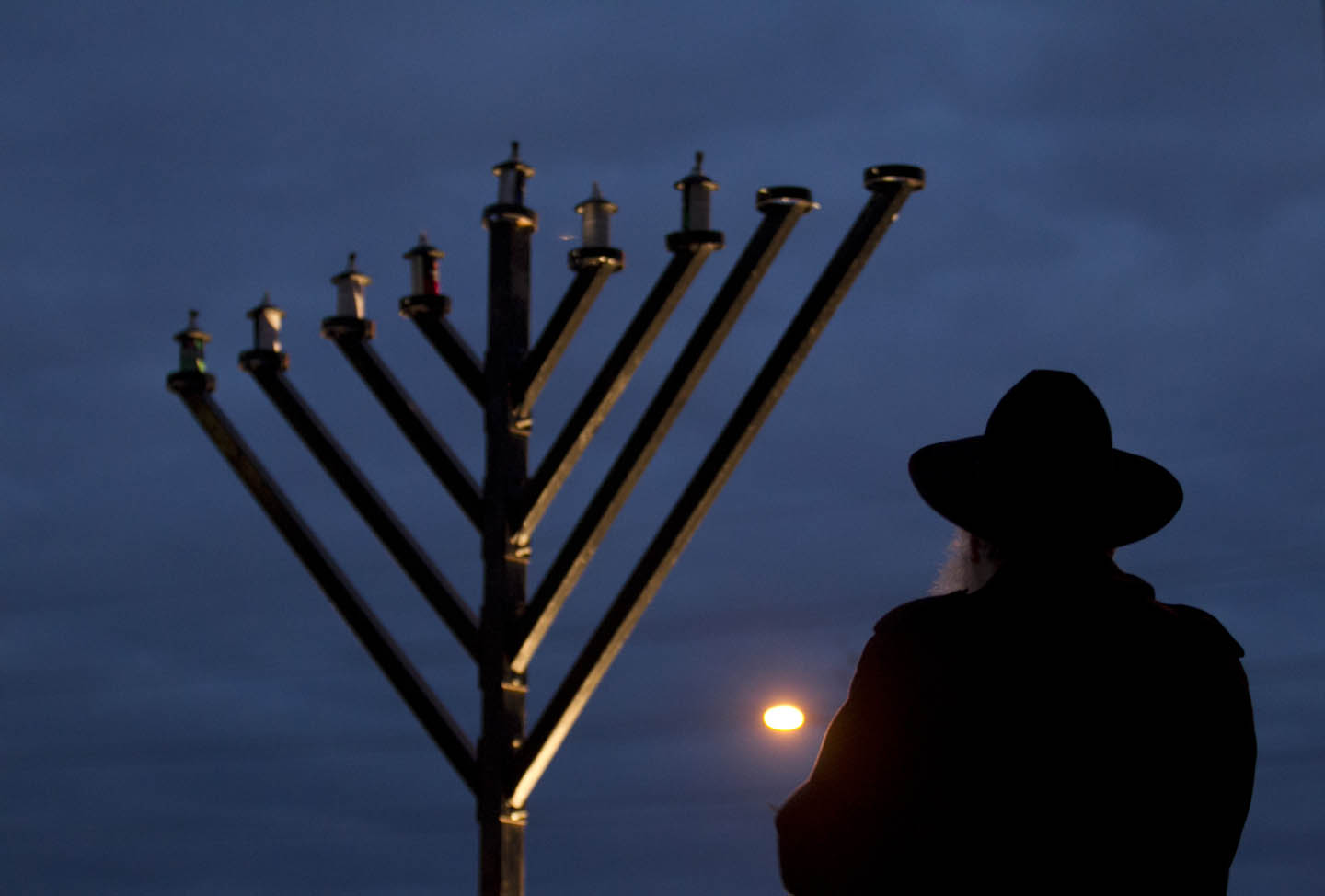
    Later, a chassid explained the Rebbe’s mysterious remark. The Talmud tells us that, as a rule, “the Divine Presence does not descend to lower than ten tefachim (approx. 31 inches) above the ground.”[18] And yet, the laws of Chanukah specify that it is preferable to place the menorah below this height.[19] This, says the Kabbalist Rabbi Isaac Luria,[20] is an expression of G-d’s great love for His people: the Divine Groom stoops down to commune with His bride Israel.

    Adapted from the teachings of the Lubavitcher Rebbe by Yanki Tauber.

    [18]. Talmud, Sukkah 5a.

    [19]. Shulchan Aruch, Orach Chaim, 671:6.

    [20]. “The Holy Ari,” 1534-1572.

  • The Face of a Child

    The Face of a Child

    And you shall make a kapporet of pure gold… and two golden keruvim(“cherubs”)… at the two ends of the kapporet….

    And you shall place the kapporet above, upon the ark; and into the ark you shall put the Testimony which I shall give you.

    And I will meet with you there; I will speak with you all that I will command you regarding the Children of Israel from above the kapporet, from between the two keruvim which are upon the Ark of Testimony….

    Exodus 25:17-22

    In the wake of the divine revelation at Sinai, G-d commanded that a Sanctuary be built to serve as a “tent of meeting”—a point of permanent contact between Him and His people. At the heart of the Sanctuary, in its innermost chamber, stood the ark that housed the “Testimony”—the two stone tablets on which the Ten Commandments were inscribed by the hand of G-d. The ark (in the form of a box and open at the top) was covered by the kapporet—a slab of solid gold, out of which rose the two winged keruvim, hammered out of the same piece of gold. When G-d spoke to Moses, Moses would hear the divine voice issuing from between the two keruvim.

    The Testament housed by the ark was the essence of the divine communication to man, for the Ten Commandments encapsulate the entire Torah. Later, the ark also held the Torah scroll written by Moses, which embodies a more detailed rendition of the laws implicit in the Ten Commandments. So the ark was the container of the Torah, the vessel of the divine wisdom and will. Yet the divine voice did not emanate from the ark, but from a space “above the kapporet, between the two keruvim.” What was the significance of the kapporet? What were the keruvim and what do they represent? And why do they mark the point of contact between G-d and man?

    Two Commentaries

    Foremost among the commentaries compiled by our sages on the Torah are those by Rashi (Rabbi Shlomo Yitzchaki, 1040-1105) and Nachmanides (Rabbi Moshe ben Nachman, 1194-1270). Rashi defines his goal by stating: “I come only to explain the simple meaning of the verse”[1]; indeed, Rashi’s commentary has been universally accepted as the most basic tool for understanding the Torah and serves as a first reference for schoolchild and scholar alike. On the other hand, Nachmanides, a noted mystic and kabbalist, often uncovers a “deeper” stratum of significance in the Torah’s words, exposing its students to “delightful things, for those who know and understand the hidden wisdom [of the Torah].”[2]

    Rashi and Nachmanides often differ in their interpretation of a particular word or verse. One example of this is their different conceptions of the kapporet and the keruvim.

    Rashi sees the ark and the kapporet as two different objects. The Sanctuary contained various “vessels,” each with a designated function (e.g., the menorah, the altars); according to Rashi the ark and thekapporet are two different vessels—it is only that the designated place of the kapporet is atop the ark.[3]

    Nachmanides, on the other hand, sees the kapporet as the cover of the ark (indeed, the word kapporet means “cover”)—as a component of the ark itself, rather than another of the Sanctuary’s vessels.[4]

    Another difference between the interpretations of Rashi and Nachmanides concerns the form of the keruvim. According to Rashi, these were two winged figures, each with the face of a child (a boy and a girl).[5]Nachmanides is of the opinion that they were a representation of the celestial figures seen by the prophet Ezekiel in his vision of the divine “chariot.”[6]

    Angel or Child?

    “There are seventy faces to the Torah,”[7] say our sages, for the divine truth reverberates on every level of reality and in every dimension of the mind. The differences between Rashi’s and Nachmanides’ visions of the kapporet and the keruvim reflect the different faces of Torah that their respective commentaries expound.

    Speaking from the perspective of “those who know and understand the hidden wisdom,” Nachmanides sees the Torah as the essence of the bond between G-d and His people. In the words of the Zohar,

    “There are three knots[8] that are bound with each other: G-d, the Torah, and Israel…. The people of Israel are bound with the Torah, and the Torah is bound with G-d.”[9]

    G-d invested His wisdom in the Torah and His will in its commandments; the Jew studies Torah and implements its commandments in his daily life; thus the Jew is bound with G-d.

    According to Nachmanides, the divine presence in the “tent of meeting” radiated from the ark, the vessel of the Torah. The divine voice emerged “above the kapporet, between the two keruvim,” all of which were components of the ark. The keruvim were in the form of the celestial beings described in Ezekiel’s vision, which contains the most profound insights into the nature of the divine perceived by man. For the stuff of the relationship between man and G-d is divine revelation: the revelation of His wisdom and will via the Torah, which attains its loftiest and most intense form in the mystic “hidden wisdom” represented by the keruvim.

    Rashi, on the other hand, elucidates the “simple meaning of the verse.” Often, this is mistakenly perceived as the most literal and superficial stratum of meaning of the Torah. But simple is not superficial. On the contrary, the simple meaning of the verse is its most profound meaning, its most elementary significance. It is the root from which all other meanings and levels of understanding derive. It is the essence of the verse, of which the others are but particular facets and expressions.

    Rashi’s conception of the ark and kapporet reflects the truth that our relationship with G-d through the Torah is but the realization of a deeper, intrinsic bond that already exists between us; that the kapporet is not part of the ark, but something else, something higher. That ultimately, the divine presence in the “tent of meeting” derives not from the Torah, but from the child-faced keruvim that hover above it.

    “For Israel is a youth, and I love him,”[10] proclaims the prophet. On the deepest, most basic level, G-d loves the Jew not for his wisdom or piety, but for his childishness. He loves us because, as the Baal Shem Tov[11] put it, “the simplicity of the simple Jew is of a piece with the simple essence of G-d.” He loves us because we are the extension of His quintessential self, as a child is the extension of the quintessential self of his father.[12]

    Based on the Rebbe’s talks on Shabbat Terumah 5741 (February 7, 1981) and on other occasions[13]

    Adapted from the teachings of the Lubavitcher Rebbe by Yanki Tauber


    [1]. Rashi on Genesis 3:8; ibid., v. 24; et al.

    [2]. Nachmanides’ introduction to his commentary on the Book of Genesis.

    [3]. Cf. Tzafnat Pa’ane’ach on Exodus 25:17 (based on the Talmud, Sukkah 5a, and Torat Kohanim 1:11): “It was not simply a cover (of the ark) but an entity of its own; it is only that it must be placed upon the ark.”

    [4]. Thus, the very same verse implies different things to the two commentators. In Exodus 25:16, after instructing Moses on the design of the ark proper—before telling him how to make the kapporet—G-d commands: “You shall place the Testimony in the ark.” Then, in verse 21, after the kapporet is described, we again read: “And into the ark you shall put the Testimony which I shall give you.” Why does the Torah repeat itself? According to Rashi, the repetition comes to emphasize that the tablets are to be placed in the ark before it is covered by the kapporet. “Place it in the ark,” the Torah is saying—in the ark as it stands alone, before the kapporet is placed upon it. According to Nachmanides, the repetition comes to make the very opposite point: that the Testament should be placed in the ark after it has been covered by the kapporet.

    In other words, Rashi and Nachmanides both understand the verse’s repetition as serving to emphasize that the tablets should be placed in theark. But what exactly is the ark? According to Rashi, the kapporet is not part of the ark proper, but another, different component of the Sanctuary (though obviously related to the ark, as evidenced by the fact that it is to be placed atop the ark). So the verse is telling us that the tablets should be placed in the ark as it is unto itself, without the addition of the kapporet. Nachmanides, on the other hand, considers the kapporet to be an integral part of the ark; so the verse comes to tell us to place the tablets in the complete ark, not in an ark lacking its cover.

    In addition to the question of when to place the tablets in the ark, there are a number of other halachic issues that relate to the question of whether the kapporet is part of the ark or a “vessel” on its own. See Tzafnat Pa’ane’ach on Exodus 37:6; Likkutei Sichot, vol. XXVI, p. 176.

    [5]. Rashi, Exodus 25:18.

    [6]. Nachmanides’ commentary on v. 21; see Ezekiel 10.

    [7]. Otiyot d’Rabbi Akiva. Cf. Talmud, Sanhedrin 34a; Midrash Rabbah, Bamidbar 14:12; Zohar, part I, 47b; et al.

    [8]. Kishrin, in the Aramaic. So reads the version of this Zoharic passage that is quoted in the teachings of Chassidism (the standard version reads “There are three levels…). See note 12 below.

    [9]. Zohar, part III, 73a.

    [10]. Hosea 11:1; see Baal HaTurim on Exodus 25:18.

    [11]. Rabbi Israel Baal Shem Tov (1698-1760), founder of Chassidism.

    [12]. See Tanna D’vei Eliyahu Rabbah, chapter 14: “Two things preceded G-d’s creation of the world: Torah and Israel. Still, I do not know which preceded which. But when Torah states ‘Speak to the Children of Israel…,’ ‘Command the Children of Israel…,’ etc., I know that Israel preceded all.”

    This concept is also alluded to in the Zoharic passage cited above, which speaks of “three knots that are bound with each other.” But if Torah is the link between G-d and Israel, then what we have are three entities (G-d, Torah and Israel) linked via two bonds (Israel’s connection to Torah and the Torah’s connection to the Almighty).  What are the “three knots” of which the Zohar speaks?

    Yet Israel’s connection with G-d via the Torah derives from a deeper connection: the “direct” connection between G-d and His people which the Torah comes to reveal. On this level, Israel’s involvement in Torah is what connects the Torah to the Almighty, what causes Him to extend His infinite and wholly undefinable being into a medium of “Divine wisdom” and “Divine will.” On this level, it is not the Jew who requires the Torah in order to be one with G-d, but the Torah which requires the Jew to evoke G-d’s desire to project Himself via the Torah. Thus we have three interlinked “knots”: G-d’s connection with Israel, G-d’s connection with the Torah, and Israel’s connection with the Torah. On the experiential level, the Torah is the link between G-d and Israel; in essence, Israel is the link between G-d and the Torah.

    [13]. Likkutei Sichot, vol. XXVI, pp. 175-182.

  • Child’s Play

    Child’s Play

    Who doesn’t wish for a better world?  A world wherein all our wishes would be granted, and all our dreams come true.  But what is the substance of this fantasy?  What is it that we are wishing for?  Are we yearning for a life of comfort and pleasure, free of pain and suffering?  A world of devotion and empathy, friendship and love?  Or perhaps our desire is for deeper perception and awareness; to comprehend the mystery of creation, to enter into a mystical union with the Divine?

    No two people have the exact same concept of a “better world.”  Apparently, our dreams and fantasies are products of our personalities, emotions, and experiences.  Against this backdrop, how are we to understand the concept of the “Messianic Era,” a very fundamental topic in Judaism. Is it a childish fantasy, a useful but escapist tool to deal with the travails of persecution and general hardships of life?  Or does it in fact represent something far more profound than that–the key to the whole mystery of creation; the why and wherefore of all existence?

    Anyone well versed in Jewish traditional thought and philosophy would likely argue the latter view.  Great Kabbalistic and Chassidic works have been dedicated to expounding upon the deep mystical significance and meaning of the Messianic era.  But one could hardly be blamed for believing that the whole Messianic concept is nothing more than a nice story for children.  After all, traditional Jewish educational practice has always been to describe the Messianic era to children in the most glorious, fantastical manner possible.  There are those references to sweets growing on trees, lions and wolves being led around like pets, and streets littered with diamonds and jewels.

    The scholar will be quick to rejoin that the literal interpretation of those stories represents nothing more than a very primitive understanding of a very lofty and delicate concept.  With maturity, the child will begin to understand the depth and profundity surrounding the whole topic.  He will outgrow his childish cravings for candy and easily accessible comforts, and start to focus more on the more ethereal but permanent joys of life.

    He will understand the famous quote of Maimonides[1], “and all delicacies will be freely available as dust,” to mean exactly that.  All earthly pleasures and delights will be about as interesting to us as dust.

    Yet if that is the case, why should the concept of Moshiach be introduced at such an infantile stage?  Why bother enticing children with images of candies growing on trees, when we can focus on developing a more sophisticated appreciation for the true values of life?  Perhaps we should delay introducing the concept until the child is already mature enough to properly appreciate its profundity?  Especially disconcerting to our rational selves is to hear children belt out a song with a refrain like:  “We Want Moshiach Now!” roared as eagerly as if they were cheering for their favorite sports team.  Is this the proper expression of such a lofty and divine concept?  Is it not a desecration of something holy and sacred?

    To put the issue into a proper Torah perspective, let us examine the structure of one of the most important vessels in the Holy Temple, the Ark.  The Ark was placed in the Holy of Holies, the most important location in the entire Temple, and contained the very tablets which G-d presented to the Jewish people through Moshe.  Being that the Ark was a hollow structure, a golden covering was fashioned for it, called the kaporet.  It served as a protection for the contents of the Ark.  It also served another purpose.  The word Kaporet in Hebrew comes from the root of kapper, which means atonement.  So the kaporet actually served to atone for the sins of the Jewish people.

    Carved out of the kaporet were the figures of two cherubim, a male and a female child.  These two cherubim have deep Kabbalistic significance, representing the union of G-d’s masculine and feminine energies.  Yet these energies are not represented in the form of a patriarchal grandfather with a long white beard and his no less matronly counterpart.  The form chosen was specifically that of two children, to strikingly demonstrate to us G-d’s great love of children, as in the verse “for Israel is a child, and I love him.”[2]

    Describing spiritual concepts in terms palatable to children is not a “profanation” of something sacred.  G-d, in His great love for children, willingly “lowers” Himself, so to speak, into those areas that even a child can appreciate. But actually, the very fact that the figure of two children is placed in such a prominent location in the Temple indicates something far more profound.  We tend to believe that childhood represents an early stage of life; one to be outgrown as we mature and develop intellectually.  We are expected to shed our childishness and move on into adulthood.  But the covering of the Ark sends a very different message.  What is placed above the holy Ark, as a shield, protection and atonement?  The Jewish child.  So childhood, in G-d’s perspective, represents the ultimate and holiest stage of life.

    Why is it that as adults, we no longer feel the same pleasure in candy, games and toys?  How is it that a child’s consumption of worldly delights is looked upon benignly, while in an adult, it would be frowned upon as immature, gluttonous, or careless?  Have we gained a new awareness, or have we lost a special gift?  The answer is a combination of the two.  We gain intellectual awareness.  We begin to understand that everything was created with a purpose, and must be utilized for a higher end.  We begin to feel shame if we merely indulge in pleasure for our own selfish purposes.  Yet our very sophistication causes us to lose touch with that essential divine side of our nature.  A dichotomy is introduced into our thinking.

    In our perception, the physical and spiritual represent two antithetical worlds.  What feels good physically must be rejected, or at least suppressed or relegated to secondary status, in order to advance spiritually.  However, in an integrated, harmonious world, no such fragmentation exists.  All of existence is a reflection of one unified truth.  Thus, the most profound spiritual experience is deeply satisfying on a physical level as well.

    Imagine all your drives and desires finding fulfillment in one unified purpose.  Imagine being able to actualize your inner potential with no conflict from any outer or internal source.  In such a world, eating a pleasurable food and appreciating the divine benevolence that brought this food into being would be no less sublime than meditating on the deepest mysteries of creation.  And this awareness is what every child essentially has from birth.  The child may not have a cognitive awareness of this; that is achieved through maturity and education.  But the child’s ability to revel unabashedly in the delights and pleasures of this world are actually an indication of a lofty spiritual status, where the physical does not threaten or negate the spiritual.

    It’s time to take a new look at childhood.  Let’s try to suffuse our worldly needs and indulgences with an awareness of the Divine. Remember that the ultimate is being able to synthesize all the components of our personality, from the most base to the most sublime, into a harmonious unit.  Skip the guilt.  G-d is not looking accusingly at you over your shoulder. Imagine, instead, the divine presence hovering lovingly and protectively above the cherubim.  Imagine the Father of us all, the G-d who is smiling benignly down at all His children, for indeed, “Israel is a child, and I love him.”

    Based on the Rebbe’s talks on Shabbat Terumah 5741 (February 7, 1981) and on other occasions[3]


    Adapted from the teachings of the Lubavitcher Rebbe by Chaya Shuchat.


    [1] Mishneh Torah, Laws of Kings, Ch. 12:5.

    [2] Hoshea 11:1.

    [3]. Likkutei Sichot, vol. XXVI, pp. 175-182.

  • The Joy of Adar

    The Joy of Adar

    The Talmud says: “when [the month of ] Adar arrives, increase in joy”
    (Taanis 26b)

    Since one has to always grow and ascend in all good activities, the increase in joy in this month must also grow from day to day.

    ***

    True wholesome joy comes from within. From a deep feeling that ‘I matter,’ my feelings count and I know I can contribute. Every person matters becasue he was created by G-D with a unique purpose that no other person can fulfill.

    ***

    Joy is contagious. When you’re down and under, fight your instict to remain alone and associate yourself with others who are celebrating in joy. Their joy rubs off on you and can often balance out your moroseness, or at least distract you from it.

    ***

    An act done with joy is always more successful and fruitful.

  • The Taste of Music

    The Taste of Music

    “A blessing is like rain,” Rabbi Israel Baal Shem Tov taught. When rain is preceded by plowing and sowing, and followed with reaping and harvesting, it yields abundant fruit; otherwise, it achieves nothing. Likewise, a person can be granted the greatest gifts from Above, but unless he makes himself a fit vessel to receive them, unless he learns to appreciate and utilized them properly, they are but futile rain on a barren field.

    Chassidim would illustrate this point with the following story:

    A king once decided to reward a peasant who had done him a great service. “Shall I give him a sack of gold? a bag of pearls?” thought the king. “But these mean virtually nothing to me. I want, for once, to truly give something—something that I will miss, a gift that constitutes a sacrifice for me.”

    Now this king had a nightingale who sang the sweetest songs a human ear had ever heard. He treasured the nightingale over all else, and literally found life unbearable without it. So he summoned the peasant to his palace and gave him the bird . “This,” said the king, “is in appreciation for your loyalty and devotion.” “Thank you, Your Majesty,” said the peasant, and took the royal gift to his humble home.

    A while later, the king was passing through the peasant’s village and commanded his coachman to halt at the peasant’s door. “How are you enjoying my gift?” he inquired of his beloved subject.

    “The truth to tell, Your Majesty,” said the peasant, “the bird’s meat was quite tough—all but inedible, in fact. But I cooked it with lots of potatoes, and it gave the stew an interesting flavor.”


    Adapted from the teachings of the Lubavitcher Rebbe by Yanki Tauber

  • Shoftim: Elul Whispers

    Shoftim: Elul Whispers

    As we enter the new lunar month of Elul – the month of love and compassion – it can be a bit difficult to feel beauty and hope.

    No doubt, there is much beauty in the world. Humans continue to demonstrate noble acts of gallantry. In many little corners of the globe unsung heroes shine and illuminate their environments.

    But collectively we are living in very troubled times. A deep cloud of fear and uncertainty hangs over the globe – not only for millions of people in the Middle East, but for populations in virtually every hemisphere. The toxic air can ignite a new attack at any moment, in any place. No one knows when and where the next crisis will strike. Politically, financially, technologically, spiritually – there is so much uncertainty.

    The compassionate power of Elul seems very distant.

    But what else is new? Elul was never an easy process. The source of this month’s history and power goes back over 3,000 years ago, and tells the entire story:

    Moses climbs Mount Sinai to receive the Torah. After 40 days Moses returns, only to find that the Jewish people defied G-d by building the Golden Calf. Moses breaks the tablets and returns to Sinai to pray that G-d pardon the people for their grave betrayal. He spends another 40 days on Sinai and his efforts are unsuccessful. But Moses does not give up. Determined, he climbs the mountain for a third time and pleads another 40 days. This time Moses is successful. He elicits not merely Divine forgiveness, but a newfound depth, a more intense dimension in the relationship between G-d and the people.

    To Moses’ entreaty, G-d responds with an unprecedented gift: He reveals His Thirteen Attributes of Compassion—thirteen secrets of G-d’s “personality” that carry the mysteries of life and the power to repair whatever is broken.

    This third period of 40 days began on the first day of the month of Elul and concluded on Yom Kippur. Elul is therefore a potent month filled with the power of hope, love and reconciliation. The mystics tell us that the Thirteen Divine Attributes of Compassion radiate during the month of Elul, when we relive Moses’ experience.

    By way of analogy, the Alter Rebbe explains, that in the month of Elul “the King is in the field.” The king had been traveling; he had left his palace and gone to a far off land outside his kingdom. And now he is on his way home. He is about to enter his palace (on Rosh Hashana and Yom Kippur) and he stands outside in the field greeting his people. When the king is in the field every person has the opportunity, without petitioning for an audience, to greet him and ask for whatever he or she needs. The king is smiling, he is in his informal mode, and he is predisposed to grant all requests.

    All year round there are many layers that conceal G-d’s presence, that shroud your own essence from yourself; there is a split between your inner self and your outer self—who you truly are and what you do, your spirit and your activities. In Elul many of these layers are stripped. You can access, if you wish, your true self, since it is part of the higher reality and the essence of all of existence called G-d.

    Elul is not a simple month. It is a complex period in time when we have the power to find hope even after loss, to discover love even after betrayal and to rebuild even after we have destroyed. All people make mistakes. The question is whether we repeat them and whether we repair them. A trusting, loving relationship is built not on perfection but on accountability. In Elul we can correct our errors and reclaim our true legacy.

    Elul’s message is relevant today more than ever.

    As a frightened world, fearful of an ominous future, enters the compassionate month of Elul, is there any more appropriate message? There is much to fear. Many mistakes have been made. The future seems uncertain. But Moses – the one and only Moses – blazed a new path: The road to hope.

    The month of Elul, which begins today – and the ensuing 40 days concluding with Yom Kippur – gives us the power to begin anew, to learn from the past, to dig deeper and come up with new reservoirs of clarity and strength.

    Ahh, Moses. He paved new paths, tread new roads, opened new doors, pioneered new possibilities. All for whom? For… us.

    Elul awakens our inner faith, hope and belief in a better future. We may not have an exact strategy, but if we assume a resigned attitude, we will lose even before we begin. Every challenge, every war must begin with absolute fortitude and belief in victory. Faith that we will prevail. Thus it was over 3,000 years ago, and many times after that, and thus it will be.

    The gusts of Elul have the power to counter the winds of war. So open your window, breath the fresh air, smell the flowers and feel the hopeful breeze waft through your life.

  • Name and Number

    Name and Number

    On Sunday afternoons, the Rebbe would stand outside the door of his office to greet and bestow a blessing upon anyone who came to see him. He would often stand for hours as thousands of people filed by, many of them seeking a blessing or advice about a personal matter or spiritual dilemma. The Rebbe was once asked how he had the strength to stand all day, sometimes for seven or eight hours, to accommodate everyone. The Rebbe beamed and replied:  “When you’re counting diamonds, you don’t get tired.[1]

    As the recent Florida election scenario amply illustrated, you don’t count until you’re counted. As the almost comical count and recount saga played itself out, many previously unknown individuals suddenly found themselves, or rather their votes, playing center stage in a riveting national drama. People came to an abrupt realization that they mattered, not only in a negligible sense but also in a very profound way, with serious repercussions for all of society.

    The Torah portion of Shmot begins with a count of Jacob, his sons and their families, seventy in number, who came down to Egypt[2]: “Now these are the names of the sons of Israel who came into Egypt with Jacob; every man and his household they came. Reuben, Simeon, Levi and Judah, Issachar, Zebulun and Benjamin, Dan and Naphtali, Gad and Asher. And all the souls …were seventy souls.”

    The narrative then describes how “the Children of Israel were fruitful, increased abundantly, and became very strong.”[3] The Jewish population in Egypt, from a mere seventy souls, experienced a phenomenal growth spurt, to become such a strong and mighty nation that they threatened the security of Pharoah’s Egypt. This verse, then, provides a likely reason for the count, to demonstrate the stark contrast between the Jewish people’s original modest number and subsequent remarkable increase.

    Rashi, in his commentary on this verse, seems to suggest an additional reason for the count[4]: “Although [G-d] counted them by their names in their lifetime[5], He counted them again after their death, to make known how precious they are to Him. For they are compared to the stars, which He brings out and brings in by number and by their names, as it says: “He who takes out their hosts by number; He calls them by name[6]“.

    What puzzles Rashi is why it is necessary to repeat the names of the sons of Jacob, who were already mentioned previously at the end of the book of Genesis. If the Torah wished to point out that the Jewish people increased in number, it would have only been necessary to relate that they numbered seventy, yet the twelve tribes are mentioned by name as well. Rashi therefore asserts that the names of Jacob’s sons are listed for the sole purpose of expressing G-d’s love for them.

    If so, it appears that it is the mention of their names, rather than their number, that expresses G-d’s love, for the counting was repeated for a different purpose – to underscore their tremendous increase. In fact, the only names mentioned are that of the twelve tribes, while the number seventy includes also their children and grandchildren. Yet Rashi says in his commentary that “He counted them after their death, to make known how precious they are to Him”. The seventy descendents were counted “each man and his household[7]“, as an extension of the twelve sons of Jacob, indicating that the count was primarily focused on the sons of Jacob. Rashi therefore concludes that both the count and the mention of the names of Jacob’s sons displayed G-d’s love for them.

    The counting and naming of objects confer significance and importance upon them. A child with a treasured rock or stamp collection will spend hours sifting through it, repeatedly counting each prized unit. The child might even apply a name to an especially valued or beloved item in the collection. Giving a name to an object raises it to an even higher level of regard and esteem. The name indicates that the thing possesses qualities so outstanding that it merits special recognition for itself.

    The Jewish people are compared to the stars, G-d’s celestial jewels, which are lovingly counted each night, and set out by name. In the morning they are gathered in and once again counted by name. A count of stars focuses on the quality of a star that is common to all – namely its essence, its identity as a star. Thus each star is counted as no more or less than any other star. Being called by a name, though, delineates the star’s unique characteristics: its particular glow and beauty, as well as the spiritual qualities that emanate from it.

    So too, each Jew has an essential soul, the “star” within, which makes us all equally great and precious before G-d. At the same time, each soul has unique qualities, which are reflected in a person’s name. Counting emphasizes the essential, indivisible quality that we all share, while being named highlights our individual strengths and attributes.

    Being both counted and named reveals the essence of the individual, beyond his outer appearance. When the Jewish people are counted, the greatest and most distinguished is counted exactly the same as the most lowly and abject.  Both contain an essential soul, which “are all equal, with one father for all.[8]” The name of a Jew also has a relationship to his essential soul. A human being carries the same name over the course of his entire lifetime – from when he is a vulnerable newborn to when he is a fully developed, accomplished adult. Thus, the name of a person is not connected to any of his external abilities, but to his inner character, which may still be latent within him.  It is the mission of each person to reveal this dormant strength and utilize it towards positive achievements. Therefore, the inner beauty of the person must be made known to him, so that he can take advantage of his potent essential power to carry out his purpose.  This is achieved through “counting by name”. Through this process, a person’s previously concealed strengths are revealed, so that they can be utilized for the maximum benefit of all of creation.

    Although both counting and naming are relevant to the person’s essence, each addresses a different level of the soul. A count reveals each soul’s essence as it exists in the celestial spheres before its descent to earth. In the heavenly realm, every soul is indeed the equal of any other soul, for it has not yet been enclothed in the body that gives it its unique attributes. The name is given to the soul once it has descended to earth; a soul in the heavenly realms has no name. So the name is only a reflection of the soul’s essence after it has descended into the body. Being “counted by name” causes the soul’s essential quality, which is above the body and above a name, to illuminate the person from within the body.

    The Book of Shmos begins: “These are the names of the Children of Israel who came to Egypt[9]“. Egypt is a symbol of the soul’s descent to earth. “Counting by name” is done prior to the soul’s descent to Earth, to give the soul the powers it needs to overcome any and all limitations imposed by the concealment of the corporeal world. The “counted” element of the soul has an advantage over its “named” element in the sense that it is transcendent, universal and indivisible. Yet the person carries out his mission in this world by virtue of the “named” element in his soul – the unique energies and abilities that he contributes to the world. Through these efforts, the essential soul itself achieves an elevation.

    This is the significance of the sons of Jacob being counted[10] “in life and after death[11]“. Just as the stars are counted by name “when set out and when brought in”, the souls are counted at birth and after death. The first counting, “when set out” on the journey to earth, gives the soul, as it is enclothed in a body, the fortitude to withstand the negative and evil forces of the physical world. Through this initial investment of energy from the transcendent element of the soul, the person engages on his mission. The count is then repeated “when brought in”, upon the death of the person. This time, it is the “named”, or embodied element of the soul that elevates the soul’s essence.

    Whether we are consciously aware of it or not, G-d continues to count each person by name, thereby infusing us with the spiritual energy to complete our unique mission in this world. Each person counts no more and no less than anyone else, but each individual has something to share that no one else possesses. We are all reflections of a single and indivisible essential soul. So too, are we are all dependent on each other to complete the elevation of that essential soul. Even one positive action by one individual can bring deliverance to the entire universe[12]. Each individual has a “vote” and a say, and no votes go uncounted, towards achieving the ultimate objective, which is the complete redemption, through our righteous Moshiach.

    Based on address by the Rebbe, Shmot, 5725 (1965) [13]. By Chaya Shuchat.

    _______________________________________

    [1] Foreword to “Diamonds of the Rebbe”, Mordechai Staiman

    [2] Shmot 1:1-5

    [3] Shmot 1:7

    [4] Rashi Shmot 1:1

    [5] Genesis 35:22-26, 46:8-27

    [6] Isaiah 40:26

    [7] ibid 1:1

    [8] Tanya ch. 32

    [9] Shmot 1:1

    [10] Although each Jew has unique characteristics, there are twelve basic prototypes, encapsulated by the twelve tribes, from which every Jewish soul derives.  Each soul has a root in one of the twelve tribes, with a spiritual service that is in line with that tribe’s divine attributes.  Therefore the verse emphasizes the count and names of the sons of Jacob, as they include all of the Jewish people.

    [11] Rashi, ibid

    [12] Maimonides, Mishne Torah, Hilchot Tshuva, 3:7

    [13] Likkutei Sichot vol.6 Shmos 1, pp 1-12