The number four figures prominently at the Passover seder: We drink four cups of wine, ask the Four Questions, speak of the Four Sons—to name but a few of the “fours” associated with the festival of freedom. Our sages explain this recurrence of the theme of four on Passover as deriving from the “four expressions of redemption” in G-d’s promise to Moses:
I will bring you out from under the hardship of Egypt, and I will save you from their bondage; I will redeem you with an outstretched arm and with great judgments. I will take you to Myself as a nation, and I will be to you a G-d.[1]
As the commentaries[2] explain, the “four expressions of redemption” relate to the four aspects of our liberation from Egypt: 1) “I will bring out”—our physical removal from the geographical boundaries of Egypt; 2) “I will save”—our delivery from Egyptian hegemony;[3] 3) “I will redeem”—the elimination of any future possibility of enslavement because of the “great judgments” inflicted upon the Egyptians;[4] and 4) “I will take you to Myself as a nation, and I will be to you a G-d”—our election as G-d’s chosen people at Mount Sinai, the purpose of the Exodus.[5]
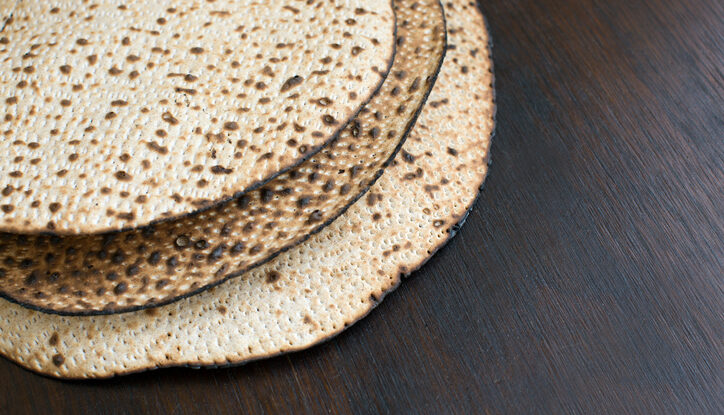
So why aren’t there four matzahs?
Matzah, the unleavened bread, is the most important item at the seder. It is the “bread of poverty” that symbolizes our hardship under Egyptian slavery.[6] It is also the “bread of haste” that did not have time to rise, reminiscent of the nature of our redemption—the sudden, drastic, overwhelming change that the Almighty wrought in our lives.[7] At the stroke of midnight on Passover eve, G-d instantaneously transformed a materially and morally impoverished clan of slaves into a free people—into the nation chosen to be His “light unto the nations”[8] and to play the central role in His purpose of creation.[9]
Virtually the entire seder centers on the three matzahs on the seder plate, from the recitation of the Haggadah over the smaller half of the middle matzah, to the eating of the “after matzah” (afikoman) at the meal’s end. Indeed, the biblical name for Passover is “The Festival of Matzahs,” for it is the matzah that embodies the essence of the Exodus.
So why aren’t the “four expressions of redemption” represented in the most basic symbol of the Exodus? Why are there only three matzahs arranged on the seder plate?[10]
Flash of Faith
The matzah, as we said, expresses both our poverty at the time of the Exodus and the haste with which the redemption came about. The two are interrelated: it was because we were impoverished—spiritually as well as materially—that our redemption had to be such a hasty affair. Our sages explain that we had become so entrenched in the paganism and depravity of Egypt that the Exodus came at the very last possible moment. Had we remained slaves in Egypt a moment longer, there would have been no “people of Israel” to redeem.[11]
Thus, we could not afford the luxury of an orderly, methodical redemption. We simply did not have the time to gradually divest ourselves of our slave mentality and pagan ways, to comprehend the significance of the role for which we were being chosen, or to develop the proper emotional response to the greatest event in human history. All we had was our faith in G-d—a faith that had persevered throughout our long and harrowing exile.[12] On Passover eve, G-d ignited this faith with a tremendous revelation of His might and truth, blasting our souls free of the chains that had imprisoned them in an internal slavery more nefarious than any physical bondage. It was this faith, and this faith alone, that took us out of Egypt and set us on the road to Sinai. The prophet Jeremiah describes the moment when he says: “So says G-d: ‘I remember your youthful love, your bridal devotion, following Me out to the desert, to an unsown land.’”[13]
But faith alone was not enough. Faith can move mountains, but it cannot remake the essence of man. For faith is a transcendent force, and therein lies both its power and its limitations: it can lift a person to unprecedented heights, but these remain “otherworldly” experiences, extraneous to his inner self.
Faith got us out of Egypt, but it could not get the Egypt out of us. To become truly and inherently free we had to change from within, by means of a gradual process of internal growth and development.
So following the instant exodus of Passover, G-d embarked us on a systematic regimen of self-refinement and transformation. Only at the end of a forty-nine-step[14] process (which we reexperience each year with the 49-day sefirah count) did He enter into His covenant with us at Mount Sinai.
Thus, while the “I will bring out,” “I will save,” and “I will redeem” elements of the Exodus were realized on Passover itself, the fourth element came to fruition seven weeks later, with the giving of the Torah at Mount Sinai (marked each year with the festival of Shavuot). At Sinai, G-d’s promise that “I will take you to Myself as a nation” was realized, after we had internalized the faith of the Exodus, attaining an understanding and appreciation of our mission as G-d’s “treasured people among the nations … a kingdom of priests and a holy nation.”[15]
Flat Cake and Sensual Drink
These two stages in our redemption are personified by two staples of the seder—matzah and wine.
Matzah, the “bread of poverty” and the “bread of haste,” is the “bread of faith”[16] which represents the state of the Jewish people at the moment of the Exodus. The matzah dough must be kneaded hastily, and placed immediately in the oven—allowing it to rise and assume the richness and texture of full-bodied bread renders it chametz, forbidden for consumption (or even possession) on Passover. Also, in order to be valid for use at the seder, the matzah must consist of flour and water only: any innovative attempt at a gourmet matzah (e.g. mixing in eggs or fruit juice) disqualifies it for the mitzvah of eating matzah on Passover eve.[17] Matzah thus reflects the intellectual and emotional poverty of one who, roused by a flash of divine truth, follows G-d into the desert with nothing but his faith and commitment. One who understands nothing, feels nothing, “tastes” nothing save his awe before the majesty of his Creator and his firm resolve to serve Him.[18]
Wine, on the other hand, is the epitome of sense and experience. Wine, the palatable beverage that “gladdens G-d and man,”[19] represents the spiritual richness of the people who stood at the foot of Mount Sinai: a people who had undergone the process of internalizing the divine truth so that it invigorated every nook and cranny of their minds and hearts.
Thus we have three matzahs and four cups of wine at the Passover seder. With the three matzahs, we reexperience the event of the Exodus itself: the flash of faith that “brought out,” “saved” and “redeemed” us from Egypt, but which fell short of enabling us to “taste” the substance of our freedom. With the four cups of wine, we savor also the fourth dimension of the Exodus—the flavor and fragrance of the spiritual maturity attained at Sinai.
The Sensitive Servant
And yet, matzah is not the “tasteless” food that many an undiscerning palate would judge it. Indeed, the taste of matzah is mandated by Torah law.
Actually, we find two seemingly conflicting rulings in halachah (Torah law) regarding the taste of matzah. On the one hand, there is the law which states that even if a person does not taste the matzah he is eating, he has nevertheless fulfilled the mitzvah of eating matzah on Passover eve. For example, if a person grinds the matzah into a powder and swallows it, he has observed the mitzvah.[20] Another law, however, stipulates that the matzah must retain its distinctive taste; if, for whatever reason, the taste of matzah is suppressed or altered (e.g., it is cooked or mixed with other foods)[21] it is not valid for the mitzvah. Rabbi Schneur Zalman of Liadi explains: “Although one need not taste the matzah in his mouth, the matzah itself must possess the taste of matzah.”[22] Matzah need not be tasted, but it must be tasteable.
For matzah does have a taste: the taste of faith, the taste of commitment, the taste of self-abnegation. Matzah is not wine—it has not the keen tang of intellectual inquiry or the intoxicating high of passion. But the sensitive servant of G-d will savor its simple yet subtle flavor, its austere yet deeply satisfying consistency.
One who does not taste the matzah he is eating—one who does not appreciate the flavor of faith and the delectability of commitment—nevertheless fulfills the mitzvah of eating matzah on the seder night. For also our forefathers, beholding the truth of truths for the first time that night, were not in a position to “taste” their faith and experience its sublime delights. The overwhelming revelation of G-dliness which they experienced was just that: overwhelming and unreal to their yet unperfected selves.
But the matzah must have its distinct flavor, even if the one ingesting it is incapable, as of yet, of relishing it. Faith, true faith, always carries the potential for a deep and satisfying relationship with G-d—no less satisfying than the most luscious vintage of the mind and heart.
Matzah, Wine, and Matzah
So it is matzah, not wine, that is the symbol of the Exodus. The sensory austerity of matzah is not merely an initial phase to be overcome and surpassed on the road to Sinai; if this were the case, the robust cup of wine, rather than the flat matzah cake, would be upheld as the symbol of our freedom. But it is the matzah which embodies the ultimate goal of the redemption, the matzah that we are to refer to, “all the days of your life,”[23] for the ultimate significance of our freedom and nationhood.
Certainly, we should strive to stimulate our senses with an appreciation of our purpose in life and our relationship with our Creator. But the purpose of it all is a return to the genesis of our journey, a return to the unequivocal commitment that transcends reason and experience.
This is not a return to the “tasteless” faith of childhood, to a faith whose simplicity stems from the limitations of the unmatured mind; it is not a return to a sense-poor Exodus that was dictated by the circumstances of the Egyptian galut. Rather, it is a reaffirmation of the faith and commitment that comes after we have comprehended all that is in our power to comprehend and we have experienced all that we are capable of experiencing. It is the acknowledgment that no matter how high our sensory self might reach, there is always something higher, a truth to which we can relate only with the simple acceptance of faith. Having supplemented our matzah with wine, we must now graduate to a higher order of matzah, to a matzah that is not bereft of thought and feeling but which surmounts them and supersedes them.
Matzah hurriedly chewed on an empty stomach is virtually tasteless; but at the meal’s end, especially after a glass or two of wine, it is a feast for the senses.
Based on an address by the Rebbe, eighth day of Passover, 5742 (1982)[24].
Adapted from the teachings of the Rebbe by Yanki Tauber.
[1]. Exodus 6:6-7.
[2] Nachmanides, Sforno, et al.
[3]. Egypt was a superpower that enslaved and oppressed many nations and peoples outside its borders.
[4]. Had Egyptians’ power not been broken by the Ten Plagues and the drowning of its army in the Red Sea, they would have posed a future threat to the freedom of Israel (indeed, no sooner had the people of Israel left Egypt than Pharaoh chased after them to try to force their return). Freedom that exists under the threat of slavery is not true freedom.
[5]. Cf. Exodus 3:12.
[6]. Deuteronomy 16:3.
[7]. Exodus 12:39: “And they baked unleavened cakes of the dough which they brought out of Egypt, for it did not [have time to] leaven; for they were driven out of Egypt and could not tarry….”
[8]. Isaiah 42:16.
[9]. See Rashi on Genesis 1:1.
[10]. The practical reason for the three matzahs is that the concept of “bread of poverty” is best represented by a piece of matzah, rather than a whole matzah; on the other hand, we honor each Shabbat and festival meal with lechem mishneh—two whole loaves of bread. We therefore place three matzahs on the seder plate. At the beginning of the seder, we break the middle matzah in two; the larger half is set aside for the afikoman, and the smaller half serves as the “bread of poverty” upon which the Haggadah (the “telling” of the story of the Exodus) is recited. To observe the mitzvah of eating matzah, we eat both from the broken matzah as well as from the top whole matzah. The third (bottom) matzah is used for korech, the matzah-and-maror sandwich.
But everything in Jewish life is significant, especially on the seder night, when everything we do is replete with symbolism and meaning. So in addition to any “technical” reason, there must be a deeper import as well to the matzah’s departure from the theme of “four” that pervades the seder.
[11]. Thus we say in the Haggadah: “If G-d had not taken our forefathers out of Egypt, we, our children, and our children’s children, would still be enslaved to Pharaoh in Egypt…” If the redemption had not come when it did, it could not have come at all (see sources cited in the Rebbe’s commentary on the Haggadah, Haggadah Im Likkutei Taamim Minhagim u’Biurim, p. 30).
[12]. Yalkut Shimoni, Hosea 519; cf. Midrash Rabbah, Shemot 3:15. See Midnight, WIR, vol. VI, no. 19.
[13]. Jeremiah 2:2.
[14]. The human character consists of seven basic attributes, each of which contains elements of each of the others, making a total of forty-nine traits and nuances of personality. Hence the forty-nine-step program of self-refinement.
[15]. Exodus 19:5-6.
[16]. Zohar, part II, 41a (see the Rebbe’s notes on page 116 of Sefer HaMaamarim 5708).
[17]. Shulchan Aruch, Orach Chaim, 462:2; see also Magen Avraham, ibid., 461, sub-section 7.
[18]. Cf. Talmud, Nedarim 41a: “There is no true poverty save the poverty of mind.”
[19]. Judges 9:13.
[20]. Shulchan Aruch, Orach Chaim, 475:3.
[21]. Ibid., 461:4 and sources cited in note 17.
[22]. Shulchan Aruch HaRav 461:12.
[23]. Deuteronomy 16:3, quoted at the beginning of this essay.
[24]. Likkutei Sichot, vol. XXVI, pp. 43-48.