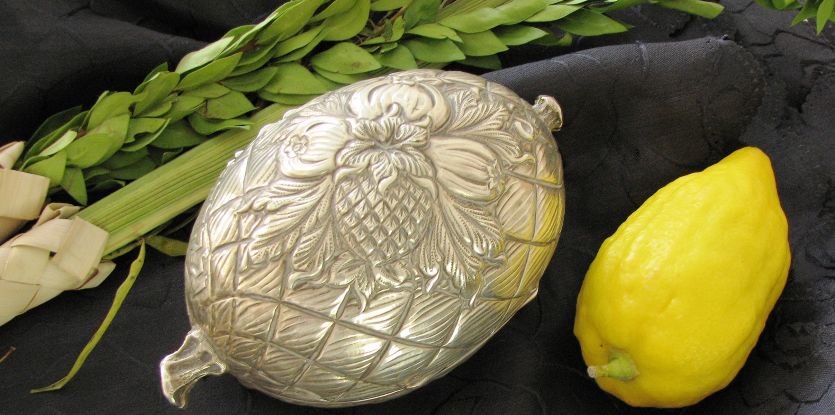
A Beautiful Etrog
Each Sukkot morning, after performing the mitzvah of taking the “Four Kinds,” the previous Lubavitcher Rebbe, Rabbi Yosef Yitzchak Schneersohn, would allow all who wished to do so to use his lulav and etrog. Many chassidim availed themselves of the opportunity, though they had a set of “Four Kinds” of their own, regarding it as a great privilege to perform the mitzvah with their Rebbe’s set.
One day, after the Rebbe’s etrog was returned to him bruised and stained from being handled by hundreds of hands, one of his chassidim said to him: “Why do you allow so many people to use your etrog? Look at what has happened to it! It has lost its hiddur (beauty)!” [1]
“Why,” replied Rabbi Yosef Yitzchak, “this is the most beautiful etrog in the world! What greater hiddur can there be for an etrog than the fact that hundreds of Jews have performed a mitzvah with it?”
—–
[1]. The chassid was referring to the principle of hiddur mitzvah (“beautification of the mitzvah”), derived from the verse, “This is my G-d, and I shall beautify Him” (Exodus 15:2). According to the Midrash, this teaches us to “make beautiful before Him with mitzvot: make Him a beautiful lulav, a beautiful sukkah, beautiful tzitzit, beautiful tefillin” (Mechilta, ibid.). One of the things that characterizes an etrog as mehudar is a “clean” surface, free of blemishes and discoloring.
*****
The Natural Chassid
When Rabbi Schneur Zalman of Liadi began to disseminate his teachings in White Russia and Lithuania (circa 1772), many young men flocked to him and became his ardent followers, despite the prevailing opposition to the Chassidic movement. They found that Chassidism injected a new vitality and joy in serving G-d that was lacking in “establishment” Judaism. Among the newly converted Chassidim were the two sons of one of the leading Torah scholars of the time.
One day, they approached Rabbi Schneur Zalman with a dilemma that had been occupying their minds for some time: should they try to win over their father to the Chassidic approach to serving G-d, or is he perhaps too set in his ways to change at this point in his life.
“Does he perform mitzvot with joy?” asked Rabbi Schneur Zalman.
“Every year,” related one of the sons in reply, “when we finish building our sukkah, father climbs onto a bench and kisses the sechach[1].”
“In that case,” said the founder of Chabad, “he is fine the way he is.”
——
[1]. The roof of branches (or other vegetation) that is the main component of the sukkah.
*****
Rainy Days
Rabbi Fishel of Strikov would sit in the sukkah even in the pouring rain. Once he was asked:
“Does not the Shulchan Aruch (The Code of Jewish Law) clearly state that, ‘If it rains, one should go back into the house’? And does not the Rama add, ‘Whoever is absolved from sitting in the sukkah and does not leave it, receives no reward for this and is nothing but a simpleton’?”
Said Rabbi Fishel: “I’d rather be a simpleton than leave the sukkah.”