
Say “Passover” and one immediately thinks “freedom.” Most festivals are likewise defined by a concept that dominates the festival’s observances and the historical events it commemorates: repentance (Yom Kippur), Torah (Shavuot), light (Chanukah), and so on.
Pinpointing the theme of Sukkot is a more complex matter. Unlike the other festivals on the Jewish calendar, it does not mark the anniversary of a particular milestone in our history. In seeking the essence of Sukkot, we must therefore look for the common denominator of the festival’s three primary mitzvot: the precept to “rejoice on your festival,”[1] the taking of the Daled Minim, (the Four Kinds), and dwelling in the sukkah.
Joy as a Bridge
All of the festivals are referred to as “occasions for joy” (moadim lesimcha), but the Torah stresses the centrality of joy to the festival of Sukkot more than with any other festival.[2] Indeed, only the festival of Sukkot that is defined in our prayers of the day as zeman simchateinu, “The Time of Our Joy.” There is a special joy associated with Sukkot, which reaches its height in the nightly “water drawing” celebrations held during the festival.
And joy, for the Jew, is an exercise in empathy and communal concern. “You shall rejoice on your festival,” says the Torah:
“You, your son, your daughter, your servant, your maid, the Levite, the stranger, the orphan and the widow….” [3]
In the words of Maimonides:
“When one eats and drinks, one must also feed the stranger, the orphan, the widow, and the other unfortunate paupers. One who locks the doors of his courtyard and feasts and drinks with his children and wife but does not feed the poor and the embittered—this is not the joy of mitzvah but the joy of his stomach.” [4]
Selfish festivity is divisive, accentuating the differences between the haves and the have-nots, between the full and empty stomachs of society. But the altruistic is a unifying force. Master and servant, family man and loner, wealthy man and pauper, are all united by the giving and compassionate joy of the Jewish festival.
Nevertheless, even the most generous joy cannot be said to achieve a “union” in the ultimate sense of the word; at most, it introduces a connection between disparate individuals. The pauper remains separated from the rich man by a gulf of status and economic station, as does the servant from the master and the vagrant from the homeowner. Joyous hearts and giving hands extend across these gulfs, but the division and distance remain.
So to evoke yet a deeper and truer unity, the Jew acquires the Four Kinds on Sukkot.
Taste of Knowledge and Scent of Deed
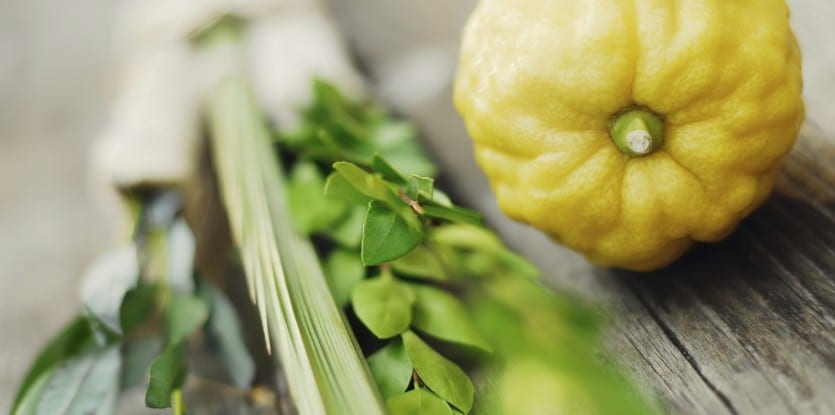
The Midrash[5] explains that the Four Kinds represent four spiritual types within the people of Israel. The etrog, which has both a pleasing taste and a delightful aroma, represents the perfect tzaddik—one who is both knowledgeable in Torah and replete with good deeds. The lulav, whose fruit (dates) have taste but no smell, personifies the learned but deed-deficient individual—the scholar who devotes his life to the pursuit of divine wisdom but shuns the active sphere of Jewish life. The delightful scent and lack of taste of the hadas describe the active but ignorant Jew. Finally, the tasteless, scentless aravah represents the Jew who lacks all outward expression of his Jewishness.
On Sukkot, the lulav, hadas, aravah and etrog are bound and joined together,[6] signifying how each group contributes its particular qualities and strengths to the communal whole. The etrog radiates its perfection to the other three types; the lulav imparts the unique brand of wisdom that is the property of a life wholly devoted to the pursuit of knowledge; the hadas contributes its singular commitment to good works; and the aravah offers the depth and power of a Jewish identity which asserts itself despite its lack of any outward expression of Jewishness.
So while the joy of Sukkot introduces a unifying bridge between various segments of the community of Israel, the Four Kinds takes this unity a step further, integrating us into a single entity. By taking the Four Kinds in hand, we reiterate that, despite—indeed, because of— our differences, we are all one.[7]
The Enveloping Home
Despite our differences, we are all one. But the differences remain, as even the unifying Four Kinds express.
The lulav towers above the lot in scholarship and erudition. The hadas exudes its scent of good works, while the aravah is marked by its obvious ignorance and fruitlessness. The etrog, of course, outshines them all with its sublime perfection. Even as they symbolize the unity of the various segment of Israel, the Four Kinds underscore the differences between them—indeed, they stress these very differences as the complementary components of a unified people.
There is, however, a more absolute form of unity that is realized by the festival of Sukkot. This is the unity of the sukkah—the unity embodied by an edifice that is deemed worthy of accommodating an entire people within its walls.
“In sukkot you shall dwell for seven days,” the Torah commands.
“All citizens of Israel shall dwell in sukkot.” [8]
In this verse, the word sukkot, which is the plural of sukkah, is spelled without the letter vav. This means that the word can also be read as sukkat, “the sukkah [of]” in the singular, implying, says the Talmud, that:
“The entire nation of Israel may, and ought to, dwell in a single sukkah.” [9]
For the sukkah represents a oneness so deep and all-embracing that all distinctions pale in significance before it.
“Sukkah is the only mitzvah into which a person enters with his muddy boots,” goes the Chassidic saying, and this expresses the very essence of the sukkah. When a person enters a sukkah, its walls and roofing encompass him entirely, and equally encompass his entirety. His mind is no more and no less in the sukkah than his toes; his heart is simply another occupant of its space, as are his “muddy boots.” So when the entire nation of Israel dwells in a single sukkah, the unity expressed is one that transcends all differences and distinctions between them.
This is not the unity that is created by our love and compassion for one another. Nor is it the deeper unity that stems from the way in which our individual roles, talents and strengths complement and fulfill one another, forming the organs and limbs of an integrated body. Rather, the sukkah brings to light the oneness implicit in our very beings—the simple and absolute oneness of a people rooted in the utterly singular oneness of their Creator and Source.
Self and Selves
The different degrees of unity embodied by the mitzvot of Sukkot explain a curious distinction that the Talmud makes between the laws governing the taking of the Four Kinds and the laws that apply to dwelling in the sukkah.
This legal differentiation relates to the notion of property and ownership. When is something “yours”? When you control it? When you have legal and moral right to its use? When it is yours alone, to the exclusion of everyone else? Indeed, ownership may mean many things, depending on the individual and social circumstances that define it.
The Torah insists that the sukkah in which the Jew dwells and the Four Kinds which he acquires on Sukkot must be “yours.” Yet the definition of “yours” varies in these two mitzvot.
In the case of the Four Kinds the Torah states:
“You shall take for yourselves on the first day [of the festival] the splendid fruit of a tree [the etrog], fronds of dates [the lulav], the branch of the thickly leafed tree [the hadas], and aravot of the brook…” [10]
Our sages explain that the words “You shall take for yourselves…” come to teach us that these must be the absolute property of their user: one who uses a stolen etrog (or lulav, hadas or aravah), or a borrowed etrog, or even an etrog which he owns in partnership with another person, has not fulfilled the mitzvah of taking the Four Kinds on the first day of Sukkot.[11]
Regarding the mitzvah of sukkah, the Torah likewise stipulates that:
“You shall make, for yourself, a festival of sukkot.” [12]
But here, the words “for yourself” are more broadly defined. In this case, says the Talmud, the verse comes only to exclude a stolen sukkah. A borrowed or jointly owned sukkah is considered to be sufficiently “yours” to satisfy the mitzvah’s requirements.[13]
To support its broader interpretation of ownership as applied to the sukkah, the Talmud cites another verse,[14] which implies that the entire nation of Israel may, and ought to, dwell in a single sukkah. Aside from stressing the brotherhood and equality of all Jews, this also has the legal implication that a sukkah need not be exclusively “yours” in order for you to fulfill the mitzvah of dwelling in it. If all Israel may dwell in a single sukkah, then the requirement to make it “for yourself” cannot to be understood in the narrow sense of exclusive ownership, but in the sense of the right to a thing’s use.[15]
Why does the “yours” of the sukkah-dweller differ from the “yours” of one engaged in the mitzvah of taking the Four Kinds? Because there is an intrinsic difference between these two Sukkot observances—a difference that extends to the very identity and self-definition of their observer.
As elaborated above, the Jew taking the Four Kinds is uniting with his fellows in a manner which preserves, and employs, his distinction as an individual. Hence the Torah’s use of the word lachem, “for yourselves” (in the plural): in addressing the people of Israel as they relate to the Four Kinds, the Torah is speaking to many individuals, each with his or her own unique contribution to the communal whole. In this context, “yours” is something that is unique to your individual self; a borrowed or jointly owned object is not “yours.”
Regarding the making of a sukkah, however, the Torah addresses us in the singular lecha (“for yourself”). For the mitzvah of sukkah touches on the intrinsic unity of Israel—a unity in which we are all seamlessly one. Here “for yourself” is the singular self of Israel; as long as your use of a sukkah does not violate the integrity of this unity (as does the use of a stolen sukkah), the sukkah of your fellow is no less yours than your own.
Based on the Rebbe’s talks on Sukkot 5724 (1963) and on other occasions [16]
Adapted from the teachings of the Rebbe by Yanki Tauber.
[1]. Deuteronomy 16:14.
[2]. See Mishneh Torah, Laws of Lulav, 8:12.
[3]. Deuteronomy 16:14.
[4]. Mishneh Torah, Laws of the Festivals 6:18.
[5]. Midrash Rabbah, Vayikra 30:12.
[6]. The lulav, hadassim and aravot are actually tied together in single bundle. But the perfect tzaddik, personified by the etrog, also bridges his natural distance from the rest during the actual observance of the mitzvah, when all four species are held and pressed together.
[7]. In addition to symbolizing the unity of Israel by being bound and held together, each of the Four Kinds embodies the concept of unity in its halachically ordained characteristics.
The lulav is referred to by the Torah as kapot temarim, “fronds of dates.” The Hebrew word kapot (“fronds”) can also be read kafut (“bound together”); from this the Talmud deduces that the lulav must be an unopened frond whose leaves are still pressed together.
The hadas is referred to by the Torah as anaf eitz avot, “the branch of the thickly-leafed tree.” The word avot (thick) also means “rope-like”—a reference to the myrtle’s tendency to grow its leaves in groups of three stemming from the same point. This mark of unity, too, translates into a halachic requirement: a myrtle twig whose leaves do not grow in this three-in-one pattern is invalid for use in the Four Kinds.
The etrog is called pri eitz hadar, “the splendid fruit of a tree.” The word hadar (“splendid”), which can also be read as ha-dar, that which dwells, refers to the fact that the etrog “dwells in its tree throughout the year” and continues to grow and develop all year round. This is a unique phenomenon, since most fruits grow only in the course of a single season, as their development requires that particular season’s set of conditions. The etrog, however, unites within it the entire array of climatic temperaments that prevail throughout the year, incorporating them all in its growth process to create a “splendid fruit” that is a harmony of all the currents and flavors that comprise an annum of nature.
Finally, an identifying mark of the aravah is that it grows in close-knit groups—in “unity” and “brotherhood” (achvana). (See Talmud, Shabbat 20a; Rashi ibid.).
[8] . Leviticus 23:42.
[9] . Talmud, Sukkah 27b.
[10]. Leviticus 23:40.
[11]. Talmud, Sukkah 41b; Mishneh Torah, Laws of Lulav, 8:10-11 (see Maggid Mishneh on section 11); Shulchan Aruch, Orach Chaim, 649 and 658. Thus, if a person wishes to accord his fellow the opportunity of observing the mitzvah of taking the Four Kinds with his own set, he must give it to his fellow as a gift, and have his fellow give it back to him as a gift after observing the mitzvah.
[12]. Deuteronomy 16:13.
[13]. Talmud, Sukkah 27b (as per the majority opinion, whose ruling we follow in practice); Mishneh Torah, Laws of Sukkah, 5:25; Shulchan Aruch, Orach Chaim, 637 (see especially the words of Shulchan Aruch HaRav, ibid., section 2).
[14] . Cited earlier in this essay.
[15]. This is also the source for another of the sukkah’s halachic criteria. Torah law sets all sorts of specifications for the sukkah’s dimensions: its ceiling may be no lower than ten tefachim (approx. 32 inches) and no higher than 20 amot (approx. 31.5 feet); its area must be no less than seven tefachim by seven tefachim. However, since “The entire nation of Israel may, and ought to, dwell in a single sukkah,” there can be no maximum limit for the length and breadth of the sukkah.
[16]. Likkutei Sichot, vol. XIX, pp. 348-355; et al. See also Siddur Im D’ach, Shaar HaLulav 264d; Likkutei Sichot, ibid., p. 224, note 35.