On Simchat Torah we rejoice with the Torah. We celebrate the joy of being a Jew—the joy of a life defined by and permeated with the divine wisdom and will communicated to us at Mount Sinai.
But where is the Torah?
Where is the all-embracing wisdom of the Five Books of Moses, the inspiration of the Prophets, the music of the Psalms? Where is the brilliance of the Talmud, the guidance of the Shulchan Aruch, the mystique of the Kabbalistic writings?
Where are the laws, the ethics and the philosophy that have molded our lives and served as a beacon of light to all of humanity for 33 centuries?
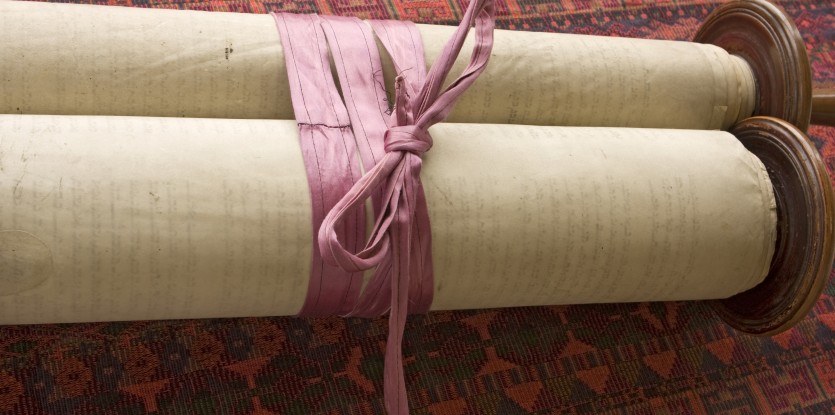
It’s all rolled up.
It’s all rolled up in a scroll of parchment, girdled with a sash, clothed in an embroidered mantle. This is the Torah we grasp in our arms as we dance away the night and day of Simchat Torah in synagogues across the globe.
Is this how we should celebrate our relationship with the Torah? By embracing a velvet-draped scroll and expending calories and shoe leather on synagogue floors? Surely the People of the Book could have devised a more appropriate way to rejoice with the essence of all wisdom. Would not the festival be more appropriately observed by immersing oneself in a page of Talmud or a work of Torah philosophy?
The Second Time Around
Actually, there are two annual festivals which celebrate our receiving of the Torah: Shavuot and Simchat Torah.
Shavuot is the day on which the entire Jewish nation experienced the divine revelation at Mount Sinai, where G-d communicated the Torah to us and summoned Moses to the top of the mountain to receive the Two Tablets of the Covenant. These Tablets, however, were broken as a result the violation of their contents by the Jewish people with the sin of the Golden Calf. It is the Second Tablets, granted us on Yom Kippur, over which we rejoice on Simchat Torah.
In other words, the First Tablets of Shavuot represent the “conventional” aspect of Torah—Torah as the study of G-d’s wisdom and the fulfillment of His will. On this level, a person’s relationship with the Torah is determined by his individual talents and behavior: the more one studies, the more one knows; the greater one’s mind, the deeper one’s comprehension; and if one acts contrary to the Torah’s commandments, one is no longer worthy of it—worshipping an idol of gold leads to a shattered Tablets and covenant.
But there is also a deeper dimension to Torah, which transcends the externalities of conduct and understanding. This is the essence of Torah, the quintessential bond between G-d and Jew which is actualized by, but not dependent upon, the Jew’s study and observance of it. No sin or transgression can weaken this bond; on the contrary, it was the breaking of the First Tablets that uncovered its power and invincibility. This is the Torah of the Second Tablets, the Torah we celebrate on Simchat Torah.
On Shavuot we spend the entire night studying. We read selections from the Five Books of Moses, the Prophets and the Scriptures; we study the first and last paragraphs of each of the Talmud’s 60 tractates, selections from the esoteric works Sefer Yetzira and Zohar, and Maimonides’ list of the 613 mitzvot. We are celebrating the manner in which Torah is realized in our lives—by study and implementation.
But on Simchat Torah we celebrate our bond with the quintessence of Torah. So the Torah remains scrolled and covered—we are grasping it rather than its words and precepts. We dance with the Torah rather than study it, because we are relating to that dimension of Torah which embraces each and every Jew equally, regardless of knowledge and spiritual station. In dancing, we all relate equally to the Torah: the sweat of the scholar is no more profound than that of his illiterate brother, and the feet of the saint move no more piously than those of the boor.
On Simchat Torah we are all equal: equal in our inability to fathom the essence of Torah, and equal in our intrinsic and inviolable connection to it.
Based on an address by the Rebbe, Simchat Torah 5742 (1981)[1]
—————————————-
[1]. Maamar Lehavin Inyan Simchat Torah 5742.