|
The Original 15 Step Program
The Passover Seder: A Blueprint for Freedom
March 2002 - Nissan 5762
by Simon Jacobson
In our shaken and uncertain world the message
of Passover has never been more timely.
The Hebrew word for Egypt, ‘Mitzrayim,’ is
rooted in the word ‘meitzar,’ which means boundaries,
limits, restrictions. Thus Egypt represents all forms of constraints
and confinements: psychological, emotional and spiritual. Any
trap, any enemy from within or from without that inhibits our
free expression is a form of mitzrayim.
Thus the Exodus from Egypt is the single most
important element in life: The ability to free ourselves from
our confines and traps. The need to do so always exists, but
the necessity is even greater in these fear-ridden, uncertain
days both here in America and in Israel.
What better time to reaffirm and relive G-d’s
promise to Abraham that we will be freed from Mitzrayim and
that we will come out with great wealth. This promise was true
for the first Exodus from Egypt and is true today, as we relive
and recreate the Exodus. “Each generation and every day one
must envision himself as if he just left Mitzrayim.”
On the first night of Passover – this year Wednesday,
March 27 – a new energy enters the world, the energy of freedom
and transcendence. How do we tap into this energy? How do we
access this power that allows us to transcend and eliminate
our personal and global miztrayims freeing ourselves
from their shackles?
The Passover Seder is the answer. The Seder is
a profound mosaic that provides us with the keys to open the
doors of freedom on Passover Eve. The actual name “Passover
Seder” is an oxymoron: The word Pesach (Passover) means to jump,
to pass over the normal order, whereas Seder means order and
organization! The Seder is actually a systematic order that
allows us to transcend order, a structure that allows us to
transcend structure. Like music: By playing the defined structure
of the musical scale we have the power to create music that
defies all structures, and to play an infinite number of combinations
and songs.
One of the objectives of the Seder is to connect
us to our inner child. That is why there is so much emphasis
on children during the Seder. Just as the innocence of a young
child has not been tarnished by the harsh responsibilities and
emotional entanglements of adult life, so too each and every
one of us has an inner child which has not been negatively affected
by the coarseness of the physical world. The fifteen steps of
the Seder help to connect us to this unblemished innocence that
is at the core of every person.
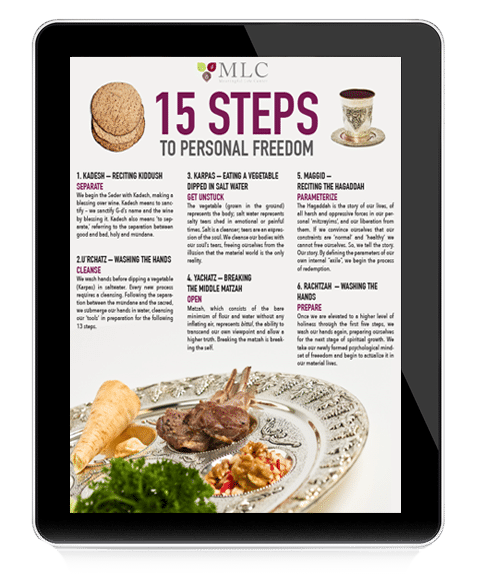
Here is a brief description of the fifteen Seder
steps, fifteen keys which each of us can use to open up doors
that help free us of our own limits and confinements, fifteen
steps that we can climb to reach a greater place.
The
Fifteen Steps
1. Kadesh – reciting Kiddush
We start the Seder with Kadesh, making
a blessing over a cup of wine. Kadesh (from the word
kedushah) means to sanctify – we sanctify G-d’s name
and the wine by blessing it. Kadesh also means ‘to separate,’
referring to the separation between good and bad, holy and profane.
The first step of the Seder process (and of every process) is
to create a new space so that the journey toward freedom can
begin. We separate ourselves from the mundane past that enslaves
us and enter the sacred spiritual experience of the Seder which
frees us.
On a cosmic level Kadesh is the counterpart
of chochmah (wisdom), the first of the ten sefirot –
the beginning of a new order, the first step in a process.
2. U’rchatz – washing the hands
The second step is U’rchatz: washing your
hands before dipping a vegetable (Karpas) in saltwater.
Following the separation between the mundane and the sacred,
we wash and submerge our hands in water, cleansing our ‘tools’
in preparation for the following 13 steps. Every new process
always requires a cleansing.
U’rchatz is the only one of the 15 steps
to have a connecting letter vav, which adjoins Kadesh
to U’rchatz. This is because they are twins: Kadesh is
chochmah and u’rchatz is binah (understanding),
the “two friends that never separate.” Kadesh is the
commencement (chochmah), a mental separation from the
past, U’rchatz is the development (binah) and
tangible implementation of that separation. Together they help
us create the transition from the confinement (mitzrayim)
of the mundane to spiritual freedom.
3. Karpas – eating a vegetable dipped in
salt water
The third step, Karpas consists of dipping
a piece of onion or potato in salt water. This is done to provoke
the children to ask: why? The Seder begins by stimulating the
child to ask questions because a critical component of freedom
is the encouragement and empowerment to ask questions. (More
on this – see Maggid).
Why Karpas? The earthy vegetable (which
grows from the ground) represents the body, which comes from
the dust of the earth, and the salt water represents the salty
tears shed in times of pain (the tears of those enslaved in
Egypt then and now). We must take our physical body, made of
earth, and dip it in salty tears. Salt is a cleanser, and tears
are an expression of the soul. We cleanse our bodies with our
soul’s tears.
After Kaddish and U’rchatz moved
us into the Seder “space,” Karpas teaches us the secret
that freedom is only possible by freeing ourselves from the
illusion that binds and enslaves us to the material world. Our
physical needs, which are vital for our survival and sustenance,
consume us to the point that we can often feel completely dependent
on them. The very nature of the material world is a narcissistic
one, that cries out “I exist and nothing else.” As long as we
are deluded by this perception, we can never be free.
Freedom comes when we realize that the material
world is like a ‘vegetable’ that needs to be dipped in spiritual
“salt water.” Karpas reminds us that the body is merely
a means, not an end in itself. Like the vegetable being dipped
in salt water, the body’s purpose is to transcend the world
that it lives in, by connecting itself to the soul, and thus
elevating and freeing both the body and the soul.
4. Yachatz – breaking the middle matzah
But even after we have this awareness, how do
we actually release ourselves from the tight grip of materialism’s
tentacles?
The answer is: Yachatz. We break the middle
of the three matzahs of the Seder plate. Matzah symbolizes bittul,
suspending oneself for a higher purpose. Matzah is made of water
and flour; water represents the soul and the Torah, and flour
represents the body. The antithesis of Matzah is chometz (leavened
bread). Chometz is bread that is allowed to rise. This represents
the inflated ego, which is mostly “air.” Matzah on the other
hand is the bare minimum of flour and water without any inflated
air
The subjective ego is the biggest trap that biases
and blinds us from seeing a broader perspective. Matzah empowers
us with bittul, the ability to transcend your own viewpoint
and allow in a higher truth.
Breaking the matzah (yachatz) emphasizes
this bittul even farther. Breaking the matzah is breaking
the self. Even the self as represented by matzah is broken to
ensure that even the selflessness does not become another expression
of self.
5. Maggid – reciting the Haggadah
After the first four preliminary steps are in
place, we now have earned the right to actually tell (Maggid)
and relive the story of Exodus. Maggid includes the largest
part of the Haggadah.
Telling the story – Maggid – begins with
the child (both inner and outer) asking the Four Questions.
As mentioned above, the first and perhaps greatest freedom of
all is the freedom to ask questions. To probe, explore and challenge.
Not only are we free to ask, we must ask. Healthy questions
are an expression of the search and the striving for something
higher, reaching for a place that is beyond us. If you are complacent
and not curious, you remain stuck in your own space. Questions
allow us the opportunity to truly grow.
After the child asks the Four Questions, we begin
the answer by telling the story of Exodus. The story begins
with the bitter Egyptian exile and ends with the liberation.
Maggid is not just telling a story-tale of past events;
it is reliving and re-experiencing them, recognizing how they
play themselves out in our lives today.
Maggid – and indeed the entire Haggadah
(which is rooted in the word maggid) – is the story of
our lives, the story of all harsh and oppressive forces in our
personal ‘mitzrayim’s,’ and our liberation from them.
The first and most critical element in achieving
redemption is awareness that we are in ‘prison.’ As long as
we convince ourselves that our constraints are ‘normal’ and
‘healthy’ we cannot even begin freeing ourselves. So, we tell
the story. Our story. By relating and recreating the
story we recognize the limits of our personal struggles and
challenges. And once we define the parameters of our own internal
“exile,” then, and only then, can we start the process of redemption.
6. Rachtzah – washing the hands
After we recite the story (maggid), we
reach a new sublime level. And just as we washed our hands at
the beginning of the Seder process (u’rchatz), we wash
our hands again at this new stage. Once we are elevated to a
higher level of holiness through the first five steps (kadesh
through maggid), we need to submerge our hands once again
in water, preparing ourselves for the next stage of spiritual
growth and freedom.
What does this new stage consist of? The first
five steps help put us into a psychological frame of mind of
a free person, and to give us a taste of that freedom. Actual
freedom is only possible when our minds and hearts are open
to being free, when we have the hope and sense that there is
more than our previous limited state. Once we reach that point
psychologically and we have had a taste of it, we are then ready
to begin manifesting and implementing this new-found freedom
in our physical and material lives, and not just a taste of
it but in a way that we can maintain it. Because after all,
we live in a material world, and for freedom to be complete
in this world it needs to be not just psychological but expressed
in a real and tangible way, where the material world no longer
holds us hostage. On the contrary, the material is transformed
and even becomes a vehicle for spirituality,
7. Motzi – reciting the blessing HaMotzi
After washing our hands, we begin the process
of transformation with Motzi: the first blessing on the matzah,
HaMotzi lechem min ha’aretz, blessing G-d, ‘who brings
forth bread from the earth.’
This first blessing emphasizes the ‘earthiness’
(the body) of Matzah (the primary ingredient of matzah is flour
– which comes from grain of the earth – mixed with water). But
unlike karpas, where the focus is on the negativity of
materialism, matzah focuses on the positive side of materialism;
on its great potential which is released when we reveal the
Divine spark within it. “It is not on bread alone that man lives,
but on the word of G-d,” the Divine spark within the bread.
Indeed, the Kabbalah teaches us that the highest Divine sparks
fall in the lowest places. Earth – symbol of all materialism
– contains the greatest spiritual energy. But it remains locked
and trapped in mitzrayim, until we begin to release it.
Lechem (bread) also means ‘to battle.’
A meal is like a war between the material and the spiritual
sparks that lie hidden within the food, between our temptation
to indulge and our ability to transcend and elevate the material
meal by revealing and releasing these sparks. And when we release
them lechem turns into cholom (the same letters
as lechem rearranged), the power to dream and reach a
greater place.
The first step of releasing and freeing these
sparks is through making the blessing HaMotzi on the matzah.
8. Matzah - reciting the blessing on the
matzah and eating it
The next step is the second blessing, the special
additional blessing which is unique to matzah, blessing G-d
for ‘sanctifying us with Your mitzvot and connecting (commanded)
us through the eating of matzah.’ This blessing emphasizes not
the ‘earthiness’ of matzah, but its spirit – the power of bittul
and selflessness[1] (see step 4, yachatz).
Then we eat the matzah. We ingest it and make
it part of our body, sustaining our body and soul. You assume
what you consume. By eating and consuming matzah – the food
of bittul – we assume its qualities. As the Rebbe MaHaRash writes,
eating matzah is like ‘eating G-dliness.’ On the first night
of Passover matzah is called the “bread of faith.” On the second
night it is called “bread of healing.”
Blessing and eating matzah is the first real food
we eat Passover.[2]
And being that Passover is the beginning of a new year, matzah
– the food of bittul and faith – is the first food that initiates
us into a new year of meals, infusing us with the power to elevate
all the food we will consume to its higher Divine purpose. This
in turn help us achieve true freedom in our lives, integrating
the material and the spiritual, body and soul.
9. Maror – eating the bitter herbs
However, materialism – including our food – still
holds us in a powerful stranglehold. Therefore, following the
matzah we eat the bitter maror, which reminds us that we are
still enslaved in a world of selfishness, and the resulting
bitterness.
Eating maror and feeling its stinging effect projects
and transfers the bitterness of life into our tangible experience.
It demonstrates our awareness of it, feeing us from the need
to have to experience any more serious form of bitterness in
our lives. Additionally, the bitter maror teaches us
the process of growth. An olive does not produce oil until it
is pressed. So too, maror hardens our mettle – the setbacks
and pain in life strengthen us. Like steel that is hardened
in fire and heat.
The maror is dipped into charoses
(a sweet conglomeration of ground apples, pears, nuts and wine),
sweetening it a bit (but not in a way that eliminates its bitterness).
This demonstrates that even when we need to feel bitterness,
its purpose and objective is not bitter, but to reach a greater
freedom. As it was in Egypt – “The more they were oppressed,
the more they proliferated and grew.” And today, 3314 years
later, millions of their descendants sit around the Seder table
all over the world celebrating freedom.
10. Korech – eating a sandwich of matzah
and maror
We now unite both the matzah and maror experience
all in one sandwich. Combining both the matzah’s earthiness
and bittul and the maror’s bitterness (dipped in sweet charoses).
There is a time to sing and a time to cry. A time
to celebrate and a time to feel the harshness of life. A time
for the sweet and a time for the bitter. But then we must learn
to join them both into one seamless experience called life –
the mission for which we are sent here by G-d. And then we have
freedom. Not through denial of the difficult and bitter, not
through escape into the spiritual, not merely through either
the material or the sublime, but through integrating them into
one unit.
11. Shulchan Oruch – lit. ‘set table’
– eating the festive meal
And now, finally, we are ready… to eat.
After the first 10 steps (corresponding to the
ten sefirot) of training to integrate spiritual freedom into
our material lives, we are now ready for the first real test:
Eating an entire material in an entirely new way, one permeated
with a sense of Higher presence and G-dliness.
Let’s see how we do.
Why is the meal called “Shulchan Oruch (set table)”?
Because a meal is not just a meal. It is not merely an exercise
in self-sustenance or self-indulgence. It is a complete experience
– like a set table, that has everything set and ready for all
the participants to sit down and partake in the meal. When we
feed ourselves and others – both physically and spiritually,
when we educate and offer services to other – we must always
do so in a manner that prepares and anticipates everything in
advance, everything is ready and prepared like a shulchan oruch,
a set table.
When we recognize that we have been blessed and
we have received so much, including the gift of the Passover
Seder table, we must in turn share the gifts with others. As
Moses was told, that he must present the teachings to the people
like a ‘set table,’ so too do we have the responsibility to
set the table for others who may not have the opportunity (for
whatever reason). We must offer them a prepared meal – both
physically and spiritually, sharing and teaching all that we
know, and setting the table by applying ourselves to provide
all the necessary elements.
12. Tzofon – eating the afikoman
Following the meal we eat the afikoman (the larger
half of the middle matzah that we broke and then hid away in
Yachatz). Tzofon means ‘hidden.’ It also means
‘north,’ where it’s cold and seemingly void of spirituality.
After we have eaten a complete meal – the first
meal of Passover and of the entire year – and we have eaten
it as free men, women and children, a material meal eaten in
a spiritual and refined way, we now have the power to reveal
that which is hidden and unconscious – tzofon – within
ourselves and those around us.
Furthermore, we have the power to conquer not
just the revealed dimensions of materialism as adversary, but
also its hidden dimensions. And we can reveal the enormous spiritual
energy that lies hidden in the ‘north,’ in the places that seem
so spiritually barren. As discussed earlier, that the highest
‘sparks’ are to be found in the darkest and coldest places.
The Afikoman is eaten as a dessert; not for sustenance
but for pleasure. The matzah eaten earlier is bittul on the
conscious level (for sustenance). The Afikoman matzah is bittul
on the unconscious (hidden) level. Another point: The earlier
matzah helps acclimate us to the bittul experience, as we learn
to tame the ‘ego’ and ‘narcissism’ of materialism. Once we have
reached bittul, we than can integrate it into the pleasure of
our lives, where even our pleasures become permeated with higher
purpose, with G-dliness.
Complete freedom is achieved only when we have
been freed not just the conscious levels but also the unconscious
and hidden ones.
13. Beirach – reciting grace
We conclude the meal with reciting grace. The
meal is thus punctuated by the two spiritual poles – the first
ten steps prior to the meal, including the washing of the hands
and the blessings made on the matzah, and the grace said after
the meal. This gives us the power to ensure that the meal –
which is symbolic of all our material experiences – will yield
the spiritual energy that lies within its Divine sparks.
Beirach (to bless) means ‘to draw down’
– to draw down into this physical world spirituality and G-dliness.
14. Hallel – reciting psalms of praise
Hallel also means ‘to shine,’ from the
expression ‘behilo nero – when his candle shone
forth.’ Hallel is recited on those occasions when G-d’s
truth shines forth into our material world, revealing and manifesting
that G-dliness is the ultimate reality and that the material
is naught.
After we have done everything in our power to
achieve freedom in the first 13 steps of the Seder, we now say
hallel and through these words of praise we place ourselves
in G-d’s hands. We surrender to G-d to complement whatever we
cannot do on our own and to conclude the process of reaching
complete freedom.
15. Nirtzah – G-d’s promise to accept our
service
Unlike the previous 14 steps, this last and final
step does not manifest itself in any prayer or action. We have
reached a point that transcends words and praise. After we have
completed our Seder service, we are accepted favorably – nirtzah
- by G-d.
As such we are ready for the final and complete
freedom and redemption
NEXT YEAR IN JERUSALEM!
***
Rabbi Schneur Zalman of Liadi, the Alter Rebbe,
did not include at the conclusion of the Haggadah the passage
‘the order of Pesach is concluded,’ because the Passover Seder
never ends. Instead, it continues throughout the year. To be
sure, the illumination of every festival radiates every day;
but Pesach extends continuously. Every day we must leave mitzrayim,
transcend out previous limitations and reach higher levels of
holiness.
======================
Before Passover we have a special mitzvah of charity
to help the needy celebrate the holiday -- both materially and
spiritually. Perhaps the greatest need of all today is to bring
Passover alive by making it meaningful and relevant, to make
it inviting and welcoming so that all men, women and children
should want to participate in the Seder.
If you enjoyed this guide and found it useful,
please help defray some of the costs for its production with
your tax deductible donation, and fulfill the mitzvah of charity
to help people everywhere celebrate Passover most meaningfully.
Any amount is greatly appreciated.
Please click
here to donate securely on-line. You can also call
us at 718-774-6448, e-mail us: donate@meaningfullife.com,
or send your donation to: The Meaningful Life Center, 788
Eastern Parkway Suite 303 Brooklyn, NY 11213.
[1] Perhaps the first blessing emphasizes the ‘flour’
(earthy) part of matzah, and the second blessing the water
part, symbol of bittul and spirit. Moses who led the Jews
out of mitzrayim, was drawn from water. Hence, his name Moshe.
Like everything in the universe
[2] Eating matzah is preceded only by drinking the first two cups
of wine and eating the karpas dipped in saltwater,
which 1) is not food, 2) attunes us so that the matzah will
have its proper transcendental effect.
|