
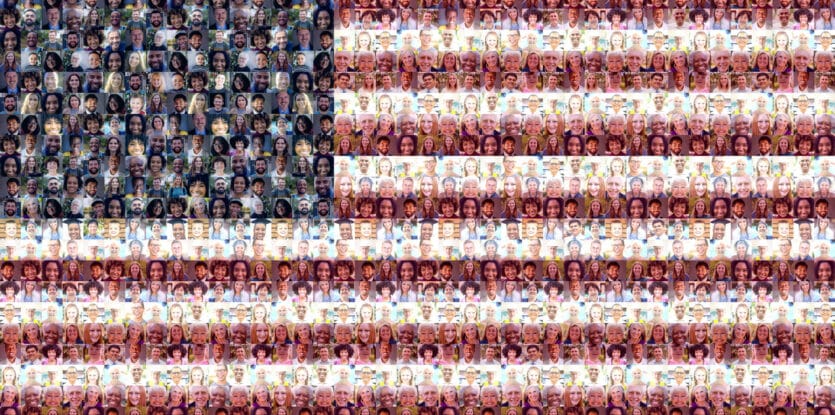
As America approaches its 250th anniversary, we are invited to pause and reflect on a profound question: What is the secret of this nation’s strength?
The Lubavitcher Rebbe often spoke about the unique role of the United States in history. He saw America not merely as a political entity or an economic powerhouse, but as a nation founded upon a moral vision rooted in the belief that human rights come from a Higher Power. The Declaration of Independence does not grant rights; it recognizes that they are endowed by the Creator. This simple but revolutionary idea—that every human being possesses inherent dignity because he or she is created by God—lies at the heart of the American experiment.
The founders understood that liberty cannot survive without moral responsibility. Indeed, they viewed Independence Day not simply as a celebration of freedom, but as an occasion for gratitude to Divine Providence. America was born not only through courage and sacrifice, but through an acknowledgment that blessings come from Above.
The Rebbe arrived on American shores in 1941, the very year Congress officially established July 4th as a federal holiday. He often pointed to the remarkable opportunities this country provided. For Jews fleeing persecution and oppression, America became a refuge. For Torah life, it became fertile ground. And for the broader world, it became a beacon of liberty and moral possibility.
Yet the Rebbe emphasized that gratitude is not simply about appreciating the past. Gratitude carries responsibility.
In a message marking America’s anniversary, the Rebbe stressed the importance of recognizing the blessings we enjoy in this country. Not only material prosperity, but the deeper gifts that are so easily taken for granted: freedom of religion, freedom of conscience, respect for human dignity, and the opportunity for people of different backgrounds to live together and contribute to the common good.
This is especially meaningful to Jews. The very name Yehudi (Jew) derives from hoda’ah, gratitude and acknowledgment. To be a Jew is to recognize that life itself is a gift. Gratitude is not merely good manners; it is a way of seeing the world.
And gratitude, the Rebbe taught, must lead to action.
When we appreciate a blessing, we do not simply enjoy it—we ask ourselves how to use it. If we are blessed with freedom, how can we use that freedom to strengthen our communities? If we are blessed with opportunity, how can we use it to help others? If we are blessed to live in a nation that protects faith and human dignity, how can we contribute to preserving and advancing those values?
As America marks 250 years, this is perhaps the most fitting response: not complacency, not cynicism, but gratitude coupled with responsibility.
America is not perfect. No nation is. But the greatness of a nation is measured not by perfection, but by its commitment to ideals greater than itself.
On this historic anniversary, let us give thanks—for the freedoms we enjoy, for the opportunities we have been given, and for the Divine providence that has guided this nation. And let us recommit ourselves to ensuring that America’s highest values continue to illuminate the path forward for generations to come.