The Difficult Lamb


Devarim    Ve'etchanan    Eikev    Re'eh    Shoftim    Ki-Teitzei
  Ki-Tavo    Netzavim    Vayelech    Haazinu    Vezot haBracha


ESSAY: The Difficult Lamb
In the barnyard of the soul

INSIGHTS
A Haven In Time
The month of Elul is the last of the Jewish year and the month that leads into the “Days of Awe” that commence the new year. It is also a sanatorium for accidental suicides
Amalek's Number
Confronted with absolute truth, the cynic responds with what is both the most sterile and noxious of attacks: doubt
Beginner
One hundred and twenty years of the greatest life ever lived might not be much, but it's a beginning

CALL: The Rebbe on the 60's
In an urgent call he issued to his followers in March of 1963, the Rebbe anticipated the upheavals and opportunities of the next ten years


The Difficult Lamb

You shall not see your brother’s ox or his sheep go astray and ignore them; return them to your brother... So shall you do with his ass, so shall you do with his garment, and so shall you do with every lost thing of your brother...

Deuteronomy 22:1-3

Obviously, the duty to return a lost object to its owner is not limited to oxen, sheep, asses and garments, but applies—as the verse concludes—to “every lost thing of your brother.” The Talmud explains that the Torah cites these examples because each of them teaches us another of the laws regarding lost objects.[1] However, while it deciphers the laws to be derived from “ox,” “ass” and “garment,” it does not succeed to do so in the case of the “sheep.” “The lost sheep is a difficulty,” it concludes the Talmud, meaning that the legal significance of the word “sheep” in the verse proved difficult for the sages.[2]

The Zohar tells us that the Torah has both a body and a soul. The “body” of the Torah is its “physical” part—the historical events it recounts and the laws it legislates. But implicit in this body is a “soul,” a mystic dimension in which every story has its sublime analogy and every legal nuance its spiritual counterpart.

Accordingly, the mitzvah of returning a lost object applies not only to the physical property of one’s fellow but to his spiritual possessions as well. If you encounter a life gone astray—a confused mind, a dysfunctional heart, a soul that has lost its moral compass or spiritual sensitivity—restore it to its owner. You may not remain indifferent to the spiritual plight of a brother any more than you may ignore his wayward ox.

Specifically, the four examples of “lost objects” enumerated by Torah correspond to four prototypical maladies of the human soul.

The ox is a powerful and volatile beast. When provoked, it is virtually unstoppable. One moment it is grazing quietly; the next, it is a thousand pounds of charging flesh and brawn, crashing through everything in its path. We all know its spiritual cousin: the contrary, opinionated brute who lashes out at anything that is disagreeable to him or challenges the tranquillity of his mastication.

When the ass rebels against its master, it doesn’t rage and gore—it digs in its heels and coldly disregards its master’s commands, pleas, even the blows raining down on its back. Spiritually, the obstinate ass is worse than the raging bull. The “ox” at least responds; the fact that he is provoked means that he has been challenged. On the other hand, coldness and indifference signify a greater distance from holiness and truth.[3]

The “garment” represents an even more noxious spiritual malady. The Hebrew word for garment, beged, is related to begidah, “treachery.” The antagonistic ox and the indifferent ass might resist or ignore their master, but they do not hide behind a contrived identity. The beged personality is one who misleads others—and worse yet, himself—as to where his loyalty lies, making it far more difficult for him to own up to his behavior and rectify it.

Useful Deficiencies

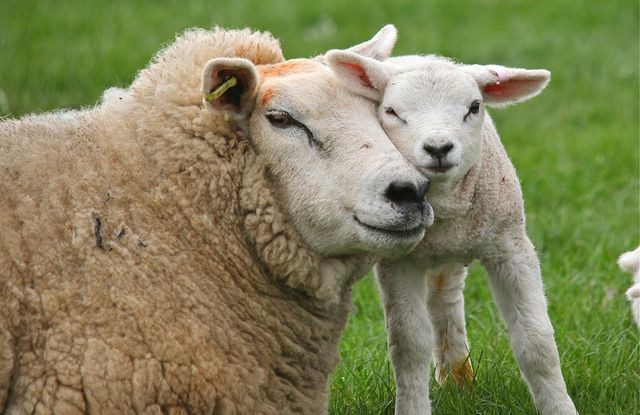
And then there is the sheep—a creature characterized by meekness and docility. While this might seem a lesser ill than the previous three, it is the most difficult to overcome. A person who fights, ignores or even betrays his G-d can come to recognize the truth and rectify his behavior. But you cannot convince the “sheep” of the error of his ways—he fully agrees with you. You cannot fan the flames of his heart—he is already fired with inspiration. He knows the truth, he cares about the truth, he desires to do what is right—but he is too timid to do anything about it.

This is the deeper significance of the Talmud’s words, “The lost sheep is a difficulty.” Regarding the “ox,” “ass” or “garment,” there are ways of dealing with a soul’s loss. But what is to be done with the “sheep”? Here the Talmud has no formula, no logistic solution.

Nevertheless, the Torah commands: “Return them to your brother!” Every spiritual loss is recoverable, every deficiency can be transformed into a positive force. An ox run amok is a destructive force, but when properly harnessed and channeled, its passion diverted to holy ends, “Much grain yields the might of the ox.”[4] The obstinacy of the ass, properly sublimated, translates into endurance and perseverance in remaining true to one’s mission and G-d in the face of trial and difficulty.[5] Treachery, too, has its positive uses; physical life is itself an act of subterfuge on the part of the soul, who assumes a material body and identity only to exploit them to serve its spiritual goals.[6]

And the meekness of the sheep, no matter how difficult a problem it poses, can also be reclaimed as a virtue. Meekness can be recast as self-abnegation to G-d—a self-abnegation that spawns not the passivity and resignation of the lost sheep but the resolute and uncompromising activism of he who has surrendered his ego and its encumbrances to serve an omnipotent master.

Based on the Rebbe’s talks, Tishrei 5715 (October 1954)[7]


A Haven In Time

Three cities you shall set aside within the land that the L-rd your G-d is giving you as an inheritance... and they shall be for all murderers to escape to.  This is the murderer who shall flee there, and live: one who strikes his fellow unintentionally...

Deuteronomy 19:2-4

And for one who did not lie in wait [to kill premeditatedly], but G-d has caused it to happen to him, I shall establish for you a place to which he can flee

Exodus 21:13

The unintentional murderer is not innocent. He is guilty of criminal negligence—negligence which has resulted in the destruction of a life. But for his sake, G-d commanded that “cities of refuge” should be established in the Holy Land. Cities to serve him both as a haven and as a place of exile; cities to which he is banished to atone for his deed as well as to rebuild his life anew.

There are cities of refuge in space, and there is a city of refuge in time. And while the spatial cities of refuge await the coming of Moshiach and the restoration of Torah law in the Holy Land to be reinstated, the haven in time that G-d has established for us in the calendar is there for us at all times, under all conditions.

This haven in time is the month of Elul—the last month of the Jewish year and the month that leads to the “Days of Awe” that commence the new year. This is alluded to in one of the verses that discuss the law of the “cities of refuge”: as master Kabbalist Rabbi Isaac Luria[8] points out, the first letters of the Hebrew words inah l’yado v’samti lach (“...has caused it to happen to him, I shall establish for you...”—Exodus 21:13) are alef, lamed, vav, lamed, which spell the word “Elul.”[9]

The Accidental Sinner

Elul is the month that Moses spent atop Mount Sinai as G-d reconciled Himself with His people after they had betrayed their covenant with Him by worshipping the Golden Calf. By divine command, Moses had hewn two tablets of stone and brought them to the top of the mountain; there G-d inscribed upon them the Ten Commandments that encapsulate His covenant with Israel to replace the original “Tablets of the Covenant” that were broken in the aftermath of Israel’s sin. After forty days, which included the whole of Elul and culminated in Yom Kippur, G-d uttered the fateful words, “I have forgiven, as you request,” thus establishing the precedent for teshuvah—for man’s ability to rectify an iniquitous past and establish it as the base for a renewed and invigorated relationship with G-d.[10]

Ever since, the month of Elul has been the “city of refuge” for all “inadvertent murderers” who seek the protection of its walls. For every transgression against the will of G-d is, by definition, an act of “inadvertent murder”: murder, because one has violated the essence and raison d’être of one’s own life; inadvertent, because man is inherently and intrinsically good, and all evil deeds result only from a lapse of awareness of one’s own true will. In the words of our sages, “A person does not sin unless a spirit of insanity has entered into him.”[11]

The twenty-nine days of Elul offer an isle in time, a sanctum for introspection and self-assessment, for atonement and rehabilitation. It is a place to which we might exile ourselves from our subjugation to the struggles and entanglements of material life to audit our spiritual accounts and restore the sovereignty of our true will over our lives. It is a month in which to resolve that, henceforth, no accidental iniquity will mar the quintessential goodness of our soul.

Based on the Rebbe’s talks on Shabbat Mevarchim Elul, 5711 (1951), and on other occasions[12]


Amalek's Number

Remember what Amalek did to you, on the way, when you were leaving Egypt...

Deuteronomy 25:17-9

Said Rabbi Yosef Yitchak of Lubavitch:

The numerical value (gematria) of the Hebrew word amalek is 240, the same as that of the word safek, “doubt.”

All things holy are certain and absolute. Torah is absolute, the mitzvot are absolute, divine providence is absolute. Amalek is doubt. Baseless, irrational doubt that cools the fervor of holiness with nothing more than a cynical shrug.


Beginner

And I beseeched G-d, at that time, saying: “L-rd G-d, You have begun to show Your servant Your greatness...”

Deuteronomy 3:23

Said Rabbi Israel Baal Shem Tov:

Moses was G-d’s faithful servant, the greatest of the prophets, the recipient of the Torah from G-d. And after one hundred and twenty of the most G-dly life ever lived, he sees himself as only beginning his relationship with the Almighty...


The Rebbe on the 60's

Editor's note: The following is a free translation of a directive the Rebbe issued to his chassidim at a gathering on Purim of 1963[13].

G-d has granted our generation opportunities that have never been granted before. To our great misfortune, we are not utilizing them to the utmost.

One of these opportunities is the recent awakening among the youth for what they call “a return to roots.” They hunger and thirst for the word of G-d[14], it’s only that they are, as of yet, unaware as to where the word of G-d is to be found. The sole responsibility therefore lies with those who are already immersed in the waters—“there is no `water' save for Torah”[15]--to explain to them that their thirst is for G-d’s perfect Torah, without compromise.

The first step, the rejection of the negative, they, our generation’s youth, have already achieved. They have shattered the idols and icons which prevailed among some of their parents. They have recognized that the man-made ideologies that were embraced forty and fifty years ago are false. We need only bring them to the second step, the acceptance of the positive---the study of Torah and the observance of mitzvot.

We are living in a time of opportunity and divine grace, and much can be achieved. We must not squander these times, G-d forbid.

We are living in a time that “The voice of my beloved knocks: Open for me.”[16] When G-d knocks on the door of every Jew’s heart and begs that it open to Him. G-d is not asking that we demolish walls or break down doors, only that we open up to him as the point of a needle,[17] “for My head is filled with dew, and My locks with the drops of the night”[18]---G-d can no longer suffer, so to speak, the tribulation of the galut night. He promises that when we open to Him as the point of needle He will do the rest, and in the blink of an eye,[19] bring the true redemption through our righteous Moshiach.

Adapted from the teachings of the Rebbe by Yanki Tauber


[1]. For example, the word “garment” teaches us that a person is only obligated to return an object that has identifying marks or characteristics (simanim) by which the owner can prove it is his (a garment is an object that can always be identified by size, color, material, and the like). If someone finds something that has no siman (such as loose coins or fruit) he is not obligated to return it, even if he knows who lost it, because it is assumed that the owner has relinquished all hope of recovering it.

[2]. Talmud, Bava Metzia 27a.

[3]. Cf. Talmud, Shabbat 53a: “A donkey is cold even in the height of summer.”

[4]. Proverbs 14:4.

[5]. Thus Jacob blessed the tribe of Issachar with the ability to pursue the study of Torah with the endurance of an ass (Genesis 49:14; Rashi on verse).

[6]. This is the deeper significance of Jacob dressing himself in Esau’s clothes to receive the blessings of “the dew of the heavens and the fat of the land,” as related in Genesis 27.

[7]. Likkutei Sichot, vol. I, pp. 155-158.

[8]. The “Holy Ari,” 1534-1572.

[9]. Shaar HaPesukim, Parashat Mishpatim.

[10]. Rashi, Exodus 33:11.

[11].  Talmud, Sotah 3a.

[12]. Likkutei Sichot, vol. II, pp. 623-626; et al.

[13] Printed in Likkutei Sichot, vol. IV pp. 1369-1370

[14] Cf. Amos 8:11: “Behold, says G-d, days are coming in which I shall dispatch a hunger upon the land; not a hunger for bread, nor a thirst for water, but to hear the word of G-d.''

[15] Talmud, Bava Kama 17a on Isaiah 55:1.

[16] Song of Songs 5:2

[17] “G-d says to Israel: My children! Open to Me an opening of teshuvah as the point of a needle, and I will open for you doors for wagons and carriages pass through...''---Midrash Rabbah on Song of Songs, ibid.

[18] Song of Songs, ibid.

[19] See Mechilta on Exodus 12:41.


A Cup of Vinegar
Intimations of Divorce
The Difficult Lamb
Threads

Visitor Comments
 Be the first to add comments to this page.
  

Google
Web Meaningfullife.com