And Moses said to the people: Remember this day on which you went out of Egypt, out of the house of slavery… and no leaven shall be eaten…
For seven days, no leaven shall be found in your homes… No leaven shall be seen in all your property…
But on the first day,[1] you shall exterminate all leaven from your homes
Exodus 13:3, 7; 12:15
More than a people’s redemption “from slavery to freedom,” the Exodus was also a transition “from darkness to a great light.” [2] The children of Israel were wrested from the “forty-nine gates of impurity”[3] of pagan Egypt and elevated to be G-d’s chosen “kingdom of priests” and “holy nation.”[4]
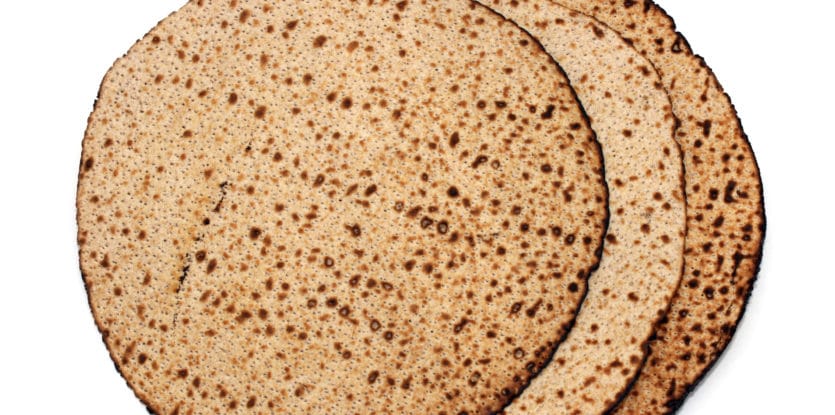
Thus, a primary feature of the festival of Passover is the purging of all leavened foods from our diet and possession. Leaven is dough that has fermented, causing it to rise and swell. In man, “leaven” is his propensity for pride and self-aggrandizement, which is the primal sin of Egypt[5] and the ultimate source of all evil.[6] On Passover, we relive the experience of the Exodus by cleansing our soul of its “leaven”; the physical and spiritual being two faces of the same reality, this is complemented by the removal and destruction of all physical leaven in our possession.
This explains the uniqueness of the prohibition of leaven among the other prohibitions of the Torah. The Torah forbids the consumption of various foods, but nowhere is the prohibition as extreme and all-embracing as the prohibition of leaven on Passover. In most cases, only the actual eating of a substance is forbidden. For example, the Torah forbids eating the flesh of a non-kosher animal, but permits deriving benefit from it in other ways—selling it to a non-Jew, feeding it to one’s animals, using it in the preparation of non-dietary products, etc. In certain instances (such as meat cooked in milk), the Torah also forbids all benefit from the substance. But in regard to leaven, it carries the prohibition even further: not only is it forbidden to eat leaven on Passover or to derive benefit from it in any way, it is also forbidden to possess leaven or to keep it in one’s domain for the duration of the festival. Furthermore, in addition to the “negative commandments” that forbid the consumption, use and possession of leaven, there is a “positive commandment” to destroy all leaven that is found in one’s possession before the onset of the festival.[7] (Legal differentiations aside, one need only observe the activity in a Jewish home in the weeks preceding Passover to appreciate the exactitude and vehemence with which the Jew “exterminates all leaven from his home.”)
When the Torah forbids the consumption of something but permits its other uses, it is saying that the thing itself is not negative—only a certain form thereof (its function as a food). A prohibition of benefit implies a deeper negativity—one that extends to all forms of beneficial use. However, the very fact that the Torah does not forbid an object’s possession implies that the object per se is not evil (though the Jew is unable to utilize it in any gainful way). The negativity of leaven, on the other hand, is not confined to one or all forms of use, but relates to the object itself: the Jew is forbidden to allow its very existence in his domain.
Evil, as a rule, is a “superficial” phenomenon. Only rarely is there any depth of commitment behind an evil deed or any profundity of thought and feeling behind an evil desire. Evil presents a sinister face, but the face is usually only skin deep, relating only to the most external surface of the “evil” person or object and having but a shallow and temporal effect on its surroundings. But the evil of Egypt, the most potent and malignant of evils, penetrates deeper than all other evils, extending beyond the external form to permeate the very substance of its object. Hence the extreme severity of the prohibition of leaven, which embodies the evil of Egypt; a prohibition that relates not to a particular form or forms of the forbidden object, but to the object itself.
Essence and Form
The above statement, however, requires further clarification. What is “the object itself” as opposed to its form? A physical object, by definition, is of a certain form—there are no formless objects. Yet the very fact that a thing can change form (to the extent that the second form is completely different from, or even antithetical to, the first) leads us to distinguish between the essence of a thing and the forms it assumes, and to speak of “essence” and “form” as two distinct components of a thing’s existence.
Thus, a physical object can be viewed on three different levels. The first, most “external” level is the object’s definition in terms of its function: a piano is a musical instrument, a loaf of bread is a food. This might be broadened to include a more generalized definition—the loaf of bread might be regarded as “an asset of value to the sustenance of human life,” a description that would include its utility as animal feed, fuel, saleable merchandise, etc.[8]
On a second, more basic level, a thing is defined in terms of its physical form, rather than its particular use (or uses). A piano is an object of a certain size and shape, and a loaf of bread is an object of a certain size and shape. We are regarding them as objects in time and space, rather than as instruments of a certain utility.
The third, most elementary, level is the thing’s “essence”—that unquantifiable “it” that lies behind the manifold forms it might assume. A loaf of bread is not an “object” but an intrinsically formless essence, whose particular form—and the fact that it possesses a form at all—is completely incidental to its being.
In most of the substances forbidden by the Torah, the prohibition relates only to the first, most external, level of existence. When a substance is forbidden only as a food, this means that only a certain function of the substance has been deemed negative by the Torah. Even when the Torah forbids deriving any benefit from the substance, the prohibition relates only to a more broadly defined function of the thing, not to its form or “objectness,” and certainly not to its essence.
The prohibition of leaven, however, extends beyond function and utility: its very existence in our possession is forbidden, and its destruction constitutes a mitzvah, the fulfillment of a divine commandment. But how far does the prohibition extend? Does it relate to leaven as an “object”—a physical substance of a certain form—or does it penetrate even deeper, to its very essence?
This question is the issue behind a Talmudic debate regarding the obligation to destroy all leaven in one’s possession on the morning of the day before Passover:
Rabbi Judah says: Leaven can be exterminated only by burning. The [other] sages say: One can also crumble it and cast it to the wind, or throw it into the sea.[9]
According to the second opinion (that of “the sages”), destroying the form of the leaven constitutes the fulfillment of the commandment to “exterminate leaven from your homes.” The loaf of bread, as defined as an object of a certain form, no longer exists; since the prohibition against leaven extends only to this stratum of its existence, the mitzvah of exterminating leaven has been fulfilled.
Rabbi Judah, however, maintains that the prohibition against leaven relates not only to its form, but also to its very essence. So it is not sufficient to destroy the form of the leaven. One must eliminate its very being, something that can be achieved (to the extent that it is humanly possible) only by burning.
The Four Elements of Form
The elimination of leaven from our domain is the physical analogue of the imperative to eradicate the evil of Egypt from our souls. So the question of the extent of the prohibition of leaven on Passover derives from a more basic question: how far does the evil of Egypt penetrate its subject?
This, too, is the underlying issue in a debate between our sages:
Rabbi Eliezer says: “… Every plague that G-d brought upon the Egyptians in Egypt was comprised of four plagues…” Rabbi Akiva says: “… Every plague that G-d brought upon the Egyptians in Egypt was comprised of five plagues…”[10]
The commentaries[11] explain this dispute as based on the fact that every existence consists of “four elements”—fire, water, air and earth. The “four elements,” however, are not the components of a thing’s essence, but the qualifying factors of its form—its heat (“fire”), moisture (“water”), etc.[12] Hence, the number of aspects to each plague expresses the degree to which the plagues affected the people and resources of Egypt. A four-fold plague means that the plague involved every aspect of its subject’s form, infiltrating each of its four elements. (The plague of blood, for example, not only affected the “water” element of the Nile’s waters, but also its “fire,” “air” and “earth” qualities.) A five-dimensional plague means that the devastation of Egypt extended not only to the four elements of form but also to the essence behind them.
Rabbi Eliezer is of the opinion that the evil of Egypt extended to its “four elements”; hence the four-fold plagues that came to crush the pagan “form” of Egypt and liberate Israel from its grasp. This opinion is reflected in the ruling of the sages who maintain that the destruction of the form of leaven (by “crumbling it and casting it to the wind, or throwing it into the sea”) eliminates the negative qualities it embodies.
Rabbi Akiva, on the other hand, is of the opinion that the evil of Egypt permeated its very essence, necessitating plagues with a fifth dimension—plagues that vanquished also the formless essence of Egypt. The same must be done each Passover, when the Jew achieves a personal Exodus by overcoming the “Egypt” within himself. Rabbi Akiva’s understanding of the evil of Egypt is thus reflected in Rabbi Judah’s ruling that “Leaven can be exterminated only by burning,” for also its “essence” must be annihilated.
The Personal Exodus
The soul of man also possesses “four elements” that give form to its transcendent essence. The four elements are: 1) his behavior (his actual deeds, words and conscious thoughts); 2) his emotional self or “character”; 3) his intellectual self; 4) his supra-rational self, which includes qualities such as will, faith and self-sacrifice. These, however, are only the elements that comprise the “form” of the soul, not the soul itself. Then there are those things that relate to a person’s essence—things that cannot be categorized or quantified by any of the above states of the soul.
“In every generation, a person must regard himself as one who has himself come out of Egypt.”[13] On the most basic level, “coming out of Egypt” entails liberating oneself from negative deeds and habits; this is self-liberation on the behavioral level, the first and most basic of the soul’s “four elements.” A deeper liberation is the transcendence of one’s emotional limitations—feelings that hamper and hinder the soul’s quest for the Divine. Yet a higher achievement is the personal Exodus from the limitations of the intellect—to free oneself from the various preconceptions and mindsets that confine the soul. Finally, the truly liberated person eradicates the “leaven” that might taint even his supra-rational self—the hint of self-consideration that might be found even in the purest faith and the most altruistic sacrifice.
According to Rabbi Eliezer (and the sages who disagree with Rabbi Judah), this is the extent to which a person can and should strive to “come out of Egypt.” This is the extent to which “leaven” can infiltrate the soul of man; these are the elements of self that can be liberated and transformed. As for the essence of the soul, there is no leaven to be eradicated, no “Exodus” to be achieved. The essence of the soul is beyond being affected by the ferment of ego, and consequently, beyond being liberated or elevated.
Rabbi Akiva disagrees. As lofty as the soul is, its potential for perfection is infinite; it can surmount even itself, liberating itself from the parameters of its very essence. Rabbi Akiva was a living example of this: the descendent of converts to Judaism, his was a soul that knew the meaning of utter transformation, of transcending one’s very identity. In his own life, Rabbi Akiva overcame forty years of ignorance of and hostility to everything holy to become one of the greatest sages in Jewish history. Self-liberation, according to Rabbi Akiva, involves not only the “form” of a life, but can be achieved also on the deepest, most quintessential level of one’s being.
Based on the Rebbe’s talks on Passover of 5714 (1954) and 5718 (1958)[14].
Adapted from the teachings of the Lubavitcher Rebbe by Yanki Tauber
[1]. “The first day” is a reference to Nissan 14, the day before Passover—see Talmud, Pesachim 5a.
[2]. Passover Haggadah.
[3]. See Zohar, part III, 93a.
[4]. Exodus 19:6.
[5]. Thus the prophet Ezekiel describes Pharaoh as “the great serpent who couches in his rivers (the Nile and the system of canals by which it irrigated the land of Egypt), who says, ‘My river is mine, and I have created [it and] myself’” (Ezekiel 29:3).
[6]. See Maamar Heichaltzu 5659.
[7]. Another stringency of leaven is that even the most minute amount of it is forbidden, as opposed to other prohibited substances which are “nullified” by a certain quantity (for example, if a drop of milk falls into a pot of meat, it is nullified if it is less than one-sixtieth of the contents of the pot).
[8]. Indeed, the prohibition against deriving benefit from leaven is derived from the Torah’s use of the term “shall be eaten” (in the above-quoted verse “and no leaven shall be eaten”) instead of the “do not eat,” implying the prohibition of anything that might lead to eating—i.e., any use that yields a profit which can then be utilized to purchase food.
[9]. Talmud, Pesachim 21a.
[10]. Mechilta, Exodus 14:31; Haggadah.
[11]. Kolbo, Ritva and Rashbatz on Haggadah.
[12]. See Mishneh Torah, Laws of the Fundamentals of Torah, 4:1; Tanya, ch. 1; Igrot Kodesh, vol XIX, p. 239.
[13]. Talmud, Pesachim 116b; Haggadah.
[14]. Likkutei Sichot, vol. XVI, pp. 87-93.