
|
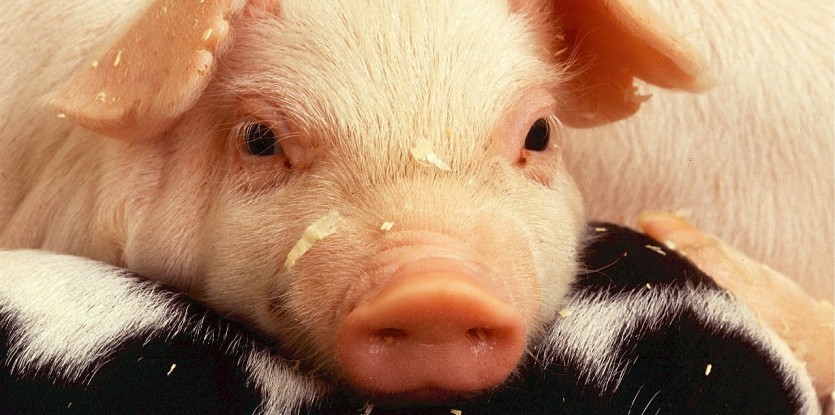
ESSAY: The Kosher Pig?
Why the epitome of treif
will one day be pure.
INSIGHTS: Ambition
How do you prepare your daily fareboiled,
baked, stewed or grilled? Fervid with desire or sodden with
contentment? Whichever way you ingest your life, on Passover,
theres only one dish on the menu

The Kosher Pig?
by Chaya Shuchat
Why is the word pig an almost universal symbol
of insult? This much-maligned animal has been slapped with
the most perverse of labels, from Nazi to sexist. We ascribe
to it the worst of human failings, including greed, gluttony,
and sloppiness. It is also the most quintessentially treif
of animals, with its name being nearly synonymous with non-kosher
of the most decadent sort. Lets face it: for an innocent
creature, the pig evokes some pretty strong emotions.
Although far from alone in the litany of non-kosher animals,
the pig seems to stand in a class of its own. True, bear or
lion meat are far less common menu items than pork or ham.
But our feelings towards the pig seem to run far deeper than
mere culinary distaste. What makes the pig distinct?
In general, when describing the kosher status of beast, fowl,
or fish, the Torah lists those which are in the minority.
Kosher birds are more numerous than those that are non-kosher,
so the Torah mentions all impure species by name. On the other
hand, there are far fewer kosher than non-kosher animals,
so only the kosher ones are specified in the verse. There
are four animals that are an exception to this rule: the camel,
the rabbit, the hare and the pig. They are specifically singled
out due to an ambiguity surrounding their status. Kosher animals
must possess two characteristics: They must chew their cud
and have split hooves. The camel, the hare and the rabbit
are all ruminating creatures, but their hooves are not split.
The pig, on the other hand, has a cleft hoof, but does not
chew its cud.
This may account for the pigs special notoriety
within the class of non-kosher species. Most animals are fairly
straightforward: their status is certain, and they are fairly
easy to identify and classify as kosher or non-kosher. The
four enumerated above, however, pose a problem. They possess
one kosher sign, but not the other. They might be considered
semi-kosher in our eyes, although they are no
less impure than the other animals. Yet it is not the camel,
the hare or the rabbit that bears the full brunt of our aversion,
but the pig. For the pig stands out even within the class
of imposters. The other three chew their cud,
a not necessarily obvious phenomenon, but do not have split
hooves, which are more readily apparent. The pig is different.
It brazenly flaunts its foreleg, boasting of its split hoof,
while its lack of cud chewing, which would give it away as
a non-kosher animal, remains obscured. It is this very attempt
to parade and masquerade itself as a kosher creature which
earns for the pig its unique status among animals.
The laws regarding the pure and impure species are placed
towards the end of the Torah portion of Shemini, literally,
the eighth. It is a reference to the eighth day
of consecration of the Tabernacle, which consummated the seven
preparatory days which preceded it. Seven represents the parameters
of existence--the seven-day cycle of time, seven colors on
the spectrum. Eight symbolizes a transcendent dimension that
rises above and sheds divine light upon the cycle of
seven. Our task is to attempt to create a fusion of the physical
and transcendent aspects of the universe, through utilizing
all physical objects for a more sublime purpose. The Holy
Temple is the quintessential example of physicality being
transformed into G-dliness. Yet the conclusion of the Torah
portion of Shemini, which discusses pure and impure
animals, signifies a higher level still. It portrays holiness
being drawn into the corporeality of the animal kingdom, a
far more challenging task of refinement and elevation.[1]
Within the task of elevating the animal kingdom, there are
two distinct modes. Certain animals are elevated through slaughtering
them in a proscribed manner, and consuming them as food, with
the intention of strengthening our bodies and utilizing that
strength to continue our Divine service. Other animals are
consecrated precisely by our rejection of them. Their very
nature conceals the Divine spark which vivifies them, and
only through categorizing them as impure, and
avoiding their consumption, can we tear off the mask of unholiness
and reveal the Divine light hidden within.
Yet even within this class, the pig defies and resists our
efforts. It enclothes itself in a garb of purity, and seeks
to deceive us regarding its true nature. The pig represents
the type of evil in the world which is hardest to resist and
combat. It encompasses all forms of flattery and deception,
the suave and smooth-talking villains who worm their way into
our confidence and take root in our hearts, before we become
wise to their true intentions. Our greatest challenge is not
fighting the blatant evil of the world, but its more subtle
and deceptive forms, which come packaged in a guise of goodness
and truth.
Yet the pigs ability to assume the semblance, however
superficially, of a kosher animal reflects on a level of holiness
embedded deep within it. For only if it contained within it
a hidden good,[2]
would it be able to pull off its clever charade. No falsehood
can long be maintained without some basis of truth. Our strong
antipathy towards the pig, and our solid rejection of it,
serve to cut off the part of it which is negative
and evil, and leave only its pure essence. Only regarding
the pig does the Midrash state: Why is the pig called
chazir? For in the future, it will be returned
(lehachazir) to us.[3]
In the Messianic Era, when the true Divine nature of every
creature will be openly revealed, the pig will stand vindicated
as a kosher animal. Because with all its posing and prancing,
the pig does one thing for us. It forces us to confront our
own insidious evil nature, combat it, and ultimately
rise above it. So the choice is ours. We can mask our deficiencies
by verbally maligning the innocent pig, or we can recognize
the pig for what it is: a mirror to our own animal selves.
We must concentrate on perfecting and purifying our own animal
souls, and G-d will reciprocate by "koshering" the
pig.
Based on Likkutei Sichos, Shabbos Parshat Shemini,
vol. 17, pp. 92-99; Parshas Toldos, vol. 35 pp.
117-118
Ambition
by Yanki Tauber
They shall eat the flesh [of the Passover offering] on
that night, roasted on the fire, with matzot and bitter herbs.
Do not eat of it half-done, or cooked, or boiled in water;
only roasted on the fire
Exodus 12:8-9
The firstborn, tithe and Passover offerings are kodashim
kallim; they can be slaughtered anywhere in the Temple courtyard,
and their blood requires only one sprinkling, as long as it
is directed toward the foundation of the altar. They differ,
however, in how they are to be eaten. The firstborn offering
is eaten by the priests, the tithe offering by anyone; both
can be eaten throughout the city [of Jerusalem], in any form
of food preparation, for two days and one night. The Passover
offering can be eaten only at night, and only up to midnight,
and only by those registered for it, and only roasted by fire.
Talmud, Zevachim 56b
We experience life as an endless chain of urges and strivings.
We desire something, agonize over our lack of it, and expend
our energies and resources in pursuit of it. And when our
goal is actually attained, our pleasure and satisfaction are
short-lived: already the next striving is forming in our hearts,
already the fire of desire is consuming our lives.
We might, at times, envy the tranquillity of those who are
free of ambition, but it is the relentless seekers whom we
admire and emulate. In our own experience, we look upon our
periods of agitated quest as the high points of our lives.
For we sense that while the tranquil person is at peace with
himself, the striving person is relating to something greater
than the self, something more than the here and now.
Three Offerings
In the twelfth chapter of Exodus (which is read from the
Torah on Shabbat HaChodesh, approximately two weeks
before Passover), G-d communicates to Moses the laws of the
korban pesach, the Passover offering. When the Beit
HaMikdash (Holy Temple) stood in Jerusalem, every Jewish
household (or group of smaller households) would bring a lamb
or kid to the Beit HaMikdash on the fourteenth of Nissan,
the day preceding the festival of Passover. The lamb would
be slaughtered in the Temple courtyard, its blood would be
sprinkled on the altar, and certain portions of it would be
burned atop the altar. It would then be roasted on a spit
over a fire. That nightthe first night of Passoverits
meat would be eaten with matzah and marror (bitter
herbs), together constituting the three staples of the seder.
[4]
Various types of korbanot were offered in the Holy
Temple, but the Passover offering was unique in many ways,
for it was governed by a set of laws that applied to no other
offering. Some of these differences are specified in the fifth
chapter of the Talmudic tractate of Zevachim, where
the Talmud compares the Passover offering with two other korbanotthe
firstborn offering (korban bechor) and
the tithe offering (korban maaser).
The Torah commands the Jew to bring the firstborn of his
cattle or sheep as an offering to G-d.[5]
Also to be offered is a tithe of the animals born in the herd
or flock (once a year, the years yield were herded into
a pen and let out one at a time; every tenth animal to emerge
was marked and pronounced holy to G-d, and brought as an offering).[6]
The firstborn, tithe, and Passover offerings all belong to
a class of korbanot called kodashim kallim,
and they resemble each other in the procedure of their offering
upon the altar; but the rules pertaining to the eating of
the Passover offering differ from those relating to the first
two.
The firstborn and the tithe offerings can be eaten for two
days and a night (on the day it was offered, on the
following night, and on the following day until sunset), while
the Passover offering can be eaten only on the night following
its offering, and only until midnight. Another difference
is that the firstborn and the tithe offerings can be prepared
in any way the eater desiresboiled, stewed, baked, roasted,
etc.while the Passover offering has to be roasted on
a spit over the fire, and cannot be prepared in any other
way (not even as a pot roast cooked in its own
juices with no other liquid added[7]).
For the most part, the Torah speaks of physical objects and
actions; but its every word also refers to the spiritual dynamics
of our lives. Each law of Toraheach organ and limb of
its bodyhas its corresponding element in
the soul of Torah. The same is true of the above-mentioned
laws: the firstborn, tithe and Passover offerings, and the
differences between them, all have their counterpart in the
inner life of the soul.
First, Last and Over
The teachings of Kabbalah describe our world as founded upon
ten divine attributes (sefirot) from which derive the
spiritual form and substance of reality. Thus, the number
ten represents the seder hishtalshelut
(literally, the order of evolution)the spiritual
order of things that G-d instituted in His creation. Firstborn
represents chochmah, the first and loftiest phase of
the seder hishtalshelut; tithe refers to
malchut, the last and lowest of the order.[8] Together, the first and the tenth embrace the
totality of the created reality.
Passover, as its name indicates, relates to that
which transcends seder hishtalshelut, that which overleaps
the standard processes of creation. The Passover offering
is so named in attestation to the fact that G-d leaped
over the homes of the Jewish firstborn when He killed
all Egyptian firstborn on the night of the Exodus,[9] despite the fact that, by all standard criteria, the Jews were
no more deserving of life than the Egyptians.[10] Passover is G-ds disregarding of the
very rules by which He ordered His world, and our reciprocation
of His deed by rising above the dictates of nature and normalcy
in our devotion to Him.
This explains the difference in how the Passover offering
is eaten, as opposed to the firstborn and tithe
offerings.
As has already been remarked, life can be viewed as a cycle
of striving and realization, yearning and gratification. The
common metaphors for these two states are fire
and water. Fire connotes thirst and upward striving;
water suggests settling down and satiation.
A normal lifelife as defined by the order
of evolution from chochmah to malchutis
nourished by both fire and water. Some meals are cooked steeped
in the water of contentment; others have lesser degrees of
liquid to temper the fire of life; occasionally, one even
partakes of a roasta spurt of utter striving,
of desire unsated by a single drop of gratification.
The Passover offering, however, can be experienced only one
wayroasted on the fire. When a soul reaches for G-dnot
for the glimmers of divinity to be found within creation and
experienced by conventional spiritual endeavor, but for G-d
Himself, as He transcends existence and realityit is
utterly consumed by an unceasing desire. For man can never
capture anything of the divine essence. He can only strive
for it, his soul a pure fire, with nary a drop of water to
slake his thirst, without even a pot to contain
his fervor.
Nighttime Meal
The firstborn and tithe offerings were eaten for two
days and a night. The Passover offering was eaten only
at night.
In the course of our history, we have experienced days of
divine light, as well as nights of spiritual darkness. Generally
speaking, there were two daytime erasthe
periods in which the first, and then the second, Beit HaMikdash
manifested the divine presence in our world.[11]
Between these two days was a brief nightthe seventy-year
Babylonian galut, when the Holy Temple lay in ruins
and the people of Israel were exiled from the Holy Land. Following
the sunset of the second day, we were plunged into the blackest
of nightsinto our current centuries-long galut,
rife with suffering and persecution, confounded by doubt and
spiritual dissonance and marked by the near-total concealment
of the face of G-d.
A normal relationship with G-d could be had only
on the two days and a night that preceded our
present galut. These were times in which G-d showed
Himself to maneven in Babylon we had prophets and other
expressions of divine immanence. But when the sun set on the
second day, the flesh of the firstborn and tithe
offerings could no longer be eaten. No longer could the divine
truth be experienced within the workings of nature or accessed
by the conventional processes of spiritual endeavor. No longer
could man experience gratification in his spiritual life,
for a glimpse of the Divine had become an elusive dream.
In this night of nights,[12]
mans striving for the Divine is an unquenchable fire,
an unrealizable yearning, an unconsummatable love. But for
that very reason, it is deeper and truer than the fire-and-water
concoctions of the past. In this night of nights, our yearning
for G-d is not focused upon first or tenth attributes or filtered
through orders of evolution. In this night of
nights, our yearning for G-d is not mitigated by plateaus
of gratification. It passes over all systems and processes
to strive for the very essence of G-dan endless striving
for the most endless of objectives.
Based on an (undated) entry in the Rebbes journal[13]
[1]. Fundamental to Jewish thought is the concept of
uniting the diversity of the universe toward one higher
end. Initially, each of the four kingdoms which comprise
the universe -- mineral, vegetable, animal and human --
stand alone. Only the human being, through his or her actions,
has the unique power to unite and transform all the kingdoms.
When a person utilizes or consumes mineral, vegetable or
animal, and harnesses its energy toward constructive ends,
he elevates it to a level that it could never have attained
on its own.
[2]. All phenomena, every personality, has a so-called
"subconscious," a beneath the surface root that
is the underlying cause for a particular behavior. The Kabbalah
calls it the "spiritual spark" within each fiber
of existence. This spark is the energy which, after evolving
and manifesting itself in physical form, informs and shapes
the entire spectrum of personality types in existence.
[3]. See Shaloh Chayei Sarah, also Likkutei
Sichos, vol. 12, p. 175.

[4]. Today, the meat of the Passover offering is represented
at the seder by the afikoman, a piece of matzah
eaten at the end of the meal.
[5]. Exodus 13:2, 12; Deuteronomy 15:19.
[7]. Tosafot on Talmud, Pesachim 41a, s.v. ikka;
Rashi, ibid., s.v. tzli kadar.
[8]. Thus the firstborn offering was eaten by the kohanim,
who represent the higher, more spiritual callings of life
(see Mishneh Torah, Laws of Shemittah and Yovel,
13:13), while the tithe offering was eaten by the farmer
who brought it, representing the lowest, or
most material, stratum of creation.
[9]. Exodus 12:27; Passover Haggadah, s.v. pesach
zu.
[10]. Zohar Chadash, beginning of Yitro; Yalkut Reuveni,
Shemot 14:27; Zohar, part II, 36; ibid., 170b (see Midnight,
WIR, vol. VI, no. 19).
[11]. The first Beit HaMikdash stood for 410
years, from the year 2928 from creation (833 bce) to 3338
(423 bce). The Second Temple stood for 420 years, from 3408
(353 bce) dates to 3829 (69 ce).
[12]. The Passover offering can be eaten only
until midnight. In Kabbalistic teaching, the first
half of the night is its harsher part, in which the attribute
of gevurah (severity) dominates (see
Midnight, WIR vol. VI, no. 19).
|