
Our Rendezvous with History
By Simon Jacobson
December 25, 2003
At the end of the year 1798 a man was miraculously released from prison in Czarist Russia. The world has never been the same since then.
Now, 205 years later to the day, another major event has taken place that is changing the landscape of the world.
The 1798 event is not widely known, but I submit that we cannot fully understand the implications of current events until we appreciate the event that transpired 205 years ago.
On the 19th of Kislev 1798 (in the Hebrew year 5559), Rabbi Schneur Zalman of Liadi was released from prison after his wrongful arrest at the hands of the Russian government. This day of liberation became known as the Rosh Hashana of Chassidus, which heralded a new stage in history.
On this same day, 205 years later, Saddam Hussein was captured “like a rat in a hole.”
What connection, you may wonder, is there between these two events?
Some history first. During the Russo-Franco war of 1812, after Napoleon invaded Russia, Jewish leaders in Russia broke into two camps, one supporting the victory of French Emperor Napoleon, the other Russian Czar Alexander. The former felt that if Napoleon won the war material life would become much easier for Jews. The latter argued that though Napoleon’s victory offered physical emancipation of the oppressed, it would compromise Jewish spiritual life. Napoleon, after all, represented an atheistic, self-glorifying, G-dless enlightenment.
Rabbi Schneur Zalman of Liadi, known as the Alter Rebbe, was a major voice in the Jewish opposition to Napoleon. His position was the one that ultimately prevailed. Rabbi Schneur Zalman was obviously not opposed to freedom from material oppression. What he wisely recognized was that this freedom has to be attained gradually, so as not to overwhelm the tenuous nature of spiritual life in a material world. And his fears were confirmed in the events that took place in Europe during the 19th century: Modern assimilation was birthed as a result of a people unprepared for the challenges of accelerated emancipation.
As time passed, emancipation was finally achieved to the point that today we are virtually free of any institutionalized oppression. But today, having achieved a deeper state of maturity we also have the opportunity to integrate both freedoms: material and spiritual. Today we have the ability to use our prosperity and comforts to advance a spiritual revolution. Yet, the challenge still remains not to take our freedoms for granted. Our greatest enemy today is within: our enemy is complacency – the one borne out of prosperity. When we don’t have to fight for our ideals, they tend to stagnate.
In Biblical terms the battle between matter and spirit is the struggle between Esau and Jacob. After Esau and Jacob reconcile (in last week’s Torah portion), Esau invites Jacob to become his neighbor. Jacob replies,
“My lord you know that the children are weak and I have responsibility for the nursing sheep and cattle. If they are driven hard for even one day, they will die… Please go ahead of me… I will lead my group slowly, following the pace of the work ahead of me, and the pace of the children. I will eventually come to you, my lord, in Seir.”
Jacob is telling Esau and all of us that there is much work to be done in resolving the inherent tension between the material and the spiritual. And this work must be done with complete focus. Jacob rejects even Esau’s offer to help by putting “some of my people at your disposal,” even that poses too great of a risk. “Just let me remain on friendly terms with you,” Jacob tells Esau.
History is a process – the process of refining the material world and slowly acclimating it to its inner soul. As the river of time flowed forward, each generation carried the baton of its leg of the great marathon of history – each progressive generation building upon its predecessor, slowly refining the mundane world.
Today, after 3559 years of work from the time of Jacob and Esau, the accumulative energy of countless generations has so refined the world that it is ready for reconciliation. Jacob can finally fulfill his promise to Esau, “I will eventually come to you,” and the world can be united under one G-d, with a complete fusion of matter and spirit and each nation serving in its own unique manner.
Yud Tes Kislev, the 19th day of the Hebrew month of Kislev, is a major milestone in this process.
Chassidus is contemporary Jewish mysticism. It renders and channels this ancient wisdom into an accessible blueprint for life that teaches us how to integrate our material lives with a higher, spiritual purpose.
The 19th of Kislev is the birthday of this powerful system. Tradition tells us that the deeper reason for the Alter Rebbe’s arrest was a heavenly challenge to his efforts to reveal the depths of mysticism to the mainstream. Until that point in history, cosmic secrets were in the exclusive domain of sacred few Tzaddikim. The Alter Rebbe’s liberation on Yud Tes (19) Kislev was a Divine signal and declaration that a new phase in history had arrived – the time had come to empower the masses with the ability to transform their material lives and the physical world into a home for the sublime.
This was always the purpose of existence, but in earlier generations global transformation would have not have been possible without overt Divine intervention. In natural terms, it did not seem possible that human efforts could achieve worldwide change. Yud Tes Kislev opened up a new channel – which would lead in subsequent years to the Industrial revolution, the emergence of democracy, the atomic and nuclear age, the information revolution – enormous changes that continue to grow at an accelerated pace.
Now back to Saddam’s capture on Yud Tes Kislev 2003. 14 years ago during the first Gulf War the Rebbe, my Rebbe, reacted strongly to the attack on Saddam Hussein. In the winter of 1991, the Rebbe elaborated on the fact that in history there were nations that had a certain level of permanence, for good or for bad. One of these forces was Babylon. Going back to the times of the great Babylonian Empire, which dominated the region, and even before that, when Babylon was developed by Nimrod, and the building of the powerful Tower of Babel.
Now, the Rebbe said, Saddam and Babylon’s firm power was disrupted, and he was forced to flee from his capital and center of power, and run from location to location. The Rebbe equated Saddam with historical villains like Pharaoh and Haman, and with the power of Babylon of old.
I always wondered why the Rebbe saw this event as so significant, more than the downfall of many previous tyrants in history. Indeed, as it turned out in 1991, Hussein remained in power, and the Rebbe’s words seemed moot. True, the Rebbe said at the time “these words will be applicable at a future time,” but still, even if Saddam had fallen, why was this such a significant event? Seemingly many greater events had occurred over the years.
My question was finally answered last Saturday night. I was on a plane flying back to NY from Seattle, when I heard the news of Saddam Hussein’s capture. What struck me immediately was that the capture took place on the eve of Yud Tes Kislev, concluding a long manhunt that began on Purim last year with the onset of the Gulf War II, and actually began 14 years ago, during Persian Gulf War I which actually ended then on Shushan Purim!
“I mean, this is just too much ‘coincidence’ to ignore,” I thought to myself sitting in my Jet Blue seat flying through the skies of free America.
“Yud Tes Kislev,” I thought to myself, “that’s the key.” 205 years ago Rabbi Schneur Zalman’s liberation opened up the door to a far greater liberation: the freedom to finally unite heaven and earth.
But the battle then was with Esau – and his different faces, the various faces of the West: Russia, France, and Europe in general (should also mention Greece, as we approach Chanukah). Initially the battle was to secure spiritual integrity. This required a certain measure of insulation from the world of “Esau.” As the years passed and we matured, and the universe continued to become more and more refined in the process, we reached a stage when we can enter the emancipated world of the West and not only would we not be compromised; we would transform, refine and spiritualize material secularism, turning the world into a home for the Divine.
But even as our peace grew with Esau, to the point that America has become a haven of opportunity to integrate material prosperity with “in G-d we trust,” our final challenge apparently is with Babylon and Ishmael.
As Rabbi Schneur Zalman and his successors explain, that the final frontier – the final refinement – is confronting Esau and Ishmael. The Zohar and other mystical texts make it very clear that the last challenge would be with Ishmael (See Zohar II 32a. Rambam, Iggeret Teiman ch. 3. R’ Dovber, Shaarei Teshuvah II 17a).
The Romans – Esau – destroyed the second Temple. The Babylonians destroyed the first one. So as we move forward in history, we first repair our rift with Rome, the West and Esau. Then, we reach further back in history and repair our rift with Babylon, a rift that goes back over four thousand years ago, with the building of the Tower of Babel (which means confusion), and even further back – to the cradle of civilization in the Garden of Eden.
So on Yud Tes Kislev, the day of “Jacob’s” liberation from the clutches of “Esau” (at the time, the Alter Rebbe and Czarist Russia respectively), the contemporary Ishmael and modern-day Nevuchadnezzar, the “lion of Babylon” vanished.
[One interesting footnote stands out: Children of Esau seem to never surrender. Hitler nor Stalin allowed themselves to be captured. Like a true “warrior and man of the field” they preferred suicide over captivity. Children of Ishmael seem to be another story. Hussein did not put up the slightest fight. Interesting… Is Ishmael a greater coward than Esau?]
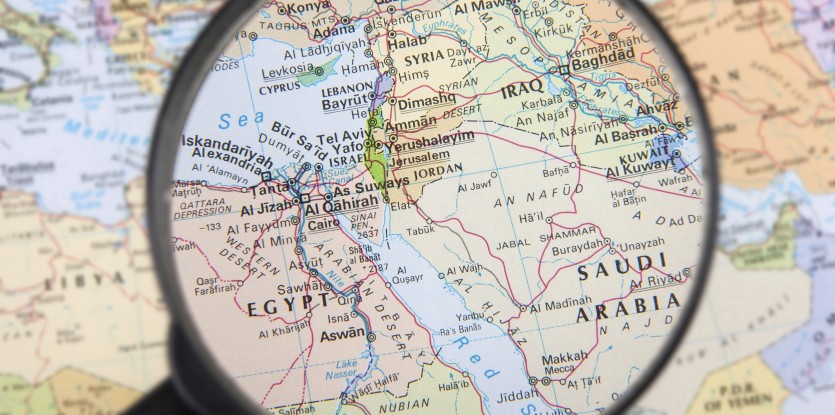
Babylon is like no other country, and its conquest like no other victory. (The Book of Daniel (chapter 5) documents in detail the fall of Babylon of old). Today everyone sees that the final frontier is the battle in the Middle East – the confrontation between Esau and Ishmael, with Jacob as usual in the middle. The first stand, the first victory, interestingly, was in Babylon.
By no means is this an endorsement of political interests and ulterior motives that the war may have; rather it is an observation on the deeper forces of destiny that we are witnessing. This isn’t even about the fall of great tyrant who perpetrated grave crimes against his own citizens. Though not insignificant, the fall of Saddam Hussein is not greater than the fall of other criminal leaders in history.
What makes Saddam’s capture stand out is the Babylon angle, and now, of course, the Yud Tes Kislev one.
History is a continuum. Peace in our lifetime will only be possible if we make peace with the rifts of our past. Today, we are confronted with forces that have been unleashed thousands of years ago.
Yud Tes Kislev in Babylon indeed. Who would have thought? We always knew that this day of liberation was related to our battle with Esau. Who would have imagined that it’s long arms would also open up doors in Babylon…
Events are sometimes separated by 205 years. But when you connect the dots, a bigger picture emerges that helps explain the world altering changes that we have experienced in the last two centuries.
And perhaps, it can help us understand what lies ahead.




You truly have meaning.