March 29th, 2015
“In the beginning G-d created the heavens and the earth.”
These words, perhaps the most well known of the Bible’s, are in fact a mistranslation.
The correct translation of the opening Hebrew word of the Torah, bereishit, is not “in the beginning” (that would be borishonah), but “in the beginning of.” How, then, are we to read the Torah’s first sentence? In the beginning of what?
The commentaries offer various interpretations. Rashi sees this as an indication that the verse is to be interpreted allegorically: the word bereishit is to be read b-reishit or 2-reishit (in Hebrew, the letter bet is also the number “2”), meaning “for the sake of the two things described by the Torah as reishit (‘first’)—the Torah (Proverbs 8:22) and Israel (Jeremiah 2:3).” In other words, the Torah’s opening verse informs us not only of the fact of G-d’s creation of existence but also of the purpose to which He did so: that the people of Israel should implement the divine will by observing the mitzvot of the Torah.
But how, after all, are we to read the literal meaning of the verse? Rashi explains that the first three verses of the Torah form a single sentence: “In the beginning of G-d’s creation of the heavens and the earth, when the earth was chaotic and void … G-d said: ‘Let there be light,’ and there was light.”
Sforno (Rabbi Ovadia ben Yaakov, circa 1470-1550) interprets the word bereishit as “In the beginning of time.” The Torah’s first verse is telling us, he goes on to explain, that the creation was not an event which took place in time, but an event which marked time’s onset. Bereishit is the very first moment of time, a moment without a past; nothing preceded this moment, since with this moment G-d created time itself out of utter nothingness.
Put another way: rather than “in the beginning G-d created…” we might say that “G-d created the beginning.”
In light of this, an oft-posed philosophical problem can be resolved. Since G-d is eternal and unchanging, we obviously cannot say that He “matured” to a certain state or had a certain idea “grow on Him.” So why did He create the world only when He did? Why not one year, a hundred years or a billion years earlier, since whatever reasons He had for creation were certainly just as valid then?
But as Rabbi Schneur Zalman of Liadi points out, the question is a non-sequitur: since time is itself part (indeed, the first part) of G-d’s creation, there is no stretch of time that can be termed “before” creation.
Certainly, the universe was “preceded” by a state of non-existence–preceded, that is, in the conceptual sense. At a certain point, G-d desired to create a world. But this is not a point in time, but a point in the divine reality. G-d, in essence, is above the desire for a world, yet He desired that He have this desire. In relation to this desire, the world exists; in relation to the divine essence which transcends this desire, it is utter nothingness. This is the “before” and “after” of creation. But in terms of physical time, creation “always” was, since the very first moment of time is also the first moment of creation.
Based on the Rebbe’s talks, Cheshvan 24, 5738 (November 5, 1977) and on other occasions.
Adapted from the teachings of the Rebbe by Yanki Tauber.
_____________________________________________
Tags: Desire, time, creation, Jewish history
Posted in Weekly Parsha, Bereishit, Bereishit, Soul & Mystical, Spiritual, Torah | No Comments »
March 29th, 2015
The power of the word.
What is it about the spoken word that can evoke such tremendous feeling? The way it is said? The one who says it? The implications it holds for the speaker and his listeners?
What are spoken words? Nothing really, at least not in the material sense. If speech is creative, it is only in the sense that it impacts its listener. Physically, speech has no substance—all it is is a pattern of sound waves. Yet there is no mistaking the power of the word. The simple word has the power to move you, to inspire you, to utterly transform your perspective on reality.
“Let there be light.” “Let the waters gather and land emerge.” “Let the earth sprout forth vegetation.”
The Torah describes the creation of the world as a series of divine statements. If we wish to understand the nature of the created reality, the Torah is telling us, we must examine the phenomenon we call speech.
As speech, G-d’s creating words did not actually create anything of substance. All they did was change a perception, change the manner in which a preexisting reality, the Preexisting Reality, would be perceived. When G-d said “Let there be light” nothing really happened—other than the impact this had on us, the listeners, to whom it made a world of difference.
The Listener
Say something. Any word or phrase. Say it again. And again. As you repeat your words they spin into meaningless noises. They have lost their impact. Spoken words that have no listener have no impact and, by definition, no existence. But say them again, this time to someone who hasn’t heard them yet, and they will regain their meaning and impact.
If G-d speaks a world, then, by definition, someone is listening. Someone outside of Himself—“outside” in the sense that he perceives his own existence as something distinct of His, failing to comprehend that he is but the embodiment of the divine desire that he be. Someone who might consider G-d to be an idea, something to think about, or a force to be reckoned with. Or who might question His existence altogether.
Someone who hears G-d’s speech of a world. Man.
The Language
You hear someone speak. He is saying something very powerful. Something with the ability to enlighten you, to provoke you, to open new vistas before you. You realize as much from the tone and timbre of his words. But you are unmoved. He is speaking Chinese.
For the word to impact the listener, the listener must know the language.
To appreciate the significance of the divine speech we call universe, we must first acquire the language in which it was spoken. “G-d looked into the Torah and created the world.” You can spend a fruitful lifetime just listening to the tone and timbre of the galaxies and quarks He articulated. But if you sense a significance to the grandeur of the stars, if you sense the whisperings of nature to be a communication, look to the Torah, the dictionary of creation. G-d gave us the Torah in order to teach us the language of creation, to enable us to comprehend His communication to us—and to communicate, in turn, with Him.
The Conversation
A conversation may sometimes serve no purpose other than to convey the information contained in its words. Directions to the bank, the price of the dress in the window. But this is speech at its shallowest. Meaningful speech is the endeavor to communicate, to reveal oneself to another.
G-d spoke to us so that we may understand Him. Not just the world He said, but Him, its speaker. By mastering the language of Torah, we not only gain insight into the significance of the created existence—we also enter into a heart-to-heart conversation with its author and orator.
Tags: creation, communication, speech, communication skills
Posted in Weekly Parsha, Bereishit, Bereishit, Soul & Mystical, Personal Life, Spiritual, Torah, Emotions & Psychology | No Comments »
March 29th, 2015
G-d said: “Let there be light.” And there was light. G-d saw the light, that it was good; and G-d divided between the light and the darkness. G-d called the light “day” and the darkness He called “night.” It was evening and it was morning, one day.
Genesis 1:3-5
Light. The first creation. Indeed, the sole creation of the First Day.
But light, by definition, is not an entity in its own right. It is the link between two other entities, the communication from its emitter to an observer or recipient. Light would have no function unless it is expressing the former and influencing the latter. So what sense is there in light as a first creation? Why create light on the first day if the first sighted creatures were not created until the fifth, the first beneficiaries of light (plants) were not created until the third, and the first luminary bodies in the universe were created only on the fourth day of creation?
Hidden Revelation
Indeed, our sages describe the light created on the first day as something that is not part of our present-day natural reality.
“The light which G-d created on the first day,” says the Talmud’s Rabbi Elazar, “a man could see with it from one end of the world to the other.” “It cannot shine by day,” says the Midrash Rabba, “it would dim the sun. It cannot shine at night – for it was created only for the day. So where is it? It was hidden. It is preserved for the righteous in the World to Come.” “Where did He hide it?” asks the Zohar, and replies: “In the Torah.”
Again we ask: Why create something that has no immediate function? We might ask this about any creation, but certainly about light. For what is light, if not illumination and revelation? Are not the words “hidden light” a contradiction in terms?
And yet, these two antithetical concepts are more closely related than one might think. The Zohar points out that the Hebrew words ohr (“light”) and roz (“secret”) share the same gamatria, or numerical value (207). According to Jewish tradition, a gamatrial concurrence between two words implies that they are intrinsically related to each other. As Rabbi Schneur Zalman of Liadi explains in his Tanya, the soul of an object or phenomenon is expressed by its name in the Holy Tongue; and when the names for two entities have a common numerical value, this means that they are, in fact, two incarnations of the same essence.
So “secret” and “revelation” are two sides of the same coin. And the very first creation was a secret revelation – a light destined to remain in the dark for millennia on end. An infinitely brilliant flash which illuminated the void of the First Day, only to retreat into its alter ego, secret, for the whole of contemporary history. So though light may be the primary element of creation, ours is a world of secrets: a world in which life means grappling with darkness and wrestling with the unknown, a world in which light is reserved for the “World to Come” – the fulfillment and culmination of our present-day struggles.
Finally First
“What is final in deed is first in thought”
from the Lecha Dodi prayer
A concept is born in its conceiver’s mind. Perhaps is it the mind of an architect, or of an artist, scientist, inventor, writer – any creative mind will do. The hands that are attached to this mind are fairly itching to put pen to paper, lathe to wood and metal, color to canvass. The mind’s eye is already envisioning segments of the edifice, parts of the machine, chapters of the book, experiments to test the theory. But wait, it tells itself, aren’t we sort of jumping ahead of ourselves? The concept, let’s get back to the concept. Is it clear? Has it come into focus yet? The details can wait – first we must define what it is we wish to create. What exactly is this invention going to do? What is the point of the theory? What is the book, painting or sculpture going to express? What is the function and/or aesthetic message of the structure?
Only after the concept has crystallized in his mind, does the artist or engineer get to work. Then, as the scaffolding rises about the developing edifice, as the canvas fills and the experiments accumulate and proliferate, the concept somewhat recedes, its clarity somewhat dims. Now there are sentences to assemble, problems to solve, angles to hone. Now the focus must shift from the concept as a whole to its component parts. True, the creator is guided throughout by his original vision; but what is at the fore of his mind is the vision as it applies to the particular task at hand, rather than the transcendent vision it was at the time of its conception.
But when the last bolt is tightened, or the final cornice or door-handle fitted into place; when the last brush-stroke is satisfactorily executed or the last revision is made to the manuscript or theorem – the concept re-erupts in all its radiance and purity. This is what was meant, this is what the sleepless nights and endless days were all about. This is what preceded all, this is what receded from view while the project developed, and this is what the final culminating detail again brought to light.
What is final in deed is first in thought.
So the concept has two states – revealed and hidden – both essential to its function. Before a creative process may begin, the concept manifests itself, clearly and vividly; for the slightest ambiguity in the foundation will set the entire structure askew. Then, during the developmental phase it withdraws, lending continued but covert focus and direction, lest it overwhelm the many short term goals which must be conceptualized, pursued and met.
Finally, when the finished product sits before us, the concept is once again manifest. This time, however, it is not floating in an abstract void; rather, it suffuses and emanates from the multifarious details of the actual creation, now integrated as a single entity with a single function and import.
What is final in deed is first in thought.
The Big Y
Why?
Why a world? What’s the point to this tremendous work of art, the function of this engineering marvel?
Light.
G-d wanted a world that conveys His truth. A world that overcomes initial darkness and distortion to express the goodness and perfection of its Creator. A world that is a ray of light shining off the Divine luminary. A world that reveals its essence and source. The creation of light is G-d’s concept of existence. It is the vision He articulated into being before getting down to the nuts and bolts of creation. The vision which precedes all, pervades all, and culminates all.
After the First Day this vision receded, as many sub-visions were articulated to create the particulars of our world. After the seven days of creation it faded into the background, so that man’s subsequent development of the world not be overwhelmed by its intensity. Throughout the process of creation and history, it retreated into the mind of G-d and consciousness of humanity – the Torah – a subdued but accessible secret to guide and mold a maturing world.
A secret until the world becomes the “World to Come.” Until our efforts to make our deeds, our lives, and the very substance of our environment a statement to the all-pervading reality of G-d are realized. Until the day the world comes off the assembly line, leaves the studio, to be seen for what it is.
Light.
Based on an address by the Rebbe, Simchat Torah 5726 (1965). Adapted from the teachings of the Rebbe by Yanki Tauber.
Tags: kabbalah, light and darkness, mysticism, creation, light, gematria
Posted in Weekly Parsha, Bereishit, Bereishit, Soul & Mystical, Beliefs & Concepts, Moshiach & Redemption, Spiritual, Torah | No Comments »
March 29th, 2015
By the Grace of G-d
11th of Nissan, 5735
Brooklyn, N.Y.
Mr. [name redacted],
New York, N.Y. 10002
Greeting and Blessing
Your letter reached me with some delay and pressure of duties further delayed my acknowledgement.
I trust it is unnecessary to point out to you at length that in regard to any and every good thing, it is not easy, often even impossible, to achieve one hundred percent. Very often, while aiming for the utmost, one must be satisfied with less than that and sometimes be satisfied with whatever percentage can be accomplished, as a beginning.
It should be self evident that by encouraging Jews to give tzedoko to a worthy cause, it does not mean that all the methods used by that organization are necessarily approved of, or that the fund raising dinners arranged by the organization will from now on be all glatt kosher.
I purposely did not mention any particular organization by name, nor the organization which you write about, since the situation applies to most charitable organizations engaged in fund raising, inasmuch as it is very rare to find perfection in human activities in every detail.
By way of illustration, although in a different area, yet it is very important factor in Jewish life which should be remedied, but despite all efforts and protestations, it has not been rectified. I refer to the attitude to Hebrew teachers, especially to Roshei Yeshivos, in the matter of remuneration and salary, as compared to equivalent teaching positions in secular schools and secular subjects. It is most lamentable that the scale of remuneration is so inequitable. Aside from the fact that we are losing vital teaching talent, the said attitude itself denigrates the value of the Torah and the prestige of a Yeshivah, and the students themselves cannot fail to see it and be influenced by it. Further, there is often also a conspicuous distinction between the Hebrew and secular departments of a Yeshivah Day School itself, where so much more emphasis is placed on the secular subjects and on scholastic achievement in the secular department, with prizes and scholarships, etc., which are not given in the sacred subjects. To be sure the Torah and mitzvos have to be studied and observed not for the sake of reward, but for its own sake. However, when we are concerned with students and children who have not yet reached this high level, this is the time when the principle “One should study the Torah even not for its own sake,” should be applied, “because one will eventually appreciate it and study it is for its own sake.” Sad to say that a similar situation may exist also in a Lubavitcher Yeshivah Day School, despite all efforts to correct it. There may be extenuating circumstances, but it does not alter the fact of the existence of an undesirable situation.
Of course, the above illustration is not intended to suggest that a charitable organization, even the one that you mention in your letter, is on par with a Yeshivah where the Torah is studied with Yiras Hashem and Ahavas Hashem. The illustration was brought only to illustrate that a letter of encouragement to any organization does not mean a hechsher on all its activities. I will go further and admit that even if there was not in the statement you mention the condition which emphasizes that the tzedoko contributed to the organization should provide for the religious needs of Jews, each according to his requirements, I would still consider it worthwhile to encourage support of an organization even if its philanthropic work was limited to material and social aspects only – and this could in no way be construed as a hechsher on the fundraising dinners that they are glatt kosher, as mentioned above.
I will have no objections if you wish to show this letter to anyone whom you think advisable to do so. However, I would appreciate, in such a case, that no specific philanthropic organization be singled out specifically, in order to avoid any possible misunderstanding, in accordance with the teachings of out Torah.
As this is the time before Pesach, the “Season of Our Liberation,” may the inspiration of this festival bring each and all of us a greater measure of true freedom from all distractions that hinder a Jew from serving G-d wholeheartedly and with joy, as this topic is discussed at greater length in the enclosed Pesach message, which I trust you will find interesting.
Wishing you a and yours a Kosher and inspiring Pesach,
With blessing,
[M. Schneerson]
Tags: priorities, charity, expectations, education
Posted in Torah Personalities, Modern, Social, Torah, Government, Rebbe, Education | No Comments »
March 29th, 2015
Said Rabbi Yitzchak: The Torah should not have started anywhere but [with the verse,] “This month shall be to you…” , which is the first mitzvah commanded to the people of Israel. Why, then, does it begin with, “In the beginning [G-d created the heavens and the earth]”? … So that if the nations of the world say to Israel, “You are thieves, for having conquered the lands of the seven nations,” they would reply to them: “The entire world is G-d’s; He created it, and He grants it to whoever He desires. It was His will to give it to them, and it was His will to take it from them and give it to us.”
Rashi on Genesis 1:1
“Torah” means “law” and “instruction.” Yet the book of Genesis and the first part of the book of Exodus read more like a history book than a law book. It is only in the twelfth chapter of Exodus that the Torah gets down to the business of conveying to us the 613 divine commandments (mitzvot) that instruct our lives.
Hence Rabbi Yitzchak’s question: Why does the Torah begin with “In the beginning G-d created the heavens and the earth”? Certainly, the story of creation, the lives of Abraham, Isaac and Jacob, and the account of the Exodus are of great historical and educational value, but why begin the Torah with these stories, if the Torah’s basic function is to legislate the mitzvot?
Rabbi Yitzchak’s answer is less easily understood. If the Torah’s account of creation and the history of Israel are required to establish the Jewish right over the Holy Land, this still does not explain why they must come before the mitzvot. Our claim to the Land of Israel—namely, that “the entire world is G-d’s; He created it, and He grants it to whoever He desires”—would have been equally valid wherever it appeared in the Torah. In any case, should the internal structure of the Torah be dictated by what the nations of the world might or might not say to the people of Israel?
Obviously, the accusation “You are thieves, for having conquered the lands of the seven nations,” and the response to it implicit in the verse “In the beginning G-d created the heavens and the earth,” does not only relate to our confrontation with the nations of the world. It also addresses an internal dialogue relating to the very essence of Torah and its place in our own lives.
The Challenge
As mentioned above, the Torah includes 613 mitzvot—divine commandments—relating to every area of life. There are mitzvot that pertain to how we eat, dress, conduct our marital life, do business, and to virtually every human activity and endeavor from the womb to the grave.
The mitzvot pertain to every area of life, but not everything we do is a mitzvah. Eating matzah on the first night of Passover fulfills a divine commandment, and refraining from eating meat with milk avoids a divine prohibition; but to eat an ordinary piece of bread on an ordinary Wednesday is neither obligatory nor proscribed by Torah law. When we wear tzitzit we observe a mitzvah, as we do when we avoid mixing wool and linen in a garment; but most of the clothes we wear involve neither a commandment nor a prohibition. The Torah commands us to give 10% of our earnings to charity, and forbids us to steal, lie or cheat; but countless decisions and actions taken in the course of a business day are completely “neutral” by the standards of Torah law.
Hence our lives might be seen as divided into two domains: the domain of mitzvah, and the domain of reshut (“permissible” or “optional”)—acts that neither fulfill nor violate a divine command.
But the Torah tells us that “All your deeds should be for the sake of Heaven,” and that we are to “Know Him in all your ways.” That everything we do can, and should, become an integral part of our relationship with G-d.
(There are two basic ways in which this is achieved, corresponding to the two maxims quoted above. “All your deeds should be for the sake of Heaven” means that everything one does is done as a means to that end: one eats in order to have the energy to do a mitzvah, one earns money in order to eat in order to have the energy to do a mitzvah, and so on. “Know Him in all your ways” means that our “mundane” activities are not only a means to a G-dly end, but are themselves ways of experiencing G-d. For example, one’s business activities are not only a means of earning money which will in turn be used to do a mitzvah, but an opportunity to observe the hand of G-d in the dozens of “lucky coincidences” that add up to a single business deal, and gain a deeper appreciation of His providence.)
Here, we are often confronted with the challenge, “You are thieves, for having conquered the lands of the seven nations!”—a challenge that might come from without, but which most often comes from one’s own secular self, from the “nations of the world” within oneself. A challenge that says: Enough is enough! When you are acting in fulfillment of a divine command, that is fine; after all, G-d Himself told you to act this way. But what business have you commandeering the secular, “non-Jewish” areas of life? Must you turn everything into a religious issue? Serve G-d in the ways He has told us to serve Him, and leave the rest to their rightful, worldly owners!
The Reply
But the Torah does not begin with its first mitzvah, but with the statement: “In the beginning G-d created the heavens and the earth.” Everything was created by G-d—not just the matzah eaten on Passover or that percentage of the one’s income given to charity.
With its opening statement, the Torah is establishing that it is more than a “rulebook,” more than a list of things to do or not to do. It is G-d’s blueprint for creation, our guide for realizing the purpose for which everything in heaven and earth was made including ownership of Israel. Every creature, object and element, every force, phenomenon and potential, every moment of time was created by G-d toward a purpose. Our mission in life is to “conquer the lands of the seven nations” and transform them into a “Holy Land”—a world permeated with the goodness and perfection of its Creator.
Based on an address by the Rebbe, Nissan 5, 5740 (March 22, 1980).
Adapted from the teachings of the Rebbe by Yanki Tauber.
Tags: relationships, Jewish law, Israel, mitzvot, Torah, transcendence
Posted in Bereishit, Bereishit, Weekly Parsha, Israel, Religion, Social, Spiritual, Torah, Current Events | 1 Comment »
March 29th, 2015
In the beginning G-d created heaven and earth. And the earth was chaotic and void, with darkness on the face of the depths… And G-d said, “Let there be light,” and there was light…
And G-d called the light “day” and the darkness He called “night.” And it was evening and it was morning—one day.
Genesis 1:1-5
“First came darkness, then light,” says the Talmud, summarizing what is perhaps the most basic law of life, and the spiritual meaning of day and night.
So it was when the world came into being. As related in the opening verses of the Torah, G-d first created a dark and chaotic world, into which He subsequently introduced light by decree of His creating word.
So it is with every individual life. We all enter the world in the dark: ignorant, uncomprehending, barely aware of our surroundings. Then begins the slow process of learning to recognize the world we live in, comprehend its significance, and ultimately generate our own light to illuminate and enlighten it.
Even the Torah, G-d’s blueprint for creation and His guide to life on earth, follows the model of “first darkness, then light.” The Torah consists of two basic components: the “Written Torah” (the Pentateuch, also called the “Five Books of Moses”), and the “Oral Torah”—a system of laws, rules, and techniques for interpretation given to Moses and handed down through the generations. The Written Torah contains the whole of the divine communication to man; but much of it is hidden, implicit within an extra word, a turn of phrase or a nuanced comparison between two other laws. So the Torah, as G-d spoke it and Moses wrote it, is a closed book; it is only by a lengthy and toilsome process of study and exegesis that its life-illuminating wisdom can be deciphered.
G-d could just as easily have created a light-flooded world, had us emerge from the womb as mature and informed beings, and given us a Torah in which everything is explicitly spelled out. But he desired a world in which “first came darkness, then light”—in which order is preceded by chaos, knowledge by ignorance, and bliss by toil and struggle.
The Day
When G-d created time, He ingrained the “darkness first” law into the structure of time’s most basic component—the day.
“Six days G-d created the heavens, the earth, the sea and all that is in them,” states the Torah, “and He rested on the seventh day.” Chassidic teaching points out that the verse does not say that G-d created the world in six days, but that “Six days G-d created,” as if to say that the created reality consists of these six days.
Indeed, according to the Kabbalah, the whole of creation is comprised of six basic spiritual elements—chessed, gevurah, tiferet, netzach, hod and yesod —deriving from six corresponding divine attributes (sefirot) and embodied by the six days of creation. A seventh element, malchut, is embodied by Shabbat, completing the seven-day cycle of motion and rest, creation and withdrawal, by which the world was brought into being and by which it continues to exist.
The day, then, is more than a measure of time. It is a component of time, which is comprised of the seven basic elements that underlie the whole of creation. Ultimately, the whole of time consists of seven days only; each week is a repetition (though on a more advanced level) of the original seven-day cycle of creation.
And each day consists of an “evening” and a “morning,” of a darkness-shrouded night followed by luminous daytime hours. In the Jewish calendar, the day begins at nightfall and ends at nightfall, following the model of the original days of creation (“And it was evening and it was morning—one day… And it was evening and it was morning—a second day,” etc.). For each of the seven time-qualities is conceived in the womb of darkness, chaos and strife before emerging into the light of day.
The Night Revealed
Yet evening and morning comprise “one day”—a single, integral unit of time.
Ostensibly, the daytime hours of a specific day seem to have less in common with the night that precedes them than with the daylight hours of a different day: a glance out the window will tell you if it is night or day, but not if it’s Sunday or Monday. In essence, however, the night and day of the same 24-hour day share a unique quality which sets them apart from the other six days ordained at the creation.
Thus, in the “World to Come”—the future world that is the culminative state of creation—the “night will be as luminous as day.” Yet the seven days of the week will remain distinct components of G-d’s creation, each revealing another aspect of the divine reality.
In other words, the differences between the seven days of creation are intrinsic and eternal, while the difference between night and day is superficial and transitory. For night is but the embryo of the day—the means to its end, the process to its product. While the process is still underway, the two seem worlds apart: the night dark where the day is bright, obscure where it is lucid, trying where it is tranquil. But when the process reaches its culmination, the night will be revealed as an integral part of the day’s harmony and luminescence.
While the process is still underway, we experience it as a struggle, as a journey through a dark and threatening place. But when we reach our destination, the journey will be revealed for what it truly was: a progression toward the light of day. A night whose every setback and frustration serves to enhance the preciousness of the day to follow, brightening its light and deepening its tranquillity.
Based on the Rebbe’s talks on Sukkot 5711 (1950), Shabbat Bereishit 5751 (1990) and on other occasions. Adapted from the teachings of the Lubavitcher Rebbe by Yanki Tauber.
Tags: Jewish calendar, creation, kabbalah, time, light and darkness, mysticism
Posted in Weekly Parsha, Bereishit, Bereishit, Soul & Mystical, Beliefs & Concepts, Personal Life, Moshiach & Redemption, Spiritual, Torah | 3 Comments »
March 29th, 2015
Come see the doings of G-d, His fearsome plot on the children of man
Psalms 66:5
And the woman saw that the tree was good to eat and desirable to the eyes … and she took of its fruit and ate; and she gave also to her husband, and he ate with her
Genesis 2:6
What would have happened if Adam and Eve had not eaten from the tree of knowledge?
The purpose of a business venture is to make a profit. No self-respecting businessman would invest capital and expend time and talent where the figures did not show a definitive potential for profit.
And yet, the greatest profits are to be harvested under the very conditions that the responsible businessman seeks most to avoid: in the wake of completely unforseeable developments, in environments over which he has no control and in which his entire venture (and perhaps his own self) are in jeopardy.
Thus, the mind of the businessman can be said to operate on two levels. On the manifest level, he seeks stability and control. On this level, “being caught unawares” is anathema to business. While he knows that there are risks to every venture, his aim is to avoid the risks, to steer clear of the unforeseeable, to have a contingency plan for every possibility.
But on a deeper, subconscious level, the businessman craves the unforeseeable. In his heart of hearts, he wants to be caught unawares, to be plunged into the very circumstances that his business is structured to avoid. For here, and only here, lies the potential for profits greater than any analyst could forecast. On this level, having “everything go according to plan” would be a disappointment rather than an achievement.
These are scenarios that he will never present to his investors, or even to his own conscious self. But in the final analysis, it is these very possibilities, lurking behind the official figures and projections, that are his greatest motivation for engaging in business.
The Fearsome Plot
Our sages tell us that “The kingdom of Heaven is similar to the kingdom of earth” —that the structures of human society and the patterns of human behavior reflect the manner in which the Creator relates to and runs His world.
G-d has a “business strategy”: the Torah—which is “G-d’s blueprint for creation” —defines the “profit” that the Creator desires to see from His enterprise. The Torah’s laws detail what should and what should not be done, and what should and what should not happen, to safeguard the divine investment in creation and assure its profitability.
But on the very first business day of history, the plan went awry. Adam and Eve, by eating from the fruit of the Tree of Knowledge, violated the first mitzvah (divine commandment) commanded to them. Their deed jeopardized the entire venture, unleashing a chaos of good and evil upon the controlled, orderly world into which they were born.
Yet our sages tell us that this was G-d’s “fearsome plot upon the children of man.” as it is written, ‘For on the day that you eat from it, you shall die’ (ibid. 2:17).
“What is this comparable to? To one who wished to divorce his wife. On the way home, he has a bill of divorce written up. He comes home, with the bill of divorce in his hand, plotting a way to give it to her. He says to her: ‘Pour me a cup, that I may drink.’ She pours out a cup for him. As soon as he takes the cup from her hand, he says to her: ‘Here is your divorce.’ Says she to him: ‘What is my crime?’ Says he to her: ‘Leave my house, for you have poured me a lukewarm cup.’ Says she to him: ‘You knew in advance that I would pour you a lukewarm cup—you have already written the bill of divorce and brought it with you in your hand!’
“By the same token, Adam said to G-d: ‘Master of the World! For two thousand years before You created Your world, the Torah was safeguarded with You… and in it is written, “This is the law: If a man should die in a tent….” (Numbers 19:14). Had You not prepared death for Your creatures, would You have so written? And then You come and attach the blame to me.’ Hence [the Psalmist says]: ‘His fearsome plot upon the children of man.’” (Midrash Tanchuma, Vayeishev 4)] “It is I who caused them to sin,” G-d admitted to Elijah the Prophet, “by creating them with an inclination to evil.”
For it is the process of teshuvah (“return”) from sin that yields the greatest “profits” of the endeavor of life. There is no greater love than the love experienced from afar, and no greater passion than the quest to return to a forsaken home and an alienated self. When a soul’s bond to G-d is stretched to the breaking point, the force with which it rebounds to its Source is greater than anything that can be generated by the soul that never leaves the divine orbit. And when a soul wanders off to the most alien corners of life, and exploits the very negativity and evil of its environment as the impetus to return to G-d, it redeems those parts of G-d’s creation that lie beyond the pale of a righteous life.
This is G-d’s “fearsome plot” upon the children of man: to create man with an inclination to evil, so that when he succumbs to it, he should rebound with a greater love for G-d, and with a greater harvest of transformed and redeemed resources, than is generated by a life lived in conformity with the divine will.
Surely, however, it cannot be said that G-d wanted that man should sin: a sin, by definition, is an act that G-d does not want done. Also, if G-d’s “plan” was that man should sin, this raises the question of what would have happened if Adam and Eve had not chosen to eat from the Tree of Knowledge. Would the purpose of G-d’s creation not have been realized?
What G-d Wants
As is the case with the conventional businessman, there are two levels of “motivation” behind the divine act of creation.
On the manifest level, the world was designed and created to carry out the plan outlined by the Torah. This plan calls for the existence of an inclination to evil in the heart of man, in order that our conformity to the divine will should have meaning and significance. In the words of Maimonides,
License is given to every man: if he desires to follow the path of good and be a righteous person, the choice to do so is in his hands; and if he desires to follow the path of evil and be a wicked person, the choice to do so is in his hands…. This is a major principle, and a mainstay of the Torah and the commandments…. For if G-d were to decree that a person be righteous or wicked, of if there were to exist something in the essence of a person’s nature which would compel him toward a specific path … how could G-d command us through the prophets, ‘Do this’ and ‘Do not do this’?… What place would the entire Torah have? And by what measure of justice would G-d punish the wicked and reward the righteous…?
This plan does not require the existence of evil—only the potential for its existence. It must be possible for us to violate the divine will, so that our not violating it should be a moral triumph for us and a source of pleasure for G-d. It must be possible for us not to do good, so that our good deeds should have value and significance. The risks must be there—they are what make the business venture rewarding and profitable—but the point of it all is that they be avoided.
But on a deeper, “subconscious” level, G-d plots man’s succumbing to sin. This is not what He “wants”—indeed, it is at variance with His express will. But when it does happen, it unleashes a wealth of possibilities that are infinitely more potent than anything the “official” business plan could have yielded. And it is these possibilities, lurking behind the official figures and projections, that are His ultimate motivation for investing in the business of human life.
Based on the Rebbe’s writings and talks. Adapted from the teachings of the Lubavitcher Rebbe by Yanki Tauber.
________________________________
Tags: teshuvah, Jewish law, creation, mitzvot, business, good and evil
Posted in Bereishit, Bereishit, Good & Evil, Beliefs & Concepts, Personal Life, Free Choice, Torah, Business, Work & Money | No Comments »
March 29th, 2015
New Manuscript Discovered and Translated for Gimmel Tammuz
A newfound manuscript – from the recently discovered Schennerson library in Moscow, Russia (a library that the Rebbe passionately fought to restore to its rightful place in the Agudas Chassidei Chabad Library) has come to light. This manuscript was penned by the second Chabad Rebbe’s (Rabbi Dovber Schneerson, the Mitteler Rebbe), and it includes the conclusion of a discourse delivered by his father, Rabbi Schneur Zalman on Shabbat Parshat Va’eirah 5568, which until now has ever been seen by the public and published!
This extraordinary manuscript, with the fascinating example of the sun always shining day and night, can perhaps shed some “light” on the stoppage of the sun on Gimmel Tammuz [1]: The sun may be silent (in ways that we can’t hear it), and its movement may have paused, but it continues to shine one way or another – either directly or through its reflection in the moon and the stars. To read more about what this manuscript means, visit meaningfullife.com to see Rabbi Jacobson’s application of the teaching, The Silent Sun.
The beginning of the discourse is printed in Ohr HaTorah of the Tzemech Tzedek Parshat Va’eirah p.165-166, and what follows below is the continuation of the discourse loosely translated from the Mitteler Rebbe’s transcript – published here for the very first time – and apropos to Gimmel Tammuz.
The level of Moses [the quintessential leader] is the uppermost tier in each and every world, i.e. the interface within each and every world that draws from the world above it. As illustrated by the name Moshe, which means to extract, like the act of drawing water from a well, as in the verse “He drew water for us, and gave our sheep to drink” (Exodus 2:19). This first stage in each world is deserving of this name for it ‘draws’ and ‘gives to drink;’ it draws from the higher world and gives to drink to the lower world which receives from it, and it serves as an intermediary to bring from the higher to the lower. For this reason he is called Moshe — draws — in the present tense, for this level constantly draws from that which is higher to that which is lower.
This is the deeper mystical meaning of that which it says [the reason given for the name Moshe] “For I drew him out of the water” (Exodus 2:10). It refers to drawing from the supernal waters which precede Atzilus which is the tier of ‘Tikkun’ (the systematic and aligned consciousness of reparation) that follows ‘Tohu’ (the chaotic consciousness of misalignment). These supernal waters are drawn down into Atzilus to effect reparations, not for their (the waters’) own ends, for their origin is far higher that Atzilus and they have nothing to gain by descending into Atzilus. Similarly there is an equivalent level called Moshe that serves to mediate the communication from Atzilus to Briah and from Briah to Yetzirah etc. In the same vein, the source of the level called Moshe within the world of Briah is higher than the world of Briah – its source is in Atzilus. It is this stage called Moshe (within the world of Briah) that draws from Atzilus into Briah etc. This is also the case from Briah to Yetzirah, and from Yetzirah to Asiyah etc.
And as it says in Zohar that “there is an extension of Moshe in every generation,” so too is there a level called Moshe in every world even in this inferior world and it is called Moshe for it draws and ‘gives to drink’ from the higher to the lower.
The archetypal instance of this function, and the context in which it is commonly described is the drawing from the essence of the Emanator (G-d as the original source of Atzilus — the world of emanation) to the emanations (the beings of the world of Atzilus). This is the level of Moshe that is referred to in mystical texts as ‘The Chaperon of The King’, implying that it draws from the revelation of infinite light from higher to lower, in each world in its particular context. Like — as an analogy — a chaperon who serves as an intermediary who mediates communications from the groom to the bride i.e. from the provider to the recipient, so too this stage called Moshe mediates communication from the King (Emanator) to His emanations.
Taking all this into account makes more easily understood the fact that we find among the words of The Sages expressions such as “Moshe did not pass away”, as it says in Zohar in reference to the verse “And no person knows the place of his burial…” (Deuteronomy 33:6).
[Here is where the discourse ends in Ohr HaTorah. The following is the conclusion of this subject in the recently discovered Mitteler Rebbe’s transcript:]
For the source of Moshe is this archetypal intermediary that draws from higher to lower, and therefore his radiance must radiate constantly because of the recipients which must continuously receive from higher worlds by means of this intermediary. This is why it is absolutely imperative that the extension of Moshe is in every generation.
Considering the abovementioned, the “gathering” (a biblical euphemism for the passing of the righteous) which is mentioned in reference to Moshe [Jacob] is not the conventional form of gathering and complete termination G-d forbid, it is merely like the illusion of gathering away of light that prevents it from illuminating the earth, such as that which occurs at night, as it is written “And when the sun has set (lit. come)…” (Leviticus 22:6). This illusion of bringing in and gathering away occurs because the sun has departed to illuminate the sky on the converse side of the earth, however in terms of the sun itself, no change has occurred whatsoever, for it radiates light when it is night just as it radiates when it is day.
Yet, there is a difference in the way in which its light radiates in the context of the earth: By day the sun radiates directly upon that place; by night its light is gathered away in the context of that particular location on earth, and illuminates that part of the earth by means of the moon and the stars which receive the light of the sun and reflect it to the earth.[2] This reflected nighttime light is also entirely from the sun, for without the sun the moon has no light of its own with which to illuminate the earth, as stated in Zohar that “The moon has no light of its own at all.”
The description of being gathered away which is made in reference to the archetype of Moshe, can be similarly understood. The gathering away of Moshe is such that his radiance illuminates the Jewish people through his disciple Joshua who is like the “face of the moon,” with Moshe’s face being like the “face of the sun” as stated in the teachings of the Sages and in Zohar. In contrast, complete gathering away (total termination) cannot be described in reference to archetype of Moshe because he is the intermediary who ‘draws and gives to drink’ continuously.
This is what the Sages mean when they say that “Moshe did not die.” Death describes a scenario in which light is completely gathered away from the world in which it was previously found, and this is impossible to say about Moshe for the reason explained above. What did happen to Moshe’s presence among the Jewish people is analogous to the illusion of the sun’s absence, which is in fact illuminating at night by means of the moon and the stars, as explained above.
[1] Seder Olam Rabba chapter 11.
[2] Compare with Tanya, Iggeret HaKodesh end of the biur of epistle 27.
בחי׳ משה המדרי׳ הגבוה שבכל עולם ועולם הוא, דהיינו שהוא בכל עולם ועולם בחי׳ הממשיך מעולם העליון הימנו שזה מורה תיבת משה לשון משוי כמו ענין דלי׳ וכמו דלה דלה כר להיותו דולה ומשקה דולה מעולם העליון ומשקה לעולם התחתון המקבל הימנו והוא במו בהי׳ ממוצע להביא מן העליון לתחתון וע״כ נק׳ משה לשון הווה שדולה ומשקה תמיד מעליון לתחתון כו’… וז״ש כי מן המים משיתיהו מבחי׳ מים העליונים שלפני האצילות שהוא בחי׳ התיקון שאחר התהו כדי לתקן תיקונים ולא בשביל עצמו כי שרשו גבוה מבחי׳ האצילות, ועד״ז יש בחי׳ משה מאצילות לבריאה ומבריאה ליצירה בו׳ דהיינו שבעולם הבריאה בתי׳ משה דשם גבוה שרשו מבחי׳ מדרי׳ עולם הבריאה כי שרשו באצילות והוא הממשיך מאצילות לבריאה כר, ועד״ז מבריאה ליצירה ומיצירה לעשיי׳ כו׳ וכמו שאמרו בזהר דאתפשטותא דמשה בכל דרא כו׳ גם בעולם הזה השפל ונקרא משה כי דולה ומשקה מעליון לתחתון, ודרך כללות בחי׳ המשכת עצמות המאציל לנאצלים הוא בחי׳ משה ונקרא שושבינא דמלכא כלומר שממשיך מבחי׳ גילוי אור א״ס מעליון לתחתון בכל עולם לפי ערכו כנ״ל ועד״מ השושבין שהוא בחי׳ ממוצע מן ההתן לכלה דהיינו מן המשפיע אל המקבל כו׳ וד״ל. ובזה יובן מה שמצינו בדרז׳יל דמשה לא מת בו׳ וכמ״ש בזהר ע״פ ולא ידע איש את קבורתו כו׳ ס״פ יתרו דפ״ט.
(עד כאן נדפס באור התורה וארא ע’ קסה-קסו הנוגע לעניננו. מכאן ואילך הוא סיום הענין מכתי”ק אדמו”ר האמצעי)
.’לפי ששרשו בחי’ הממוצע הממשיך מעליון לתחתון כנ”ל א”כ הרי בהכרח שיאיר אורו תמיד מפני המקבלים שצריכי’ תמיד לקבל על ידו מעולם העליון, והיינו שאמרו דאתפשטותי’ דמשה בכל דרא בהכרח כו
אך מה שנא’ בו ויגוע ויאסף כו’, אסיפה זו אינה בחי’ אסיפה והסתלקות לגמרי ח”ו אלא היא כמו דמיון אסיפת אור זריחת השמש מלהאיר בארץ כמו בלילה, וכמו דכתיב ובא השמש כו’ ענין ביאה ואסיפה זו היינו מפני שיצא השמש להאיר ברקיע בעבר השני שמתחת לארץ, אבל בגוף השמש אין שינוי כלל כי מאיר בלילה כביום, אך אופן התפשטות הארתו בארץ משונה – ביום השמש מאיר בעצמו ובלילה נאסף אורו מן הארץ ומאיר בארץ דרך אמצעו’ הירח והכוכבים שהן מקבלים אור השמש ומהן מאיר האור בארץ, אבל גם זה האור הכל מן השמש כי בלתי השמש אין אור עצמי בירח להאיר על הארץ, וכמאמר הזוהר דסיהרא לית לה מגרמא כלום כו’ וכמבואר במ”א.
וכך מובן מדרגת משה מה שנא’ בו ויאסף אסיפה זו היינו שיאיר אורו בישראל ע”י יהושע שהוא כפני לבנה ופני משה כפני חמה כידוע בדברי חז”ל ובזוהר, אבל בחי’ אסיפה לגמרי א”א לומר בבחי’ משה מטעם שהוא בחי’ הממוצע הדולה ומשקה בתמידו’. והיינו שארז”ל דמשה לא מת, דבחי’ מיתה הוא בחי’ הסתלקו’ האור לגמרי מעולם שהיה בו וזה א”א במשה מטעם הנ”ל, וכדמיון אור השמש שמאיר גם בלילה בירח וכוכבי’ כנ”ל וד”ל.
The manuscript was translated and printed with the help of Rabbi Simon Jacobson. Below is the actual manuscript pictured.
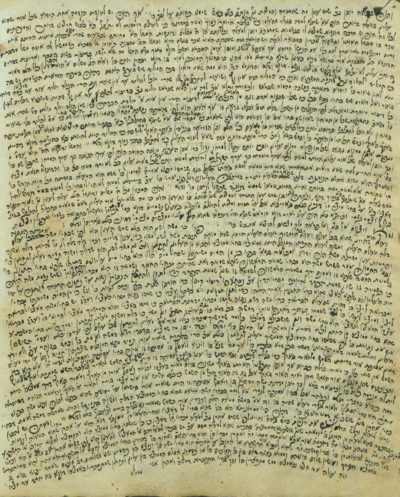
Read more about how we can better incorporate this manuscript into our life, notably the challenging day of Gimmel Tammuz.
Tags: mysticism, sun, light, moon, Gimmel Tammuz, kabbalah, light and darkness
Posted in Gimmel Tammuz, Biblical, Months & Holidays, Alter Rebbe, Torah Personalities, Mittler Rebbe, Modern, Torah, Rebbe, Tammuz, Moses | No Comments »
March 29th, 2015
Rabbi Shimeon Bar Yochai (Rashbi) – (80-160 CE)
“With this book (Zohar) of yours, the people will be redeemed from exile with mercy” (Zohar III, 124b)
“In the sixth century of the sixth millennium, the gates of the supernal wisdom will be opened, as will the springs of the earthly wisdom, preparing the world to be elevated in the seventh millennium”
(Zohar I, 117a)
Rabbi Shimeon is the author of the classic Kabbalistic work, the Holy Zohar (‘Book of Splendor’), first published in 1558. Transcribed by his student R’ Abba, the Zohar lays out the foundations and core principles of mysticism and contains, often in cryptic form, the deepest cosmic secrets. An extraordinary scholar and miracle worker, Rabbi Shimeon was renowned for his mastery of both the revealed and the hidden dimensions of Torah.
Biographical Highlights:
~ 80CE: Born in Israel shortly after the destruction of the Second Temple (67CE).
~As a young boy studies in the great academy of the scholars of Yavneh, founded by Rabbi Yochanan ben Zakkai.
~ His principal teacher is Rabbi Akiva whose academy is in B’nei Brak. Rabbi Akiva calls him “my son.”
~ Due to persecution against Jews led by the Roman Emperor Hadrian, R’ Shimeon is sentenced to death for defying the government. Forced to flee, he hides in a cave for thirteen years together with his son, R’ Elazar, where they study Torah day and night. A carob tree and a spring of fresh water miraculously spring up at the entrance to the desert cave and they are sustained until the Emperor dies and the decree is annulled.
~ Establishes an academy in the town of Tekoa. The greatest Torah scholars gather there including Rabbi Yehudah HaNassi who compiled the Mishnah
~ 160CE: Passes away on 18th of Iyar in Meron, a village near Sfat, Israel. On Lag B’Omer (the 33rd day of the Omer count), the day of his passing, thousands of Jews make a pilgrimage to his grave where they pray and celebrate. There is also a tradition to light bonfires. At R’ Shimeon’s request, Lag B’Omer is a day of great celebration and an opportune time for miracles.
Published Writings:
Zohar
Sifre (Midrash)
Mechilta of Rashbi (Midrash)
Resources in English:
The Zohar, originally written in Aramaic, has been translated into Hebrew and English (5 volumes. Soncino Press). A new English edition has recently been released, published by Fiftieth Gate Publications. It includes selections translated and annotated by Moshe Miller.
Tags: mysticism, Rabbi Shimon Bar Yochai, Zohar
Posted in Rabbi Shimon Bar Yochai, Talmudic, Great Mystics, Torah Personalities, Spiritual, Torah | No Comments »
March 29th, 2015
[When Moses said to the people of Israel,] “Remember what Amalek did to you on the road when you were going out of Egypt,” the people of Israel said to him: “Moses our master! One verse [in Torah] states: ‘Remember what Amalek did to you.’ Another verse states: ‘Remember the day of Shabbat, to sanctify it.’ How can both be fulfilled? This one is ‘Remember’ and that one is ‘Remember’!”
Said Moses to them: “A cup of spiced wine is not the same as a cup of vinegar; yet one is a cup and the other is a cup. There is a remembrance to keep and sanctify the day of Shabbat, and there is a remembrance to punish [Amalek]…”
Pirkei D’Rabbi Eliezer, ch. 44
In the course of our lives as human beings, we are called upon to remember hundreds, if not thousands, of things every day: good things and bad things, beneficial things and adversarial things. Why did the people of Israel have a problem with remembering both the sanctity of Shabbat and the evil of Amalek?
Once we understand Israel’s question, perhaps we’ll understand Moses’ enigmatic answer. What is the common denominator between the two “remembrances” expressed by the analogy that “one is a cup and the other is a cup”? And why is the difference and relationship between them expressed by comparing the memory of Shabbat to a “cup of spiced wine” and the memory of Amalek to “a cup of vinegar”?
The Memory of Shabbat
The significance of Shabbat, as we say in the Friday night Kiddush, is that it is “a remembrance of the work of creation.” By ordering our lives, week after week and year after year, after the original days of creation (six days of work followed by a day of hallowed rest), “we remember the work of creation at all times, perpetually conceding that the world has a Creator.” Thus “we permanently establish in our hearts the belief in the creation of the world by G-d in six days.”
The awareness of G-d’s creation of the world is “at all times,” “perpetual” and “permanent” because, as Rabbi Schneur Zalman of Liadi explains in his Tanya, the act of creation itself is unceasing and perpetual. The ten divine utterances (“Let there be light,” “Let the earth sprout forth vegetation,” etc.) that brought the world into being were not a one-time occurrence, but “stand firmly forever within [every creation] and are forever enclothed within [them] to give them life and existence… For if these letters were to depart even for an instant, G-d forbid, and return to their source, all… would revert to naught and absolute nothingness, and it would be as if they had never existed at all.” G-d is constantly “speaking” the world into being; were He to cease verbalizing His desire for a world for a single instant, the world would cease to be.
The ramifications of such a perspective on creation are many and far-reaching. No longer can the world’s relationship with its Creator be delegated to a single moment at the beginning of time; no longer can we conceive of the world as a programmed machine running under the benign eye of its inventor. G-d does not merely watch over the world, or interfere with the world, or even run the world; He creates it, down to its every particle of matter and its every configuration of forces, in every moment of time. The state of the universe at any given point in time is not merely the result of G-d allowing or compelling it to be so, but of His creating it that way, at that very instant, out of absolute nothingness.
With this perspective on reality, we can begin to understand the Torah’s amazing statement that “there is none else besides Him.” The world and everything it contains; the laws of nature, logic and reality; our own sense of identity and selfhood—these are not realities “besides Him.” They possess no existence of their own, for they are utterly dependent upon Him, at any and every given moment, for their very existence and their every quality.
A Dubious Existence
Amalek, on the other hand, represents the ultimate challenge to G-d’s sovereignty. The Midrash compares the circumstances of Amalek’s attack on Israel “to a tub of boiling water which no creature was able to enter. Along came one evil-doer and jumped into it. Although he was scalded, he cooled it for the others. So, too, when Israel came out of Egypt, and G‑d rent the sea before them and drowned the Egyptians within it, the fear of them fell upon all the nations. But when Amalek came and challenged them, although he received his due from them, he cooled the awe of them for the nations of the world.”
Amalek “recognizes his Master and willfully rebels against Him.”
But if the significance of Shabbat is truly internalized, can Amalek be taken seriously? If everything is the exclusive product of the divine volition, can there be any true existence to a phenomenon such as Amalek? One might perhaps conceive of beings that are ignorant of the basis and essence of their own existence; but a being who knows that G-d is his master and nevertheless rebels against Him?
To one who is truly aware of the nature of creation and its utter dependence upon G-d, Amalek is a nonentity, a phantom devoid of all existential validity. How can such a person carry within him a perpetual awareness of Amalek’s deed? How can he be driven to combat something that, to him, does not and cannot exist?
Life as a Meal
In his Tanya, Rabbi Schneur Zalman of Liadi speaks of the internal struggles experienced by most every man. There are righteous individuals (tzaddikim) who have so completely transformed their nature that they desire only good; in them, the natural selfishness and rebelliousness of the human heart has been supplanted by a selfless devotion to G-d, to the extent that anything that is contrary to the divine will is literally repulsive to them. But such individuals are extremely rare; most people struggle for their entire lifetime against the negative traits and desires that are part of the inborn character of man.
However, says Rabbi Schneur Zalman, the fact that, for most of us, the struggle continues for as long as we live does not mean that our lives are an exercise in futility. For “there are two kinds of gratification before G-d. One, from the complete annihilation of evil… by the righteous. The second, from the subjugation of evil while it is still at its strongest and most powerful… through the efforts of the ordinary man.
“This is the deeper significance of the verse, ‘Make for me delicacies, such as I love’ —delicacies, in the plural, to indicate two types of gratification… The analogy is to earthly food, in which there likewise exist two kinds of relishes: sweet and luscious foods, and tart and sour foods which have been spiced and fixed in such a way that they are made into delicacies which revive the soul.
“This,” concludes Rabbi Schneur Zalman, “is the meaning of the verse, ‘G-d has made everything for His own sake, even the evildoer for the day of evil,’ meaning that the evildoer should repent of his evil and turn his evil into ‘day’ and light.”
The feast of life includes both wine and vinegar, and the vinegar, too, contributes to the tastiness of the meal. Of course, one must know how to use the vinegar. If one drinks it as one drinks his wine, his meal would be ruined. But when the taste of the vinegar is mitigated and tamed by other ingredients, its very sourness yields a “delicacy to gratify the soul.”
When a person indulges his instinctive ego and rebelliousness as one should indulge one’s positive traits— directly and uninhibitedly—the result is an “evildoer,” and, when taken to the extreme, an Amalek. But when these are moderated and channeled to constructive ends, the result is a “delicacy of the second sort”—a tasty dish concocted out of “the subjugation of the evil while it is still at its strongest and most powerful.”
The Source of Evil
To carry the analogy further, vinegar is a derivative of wine. Vinegar is wine “gone bad,” its natural sweetness and spice deteriorated to virulent sourness.
By the same token, G-d, who is the essence of good, is the ultimate and exclusive source of every existence. Not only the “wine” of life comes from the divine vineyard, but also its “vinegar,” which is actually the offspring of the wine.
There is nothing original to evil. The depraved lusts that inhabit the cellar of the human heart are but the convoluted expressions of its purest loves. The violence that man is capable of is but the corruption of his holiest passions. The most self-destructive addictions are but the soul’s nurturing instincts gone awry.
The rebelliousness of Amalek, too, has a holy source. G-d desires that we challenge Him and has imbued us with the courage to do so. He wants us to contest His conduct when we encounter pain and suffering in His world, as Abraham and Moses protested His decrees against the sinners of Sodom and the worshippers of the Golden Calf, even as we acknowledge the justice and goodness of everything He does and our inability to fathom His ways. By giving us the Torah, He communicated to us His wisdom and will and then told us that “it is no longer in heaven” but entrusted to the finite mind of the Torah sage to interpret and apply. The Talmud relates how when a heavenly voice intervened in support of one opinion in a debate between sages on a point of Torah law, “Rabbi Joshua stood on his feet and said: ‘The Torah is not in heaven’”; G-d’s response was to smile and say “You have triumphed over Me, my children; you have triumphed over Me.”
These challenges are “rebellions” of a holy sort, stemming from a profound faith in G-d, a selfless devotion to His will, and a true appreciation of what He desires from us. But G-d wanted more than the wine of faithful contest. So He distilled from it the vinegar of Amalek—a negative, egotistical rebelliousness that is the antithesis of everything holy—and charged us to vanquish Amalek and exploit its sourness by “spicing it and fixing it” as a delicacy of the second sort, mitigating and redirecting its selfishness and independence as a constructive force in our service of G-d.
The Two Cups
So the remembrance of Shabbat and its message that everything comes from G-d and is utterly servant to Him, and the awareness of the challenge presented by an Amalek who “recognizes his Master and willfully rebels against Him,” are fully compatible with each other. The one is wine, the pristine nectar of divine truth. The other is vinegar, a derivative of that very wine—a corrupt and soured derivative, but a derivative all the same.
As Moses tells the children of Israel, “one is a cup and the other is a cup.” Despite their very different tastes, both are vessels of G-dliness served up to the table of life by the divine caterer; both are part of “All that G-d made, He made for His own sake.” The one is a cup of wine to be relished as is, a direct infusion of joy and flavor into our sanctification of life. The other is a cup of vinegar, belonging to the “tart and sour” elements of life. These we are to “spice and fix in such a way that they are made into delicacies which revive the soul.”
Based on an address by the Rebbe, Shabbat Parshat Zachor 5732 (February 26, 1972)
Adapted from the teachings of the Rebbe by Yanki Tauber
Tags: wine, good and evil, creation, ego, Amalek
Posted in Good & Evil, Biblical, Weekly Parsha, Beliefs & Concepts, Alter Rebbe, Modern, Torah Personalities, Devarim, Ki-Teitzei, Torah, Amalek | No Comments »