August 17th, 2016
Day One
The first ten days of the Jewish calendar are known as “the ten days of teshuvah.” These are days for soul-searching, repentance and return (teshuvah) to G-d. Citing the verse, “Seek G-d  when He may be found, call upon Him when He is near,”[1] the Talmud states: “these are the ten days between Rosh Hashanah and Yom Kippur.”[2]
Actually, this ten-day period includes Rosh Hashanah, which occurs on the first and second days of the month of Tishrei, as well as Yom Kippur, which falls on the tenth of Tishrei. This means that while Rosh Hashanah and Yom Kippur are themselves days of teshuvah, they each embody a principle that goes beyond the concept of “return”: the essence of Rosh Hashanah precedes teshuvah, while the essence of Yom Kippur supersedes teshuvah. Thus, the ten days of teshuvah include the days of Rosh Hashanah and Yom Kippur and, at the same time, are “the ten days between Rosh Hashanah and Yom Kippur.”
The Virtue in Sin
The people of Israel are G-d’s intimates—“the nation close to Him.”[3] What is the nature of this relationship? There are three fundamental aspects to our bond with G-d and the manner in which it is expressed in our lives.
On the most basic level, we achieve connection with G-d through our observance of the mitzvot, the divine commandments (indeed, the word mitzvah also means “connection”). The mitzvot embody the will of G-d; by fulfilling the mitzvot, we make the divine will the substance and aim of our lives. Our souls and bodies become vehicles of the supernal will.
But when a Jew violates the divine will, G-d forbid, he uncovers an even deeper dimension of his bond with G-d. The connection created by the mitzvah is exactly that—a connection created between two separate entities. Taken on its own, this connection does not point to any intrinsic bond between the two. In fact, it implies that the natural state of the observer of the mitzvah is one of separateness and distinction—a state which is overcome by the act of the mitzvah, which bridges the gulf between the mortal and the divine. But when a Jew transgresses a divine command, a more innate bond with G-d comes to light. His inner equilibrium is disturbed; his soul finds no peace and is driven to compensate for its ravaged identity by profane spiritual quests, material excesses, or both. His transgressions highlight the fact that there is nothing more unnatural than a Jew estranged from his G-d.
Teshuvah is a soul’s experience of the agony of disconnection and its channeling of this agony to drive its return to G-d. Thus, our sages have said that through teshuvah, “sins are transformed into merits,”[4] since the sin itself becomes the impetus for connection with G-d. Indeed, the baal teshuvah (penitent or “returnee”) attains a level of relationship with G-d on which “even the perfectly righteous cannot stand.”[5] His sins have provoked—and his teshuvah has actualized—a dimension of his soul’s connection to G-d which a perfectly righteous life never touches.
The Singular Day
But there exists an even deeper unity between a Jew and G-d. The mitzvah relates to the level on which the finite and mortal nature of man sets him apart from the divine—a nature that the mitzvah comes to overcome. The transgression makes the opposite point—that connection with G-d is the natural state of the Jew—by its very dissevering of this connection, with teshuvah being the consequential effort to restore the natural bond. What both the above relationships have in common is that they allow for the possibility of disconnection. Ultimately, however, the quintessential bond between the Jew and G-d is immutable. On the deepest level of our being, there can be no disconnection, “natural” or “unnatural.”
This underlying unity is the root from which the other two levels of connection stem. Every time a Jew does a mitzvah, he draws from this quintessential unity with G-d the power to overcome his “natural” apartness and connect to G-d through the fulfillment of His will. Every time he sins and experiences the agony of disconnection from G-d, this is but another expression of the fact that, in essence, he is one with his Creator. And it is this unity with G-d that empowers him to restore his relationship with G-d—on the level on which his transgressions do affect it—through the process of teshuvah.
These, however, are only expressions of a deeper truth, glimmers of unity rising to the surface of a life that is perceptively distinct and apart. But one day each year, the Jew’s quintessential oneness with G-d shines forth in all its glory. This day is Yom Kippur, which the Torah refers to as “the ‘one’ of the year.”[6] Yom Kippur is more than a day of teshuvah. Teshuvah, “return,” implies that, in the interim, one has been somewhere else; Yom Kippur is a day on which we are empowered to actualize that dimension of our selves whose unity with G-d has never been disturbed in the first place. Thus, our sages say that on Yom Kippur, “the essence of the days atones”[7]—on this day, we achieve atonement for our sins not only by transforming them into the dynamics of “return,” but (also) by uncovering that element of self never touched by sin.
Basis and End
During the “ten days of teshuvah,” G-d makes Himself more accessible to man—on all three levels of connection discussed above. It is a period in which special mitzvot are commanded to us (sounding the shofar on Rosh Hashanah, fasting on Yom Kippur, etc.), opening unique avenues of connection to G-d via the fulfillment of His will. It is a period of heightened opportunity for teshuvah—a time when our souls are more sensitive to the break from G-d caused by our transgressions and more driven to “return.” But the foundation and end of all connection with G-d is the quintessential bond which requires no deed to effect it and which no deed can affect. In the ten days of teshuvah, the foundation is laid on Rosh Hashanah and the end attains its ultimate realization on Yom Kippur.
The defining quality of Rosh Hashanah is that it is the day we crown G-d as king over us. What does it mean that we accept G-d as our “king”? The king/subject metaphor is one of many employed by the Torah to describe our relationship with G-d, which is also referred to in terms of the relationships between man and wife, shepherd and flock, master and disciple, among others. The king/subject relationship is unique in that it is not defined by equivocal criteria (love, nurture, intellectual appreciation, etc.), but rather involves the abnegation of the subject’s very self to the sovereign. On Rosh Hashanah we relate to G-d as our king, affirming our bond to Him as the very essence of our identity.
But our acceptance of G-d as king is also the basis for our other levels of connection with G-d—mitzvot and teshuvah. The concept of a “divine commandment” has meaning only after one has accepted G-d as the authority over one’s life;[8] a transgression is a transgression only because it violates a divine command, and teshuvah is spurred by transgression.
Thus, the ten days of teshuvah are defined as the “days between Rosh Hashanah and Yom Kippur.” They are preceded by “Rosh Hashanah” (the concept, not the days, which are themselves part of the ten), since our submission to the divine sovereignty is the basis for the “ten days of teshuvah.” And they are superseded by “Yom Kippur,” since Yom Kippur, in addition to itself being a day of teshuvah, is the ultimate realization of the soul’s quintessential oneness with G-d.
Based on the Rebbe’s talks, Tishrei 5723 (October, 1962)[9]
[1]. Isaiah 55:6.
[2]. Talmud, Rosh Hashanah 18a.
[3]. Deuteronomy 4:7; Psalms 148:14.
[5]. Ibid., Berachot 34b.
[6]. Achat bashanah—Leviticus 16:34.
[7]. Talmud, Shavuot 13a (see Likkutei Sichot, vol. IV, p. 1150 and note 3 there).
[8]. Cf. Mechilta on Exodus 20:3 (quoted in note 8 of last week’s essay).
Tags: perception, unity, Rosh Hashana, Yom Kippur, Jewish calendar, truth, forgiveness, sin, mitzvot, infinite, crowning the King, finite, relationships, baal teshuvah, connection with G-d, teshuvah, transformation, soul, sovereignty, suffering, Divine will, pain
Posted in Tishrei, Soul & Mystical, Months & Holidays, Yom Kippur, Religion, Beliefs & Concepts, Spiritual, Torah | 1 Comment »
August 16th, 2016
You at Your Best
On Yom Kippur your core soul — your very essence — is laid bare. — Rabbi Schneur Zalman of Liadi
On the holiest day of the year, the holiest part of your soul enters the holiest space in existence. — The Rebbe
How much of your potential has been actualized? As you may have guessed, this is a trick question. Because we must first know how much potential we have before determining the amount that has been tapped. The real question then is: Do you know how much potential you contain? How deep is your soul? Or in the words of Alice’s Wonderland: How far down does the rabbit hole go?
This is not a mere academic exercise; it is the key to solving many if not most of our challenges and struggles. How many of our problems are a result of us feeling hopeless and demoralized due to a wrong or underestimated assessment of our true potential? How many of our concerns would be resolved if we knew that we had the resources and strength to deal with them?
Think of it this way: When faced with a dilemma, how much of the challenge is the issue itself and how much is it our confidence in our ability to find a solution? Who is in a better position to handle a predicament: One with more potential (but less awareness of his latent power) or one with more confidence and conviction (but with less potent fire-power)? All this underscores the critical importance of getting to know how powerful you actually are as opposed to how powerful you think you are.
The Holiest Day of the Year
Now imagine that you have one day a year when you can meet yourself face to face. A day when core soul is bared and you can see who you really are — not just who you think you are.
Wouldn’t that be something?
Well, we are indeed given such a day. That day is called Yom Kippur. A day when we can travel into the innermot depths of our souls, and discover hitherto unknown recesses and dimensions that can empower you to achieve the seemingly impossible.
Yom Kippur opens up doors to the core of our inner souls, to our very essence, and how to channel those intimate powers into our daily lives and relationships.
The Kabbalists and Chassidic masters teach us that the soul as it were is comprised of five dimensions, one curled into the next:
1. The surface level of the soul is Nefesh – sensory life. The medical definition of biological life: a beating heart, a live brain, a breathing organism. In the language of he Kabbalistic sefirot — the functional lowest three sefirot, netzach, hod, yesod (neh”i).
2. Layer two is Ruach – emotional life. The higher middos, chesed, gevurah, tiferet (chaga”s).
3. Neshomo – intellectual life. Mochin, chochma, binah, daas (chabad).
These first three levels are immanentm, conscious and localized dimensions (kochos penimi’im). Then comes the transecendent, non-localized powers of keter (the crown abve the head):
4. Chaya – transcendent life. Arich (the lower domension of keter).
5. And finally Yechida – oneness – the pure essence of the soul. Atik (the higher dimension of keter). Yechida, oneness, is the pintele yid – the inner dot, the purest point of your most intimate self. The inner child of innocence. Your core.
Our most tangible experiences are on the outer layers of the soul; what our surface senses and basic consciousness can perceive. But our truest and most meaningful experiences are on the inner levels of the soul, the deepest of them all – on the yechida level.
However, the deepest recesses of the soul are shrouded within its outer layers, which in turn are encased in the hard crust of the physical body and material universe.
Thus, we have three daily prayers (shacharit, mincha and maariv) corresponding to the first three conscious soul-dimensions (nefesh, ruach, nehsomo, nara”n) which we can access in our daily life routines.
On Shabbat and holidays we add a fourth prayer (musaf), reflecting the transcendent chaya dimension accessible on these material-labor-free days.
And once a year, achas ba’shono (lit. once a year), all the layers are stripped and we experience the fifth dimension — hence the fifth neilah prayer at rthe conclusion of Yom Kippur — “achas,” the oneness and unity of the innermost dimension of the soul, the holy of holies – yechida sheb’nefesh.
Like the high priest who entered the holy of holies only on the holiest day of the year, on Yom Kippur, the holiest part of each soul enters the holiest space in existence, and can access the innermost core of its being.
This is the story of our lives. We are born pure and innocent children. Children who dream enchanted dreams, believe that everything is possible and expect the most. Vulnerable children – unpolluted and uncorrupted. Then life’s challenges being to seep into our experiences. We slowly (some faster than others) learn about deceit, duplicity, disappointments and unrealized expectations. As the years roll on the outer layers of our soul and the body’s shell harden, innocence lost and expectations lowered. As we experience harsher realities many of our dreams and idealism wanes, until many of us come to a point of silent resignation, distracting ourselves with outer stimulation, anything that will relieve our existential loneliness. Some develop sharper tools like cynicism or worse.
As much as we crave intimacy which resonates deep within us, the sad fact is that sensory stimulation consumes our daily lives, obfuscating our innocent essence, to the point that our inner life is most often left wanting if not plain starving.
So is there hope? Can we reach our inner yechida?
The answer is yes — on Yom Kippur. But it is not a simple process.
Entering the souls’ holy of holies is not a light matter. We don’t enter there at will and without great care. Being the purest place in your heart and the most intimate dimension of the soul, yechida (the holy of holies) is extremely sensitive. Every subtle move, even the slightest quiver, has a dramatic impact on that most tender of places in our psyches. Observe a newborn child’s’ ultra sensitivity to touch and surroundings. [This is why abuse that touches our intimacy, especially as young children, has such devastating consequences]. By means of analogy: A strand of hair on your sleeve is harmless, but in your eye it is highly irritating. Our outer organs are protected from bacteria, but exposing our internal organs requires a highly sterilized environment. The subtler and purer the place, the greater the care necessary to preserve its pristine character.
But one day a year we are given the power to enter our holy of holies. And we enter with great care: We fast and suspend, as much as possible, our immersion in the material world. We spend the day in prayer and clothed in white – all to set the proper ambiance to enter the holiest place in our souls.
That one day is Yom Kippur – the day of the fifth dimension, when we celebrate yechida: The one and only day in the year when each of us has the power to access our innocence. On this day you can become like the High Priest and enter your own holy of holies.
On Yom Kippur you return to your child, to your innocence, to your purest place. But this time, the innocence and exuberance of the child comes joined with the seasoning and experience of an adult. [One of the most awesome sights is to witness the fusion of adulthood and childhood. Observe an elder who still maintains the twinkle – the spunk, enthusiasm and possibilities – of youth].
And therein lays the power of Yom Kippur.
Yom Kippur tells us that your intimate innocence is never lost. Perhaps concealed. Maybe deeply concealed. Your child may be hiding. After your child has been hurt and disappointed, after he or she has seen how cruel people can be – your child goes into hiding. What emerges is an adult with a metal sheet of armor, an extensive and complex battery of defense mechanisms, protecting the vulnerable child from the pains of the world. Sometimes the child is so well concealed that the “mature adult” cannot even see his own child within.
But then we are given a day like Yom Kippur, when we are able to open the doors, and peer inside. And as we do – the child within is given the power, permission and strength to peer out back to us.
Can you see your child, your core, your yechida?
Even the most cynical among (and within) us has a pure side. Even the most jaded has a moment of truth. Yom Kippur teaches us the most vital message of hope: Never give up on your self – on your inner, pure self. No matter how challenging your life has become, no matter how worn down you are, despite your bitter disappointments, losses and wounds – your inner yechida always remains intact.
Even if you give up on everything, never give up on that pure child that lies embedded within you. That child – the holiest part of your heart and soul – may be your last vestige of your greatest potential, and the last refuge of hope.
If nothing else – one day a year hold on to what is most dear. Give your child, your soul, a chance to speak to you.
Cherish your child. Protect her. Nurture her tenderness. Above all, be kind to her. After all, she is you – the best of you.
* * *
On a very basic level this awareness can change your every interaction, the way you look at others and the way you look at yourself.
Indeed, this Yom Kippur/Yechida outlook has transformed my life and my work. On a personal note allow me to share one of the most important lessons I have taken from the single holiest day of the year: To get beyond your own perceptions, expunge all judgment, and see the majesty in every soul’s journey.
I meet many people. A number of them come to me for personal advice and counseling. I have learned that one thing above all allows one the confidence to offer help — and to always have a positive outlook. And that is: to always look beyond the surface and see the beautiful soul in each person. Even before you begin speaking and interacting, seek out the pure and innocent dimension in the individual sitting before you, and make it your mission to do everything in your power to help that person recognize and access that force in his life.
This is how I was trained by my Rebbe — our Rebbe — to travel beneath the outer shrouds and seek out the inner core of each individual we encounter.
Imagine what our lives would be like were we to look at each other in this fashion — seeking out the best within every soul we meet; recignizing the best within our own souls.
With such an attitude imagine what the world would be like…
To learn more, watch How Deep is Your Soul: Yom Kippur Workshop
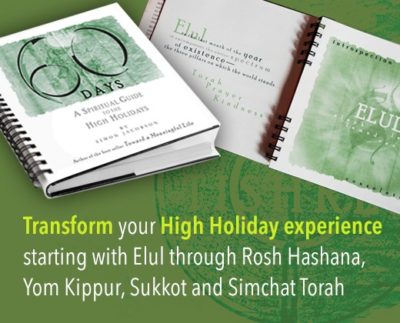
Transform your High Holiday experience starting with Elul through Rosh Hashana, Yom Kippur, Sukkot and Simchat Torah with best-selling 60 Days: A Spiritual Guide to the High Holidays.
Learn more about Yom Kippur.
Save
Save
Save
Save
Tags: Rebbe, soul, personal growth, essence
Posted in Tishrei, Soul & Mystical, Months & Holidays, Yom Kippur, Beliefs & Concepts, Torah Personalities, Modern, Spiritual, Torah, Prayer, Rebbe | 4 Comments »
August 15th, 2016
As we celebrate the Jewish holiday season, one of the important challenges facing us today is to make the holidays come alive by recognizing their personal relevance. Relevance is the key word and integration is the primary objective: To experience the holidays as a process of personal growth and improvement, and to integrate it into our lives, routines, talents and aspirations.
Mechanical holidays celebrated by rote will ultimately lead to waning commitment. Perpetuation of our rich heritage – in a crowded marketplace aggressively competing for our time and attention – cannot depend merely on guilt, fear or blind commitment; it must include a personal dimension that makes the tradition indispensable to our lives.
So, let us look at one aspect of Sukkot that resonates in our life experience.
One reason for the mitzvah of dwelling an entire week in a Sukkah — a portable shack — instead of the comforts of our home, is to remind us of the temporal nature of existence. The material world is not our home. We must never succumb to the illusion that our man-made structures and mortal edifices are our natural environments. Corporeal life is a means, a road that leads us to a deeper, spiritual reality.
The transitory Sukkah reminds us that we are just travelers in this impermanent material world; we are spiritual beings on a material journey, not material beings on a spiritual journey.
By no means is this reminder a simple matter. Fighting the illusion of material reality is no simple battle. The world has a powerful hold on us – so powerful that it sucks us in, like a black hole, into its own reality, making us think that this material existence is the only thing real. Until it comes to a point that we are no longer neutral and we become part of the illusion; in one vicious cycle we feed it and it feeds us: The blind leading the blind in a seemingly airtight Matrix.
Indeed, mystics have a name for our world: Alma d’shikra, a deceptive universe. [Olam – world in Hebrew – is rooted in the word “helem,” hidden]. Quite harsh, but quite accurate. Why is the world false? Because it lies all the time. What you see is not necessarily what you get. Some would even say, what you see is never what you get. PR and image cynics put it this way: It’s not important what happened, but what people perceive happened. Hence, spin, buzz, positioning, hooks and angles – all to create the proper package that will project an image that may or may not reflect the substance within.
My grandfather used to tell me that newspapers are filled with untruths. Even the date on the paper is false: Today’s paper was printed yesterday! I used to dismiss his extremism as the distrust of the older generation. But as I have grown older I see the wisdom of his words. True, the media may tell an objective story, but there is always the possibility, which unfortunately is often the reality, for subjectivity, distortions and worse.
We do not live in a seamless universe. The body hides the soul within. Someone can smile at you and then stab you in the back. Abusive people are honored. Thieves rewarded. Good people suffer. Scientists falsifying data. Indeed, all crime is driven by the fact that our world is one where you can get away with murder, and the universe won’t cry out.
Wherever you turn, whether in business or relationships, science or education, in virtually every sector of life, deception (actual or potential) is part of our reality. This doesn’t mean that there is no truth and one can’t choose to be honest; yet that doesn’t change the fact that deception is always a lingering possibility. To the point that as adults we see no problem with this: This is the way of the world, the way of all flesh.
Above all, existence itself hides its true nature and can deceive us into thinking that nothing exists beyond the surface level. Had we not searched who would know, for instance, about DNA, or about the complex subatomic infrastructures that make up existence, the elaborate world under the sea and in outer space, or the sophisticated systems that keep us and the universe alive and balanced. Even after all our research we have barely scratched the surface and cannot even fathom how much more there is to know.
A psychological study has yet to be made as to the myriad effects of this deceptive world, all its manifestations and consequences; the psychological toll that it takes on us humans. Such a study would be some project wouldn’t it?
However, such research would first require a level of clarity that could only come from a force outside of the deceptive world. As long as you are part of the universe, you are part of the problem. As the maxim goes: If you’re not part of the solution, you are part of the problem.
That’s the bad news.
The good news is that we have Sukkot: A reminder from another place that the material world is not where’s it’s at. Or more accurately: Material existence is not airtight; it carries within profound truths that must be uncovered by us humans. Our role is to reveal the beauty that lies concealed within our deceptive universe.
With all the falsities in life, there are also majestic truths; with all the hypocrisy there can be found astonishing nobility and virtue.
Half the cure of the disease is knowing that you have it. To free yourself from the shackles of this lying universe, you have to first recognize the falsity around you and not get caught up in it.
As humans created in the Divine Image we have been charged with the power – and the responsibility – to transcend the cloaked universe and reveal its inner spirit.
Sukkot is a time when we are asked to act on this awareness. Move out of your home, recognize the temporal nature of everything material, submit to the fact that security comes from above.
Sukkot focuses our attention to recognizing the real from the false. Seven days of the year we are asked to physically move out of our so called “homes” and comfort zones, and actually live in a temporary shack, teaching us that our physical homes are not necessarily our definitive source for security. Sukkot is meant to provoke us and imbue the entire year with a higher sense of priority.
Perhaps a useful daily exercise would be to identify deception in our lives. Make a daily list of both your true and false experiences.
One example recently came my way. I was reading a fascinating article on the cosmological search for the beginning of existence. Every possible theory was being explored. The consensus among scientists is that “the great, great, great (to the power of a gazillion) grandparent of you and me and everything else that we see (or can’t see) living around us” is traced back to what they call LUCA (Last Universal Common Ancestor). LUCA they believe is a hard-bitten little extremophile (primitive bacteria, a single-celled organism) of some kind or other. Somewhere along the line these single-celled primordial superbugs and their specialized functions “got co-opted, in a kind of primitive symbiosis, into the greater service of the more secure, membrane-bound, multitasking complex that would become the eukarytic cell and its subsequent multicellular manifestations, most prominent among these (at least in our minds) being ourselves.”
What came before LUCA? “Many scientists now argue that before LUCA and the emergence of our current DNA-protein world, there was what’s referred to as an RNA world, one made up only of rudimentary RNA-based entities that were later subsumed into RNA’s current role as our DNA’s messenger. And before the RNA-world, there has to have been what might be described as the real prize for astrobiologists, the so-called first living organism, or FLO.”
Now FLO “had to have been an even tougher entity than LUCA was merely to overcome the universe’s most prohibitive law, the second law of thermodynamics, which dictates that all matter tends toward entropy, the dissipation of energy. All life is in utter defiance of that law, a bound, energy-gathering stay against entropy.”
The other essential requirement for life to begin is that there had to have been a “first bit of information, some kind of biochemical message, or code, however crude, to begin to convey. Or, in this case, to misconvey, the whole story of life’s emergence and evolution on earth being, in essence, a multibillion-year-long game of telephone, in which the initial utterance, the one that preceded all others, was increasingly transmuted and reinvented the further along it was passed. It is the precise nature of that first utterance that astrobiologists are trying to decipher.”
Throughout this entire article – and all the exhaustive material that addresses these issues – no mention of G-d is ever made. I am not stating this from a religious perspective, but simply from an intellectual one. When you are exploring the origins of life and you see a miraculous order, and you have the Biblical texts that describe creation, why should that not be included in at least as one of the possible theories? Perhaps the “initial utterance” was G-d creating the universe with “ten utterances”?
The possibility that perhaps, perhaps G-d created the universe from nothing is not even presented and dismissed. The entire concept is not even a consideration. The article mentioned creationism, not as a theory but as the belief of some fundamentalists who still embrace archaic texts.
Now tell me, even if you are the biggest skeptic, how could you not consider that maybe the universe was created by G-d from nothing, and the human perhaps is not just evolved bacteria, but created in the Divine Image? Can anyone utterly rule that out?
The only way I can explain how certain “facts” have become “facts”, with a complete disregard for the possibility in the truth of the Biblical narrative, is that the universe is an “agnostic” one, so airtight that it can deceive anyone within this universe that there is nothing more than what we can empirically experience. If you so choose, G-d the can simply be totally disregarded by His creation…
I would greatly appreciate hearing from you any other examples of the deceptive world in which we live, especially in areas where we may not see the obvious deception. As the Baal Shem Tov says, there is a darkness that is so deep that it conceals the fact that it is dark: War is Peace. Deception is Truth. Evil is Good. It’s 20 years after 1984, but Orwell’s world is alive and kicking.
Every day life is replete with falsities. Identify them and you are well on your way to freeing yourself and discovering truth.
That’s the true way to celebrate Sukkot.
And that’s the ultimate beauty of our Sukkot challenge: Not to escape a lying world, but to reveal its deeper truth.
Tags: concealment, material, sukkah, spiritual and material
Posted in Tishrei, Soul & Mystical, Months & Holidays, Sukkot, Social, Spiritual, Torah, Science & Technology | 5 Comments »
August 14th, 2016
The Midrash recounts the following dialogue on the significance of sin:
Wisdom was asked: What is the fate of the transgressor? Wisdom replied: “Evil pursues iniquity” (Proverbs 13:21).
Prophecy was asked: What is the fate of the transgressor? Prophecy replied: “The soul that sins, it shall die” (Ezekiel 18:20).
The Torah was asked: What is the fate of the transgressor? Torah replied: He shall bring a guilt-offering, and it shall atone for him (Leviticus, ch. 5).
G-d was asked: What is the fate of the transgressor? G-d replied: He shall do teshuvah, and it shall atone for him. [1]
The Philosophical Perspective
The concept of “reward and punishment” is one of the fundamental principles of Jewish faith.[2] But punishment for wrongdoing, say our sages, is no more G-d’s “revenge” than falling to the ground is divine retribution for jumping out the window. Just as the Creator established certain laws of cause and effect that define the natural behavior of the physical universe, so, too, did He establish a spiritual-moral “nature,” by which doing good results in a good and fulfilling life and doing evil results in negative and strifeful experiences.[3]
This is the philosophical perspective on sin and punishment, expressed by King Solomon in the above-quoted verse from Proverbs. “Evil pursues iniquity”—the adverse effects of sin are the natural consequences of acts that run contrary to the Creator’s design for life.
The Prophet’s View
Prophecy, which is G-d’s endowment of man with the capacity to cleave to and commune with Him,[4] has a deeper insight into the significance of sin.
The essence of life is connection with G-d. “And you who cleave to G-d,” says Moses to the people of Israel, “are all alive today.”[5] “Love the L-rd your G-d,” he also enjoins them, “for He is your life.”[6]
So a transgression is more than a spiritually “unhealthy” deed—it is an act of spiritual suicide. In the words of the prophet Ezekiel, “The soul that sins, it shall die,” for to transgress the divine will is to sabotage the lifeline of vitality that connects the soul to its source. Our sages echo the prophet’s perspective on sin when they state:
“The wicked, even in their lifetimes, are considered dead…. The righteous, even in death, are considered alive.” [7]
The Guilt-Offering
The Torah has yet a more penetrating view on the nature of transgression. It, too, recognizes that the essence of a person’s life is his relationship with G-d. But the Torah also perceives the superficiality of evil—the fact that:
“A person does not sin unless a spirit of insanity enters into him.” [8]
The soul of man, which is “literally a part of G-d above,”[9]:
“Neither desires, nor is able, to separate itself from G-d.” [10]
It is only a person’s animal self—the material and selfish drives which overlay his G-dly soul—which might, at times, take control of his life and compel him to act in a manner that is completely at odds with his true self and will.[11]
Because the Torah perceives the superficiality of sin, it can guide the transgressor through a process by which he can undo the negative effects of his transgression—a process by which the transgressor recognizes the folly and self-destructiveness of his deed and reinstates his true, G-dly self as the sovereign of his life. This process culminates with the transgressor’s bringing of a korban (animal sacrifice) as an offering to G-d, signifying his subjugation of his own animal self to the spark of G-dliness within him.[12]
In this way, the “guilt-offering” achieves atonement for sin. Only the most external self was involved in the transgression in the first place; by renouncing the deed as “animal behavior” and subjugating the beast within to serve the soul’s G-dly aims, the transgressor restores the integrity of his relationship with G-d.
The Fourth Perspective
There is one thing, however, that the philosophical, prophetic and Torah perspectives on sin have in common: the transgression was, and remains, a negative occurrence.
“Wisdom” sees it as the harbinger of misfortune in a person’s life. “Prophecy” sees it as antithetical to life itself. Torah delves deeper yet, revealing the root cause of sin and providing the key to the transgressor’s rehabilitation; but even after the atonement prescribed by the Torah, the transgression itself remains a negative event. Torah itself defines certain deeds as contrary to the divine will; so nothing in Torah can change the fact that a transgression constitutes a betrayal of the relationship between G-d and man.
G-d, as the author of wisdom, the bestower of prophecy and the commander of Torah, is the source of all three perspectives. But He also harbors a fourth vision of sin, a vision that transcends the three venues of relationship with man which He established, a vision that is His alone: sin as the potential for teshuvah.
The Forbidden Realm
What is teshuvah? To understand the fourth, supra-Torah dimension of sin, we must first take a closer look at the significance of sin according to Torah.
The commandments of the Torah categorize the universe into two domains: the permissible and the forbidden. Beef is permissible, pork is forbidden; the trait of compassion is to be cultivated, and that of haughtiness is to be eliminated; and so on.
Chassidic teaching explains that this is more than a list of do’s and don’ts—it is also a catalog of realizable and unrealizable potentials.
Every created entity possesses a “spark” of divine energy that constitutes its essence and soul. When a person utilizes something—be it a physical object or force, a trait or feeling, or a cultural phenomenon—toward a G-dly end, he brings to light the divine spark at its core, manifesting and realizing the purpose for which it was created.
While no existence is devoid of such a spark—indeed, nothing can exist without the pinpoint of divinity that imbues it with being and purpose—not every spark can be actualized through man’s constructive use of the thing in which it is invested. There are certain “impregnable” elements—elements with which the Torah has forbidden our involvement, so that the sparks they contain are inaccessible to us.
For example: when a person eats a piece of kosher meat and then uses the energy gained from it to perform a mitzvah, he thereby “elevates” the spark of divinity that is the essence of the meat, freeing it of its mundane incarnation and raising it to a state of fulfilled spirituality. However, if he would do the same with a piece of non-kosher meat—meat that G-d has forbidden us to consume—no such elevation would take place. Even if he applied the energy to positive and G-dly ends, this would not constitute a realization of the divine purpose in the meat’s creation, since the consumption of the meat was an express violation of the divine will.
This is the deeper significance of the Hebrew terms assur and mutar employed by Halachah (Torah law) for the forbidden and the permissible. Assur, commonly translated as “forbidden,” literally means “bound”; this is the halachic term for those elements whose sparks the Torah has deemed bound and imprisoned in a shell of negativity and proscription. Mutar (“permitted”), which literally means “unbound,” is the halachic term for those sparks which the Torah has empowered us to extricate from their mundane embodiment and actively involve in our positive endeavors.
Obviously, the “bound” elements of creation also have a role in the realization of the divine purpose outlined by the Torah. But theirs is a “negative” role—they exist so that we should achieve a conquest of self by resisting them. There is no Torah-authorized way in which they can actively be involved in our development of creation—no way in which they may themselves become part of the “dwelling for G-d”[13] that we are charged to make of our world. Of these elements it is said:
“Their breaking is their rectification.”[14]
They exist to be rejected and defeated, and it is in their defeat and exclusion from our lives that their raison d’etre is realized.
The Man in the Desert
These are the rules that govern our existence and our service of G-d. One who lives by these rules, establishing them as the supreme authority over his behavior, attains the status of tzaddik (“perfectly righteous”). Yet our sages tell us that there is an even higher level of closeness to G-d—that:
“In the place where baalei teshuvah (“returnees”; penitents) stand, utter tzaddikim cannot stand.” [15]
The tzaddik is one who has made the divine will the very substance of his existence. Everything that becomes part of his life—the food he eats, the clothes he wears, the ideas and experiences he garners from his surroundings—are elevated, their “sparks” divested of their mundanity and raised to their divine function. And he confines himself to the permissible elements of creation, never digressing from the boundaries that Torah sets for our involvement with and development of G-d’s world.
The baal teshuvah, on the other hand, is one who has digressed; one who has ventured beyond the realm of the permissible and has absorbed the irredeemppable elements of creation into his life. His digression was a wholly negative thing;[16] but having occurred, it holds a unique potential: the potential for teshuvah, “return.”
Teshuvah is fueled by the utter dejection experienced by one who wakes to the realization that he has destroyed all that is beautiful and sacred in his life; by the pain of one who has cut himself off from his source of life and well-being; by the alienation felt by one who finds himself without cause or reason to live. Teshuvah is man’s amazing ability to translate these feelings of worthlessness, alienation and pain into the drive for rediscovery and renewal.
The baal teshuvah is a person lost in the desert whose thirst, amplified a thousandfold by the barrenness and aridity of his surroundings, drives him to seek water with an intensity that could never have been called forth by the most proficient welldigger; a person whose very abandonment of G-d drives him to seek Him with a passion the most saintly tzaddik cannot know. A soul who, having stretched the cord that binds it to its source to excruciating tautness, rebounds with a force that exceeds anything experienced by those who never leave the divine orbit.
In this way, the baal teshuvah accomplishes what the most perfect tzaddik cannot: he liberates those sparks of divinity imprisoned in the realm of the forbidden. In his soul, the very negativity of these elements, their very contrariness to the divine will, becomes a positive force, an intensifier of his bond with G-d and his drive to do good.[17]
This is teshuvah, “return,” in its ultimate sense: the reclaiming of the “lost” moments (or days, or years) and energies of a negative past; the restoration of sparks imprisoned in the lowliest realms of creation; the magnified force of a rebounding soul.
Good and Evil
But what of the “bindings” that imprison these sparks? If the tzaddik were to employ a forbidden thing toward a positive end, he would fail to elevate it; indeed, the deed would drag him down, distancing him from, rather than bringing him closer to, the G-d he is presuming to serve. From where derives the baal teshuvah’s power to redeem what the Torah has decreed “bound” and irredeemable?
In its commentary on the opening verses of Genesis, the Midrash states:
At the onset of the world’s creation, G-d beheld the deeds of the righteous and the deeds of the wicked…. But I still do not know which of them He desires…. Then, when it says, “And G-d saw the light, that it is good,”[18] I know that He desires the deeds of the righteous, and does not desire the deeds of the wicked. [19]
In other words, the only true definition of “good” or “evil” is that “good” is what G-d desires and “evil” is what is contrary to His will. The fact that we instinctively sense certain deeds to be good and others to be evil—the fact that certain deeds are good and certain deeds are evil—is the result of G-d having chosen to desire certain deeds from man and to not desire other deeds from man. We cannot, however, speak of good and evil “before” G-d expressly chose the “deeds of the righteous.” On this level, where there is nothing to distinguish right from wrong, we cannot presume to know what G-d will desire.
Therein lies the difference between the tzaddik and the baal teshuvah.
The tzaddik relates to G-d through his fulfillment of the divine will expressed in the Torah. Thus, his achievements are defined and regulated by the divine will. When he does what G-d has commanded to be done, he elevates those elements of creation touched by his deeds. But those elements with which the divine will forbids his involvement are closed to him.
The baal teshuvah, however, relates to G-d Himself, the formulator and professor of this will. Thus, he accesses a divine potential that, by Torah’s standards, is inaccessible. Because his relationship with G-d is on a level that precedes and supersedes the divine will—a level on which one “still does not know which of them He desires”—there are no “bound” elements, nothing to inhibit the actualization of the divine potential in any of G-d’s creations. So when the baal teshuvah sublimates his negative deeds and experiences to fuel his yearning and passion for good, he brings to light the sparks of G-dliness they hold.
To Be and To Be Not
What enables the baal teshuvah to connect to G-d in such a way? The tzaddik’s ability to relate to G-d through the fulfillment of His will was granted to each and every one of us when G-d gave us the Torah at Mount Sinai. But what empowers the baal teshuvah to reach the “place where utter tzaddikim cannot stand” and tap the “pre-will” essence of G-d?
The thrust of the baal teshuvah’s life is the very opposite of the tzaddik’s. The tzaddik is good, and the gist of everything he does is to amplify that goodness. The baal teshuvah has departed from the path of good, and the gist of everything he does is to deconstruct and transform what he was. In other words, the tzaddik is occupied with the development of self, and the baal teshuvah, with the negation of self.
Thus the tzaddik’s virtue is also what limits him. True, his development of self is a wholly positive and G-dly endeavor—he is developing the self that G-d wants him to develop, and by developing this self he becomes one with the will of G-d. But a sense of self is also the greatest handicap to relating to the essence of G-d, which tolerates no camouflaging or equivocation of the truth that “there is none else besides Him.”[20]
The baal teshuvah, on the other hand, is one whose every thought and endeavor is driven by the recognition that he must depart from what he is in order to come close to G-d. This perpetual abnegation of self allows him to relate to G-d as G-d is, on a level that transcends G-d’s specific projection of Himself formulated in His Torah.
This is G-d’s perspective on sin: sin as the facilitator of teshuvah. “Wisdom,” “prophecy” and “Torah” are all part of a reality polarized by good and evil; they can perceive only the damage inflicted by sin, or, at most (as in the case of Torah), the manner by which this damage might be undone. G-d’s reality, however, is wholly and exclusively good. “No evil resides with You,” sings the Psalmist.[21] In the words of Jeremiah:
“From the Supernal do not stem both evil and good.”[22]
From G-d’s perspective, there is only the positive essence of transgression—the positive purpose for which He created man’s susceptibility to evil and his capacity for sin in the first place. As viewed by its Creator, transgression is the potential for a deeper bond between Himself and man—a bond borne out of the transformation of evil into good and failure into achievement.
Based on the Rebbe’s writings and talks, including a letter dated 8 Tishrei, 5712 (October 8, 1951) and an address delivered on 9 Adar II, 5725 (March 13, 1965)[23]
[1]. Yalkut Shimoni on Psalms 25.
[2]. The 11th of Maimonides’ “Thirteen Principles.”
[3]. Shaloh, Bayit Acharon 12a. See also Shaar HaTeshuvah, part I, 6c and 50b; Likkutei Biurim on Tanya, vol. II, p. 129.
[4]. See ch. 7 of Maimonides’ “Eight Chapters” of introduction to his commentary on Ethics of the Fathers.
[7]. Talmud, Berachot 18a-b.
[8]. Ibid., Sotah 3a, based on Numbers 5:12.
[9]. Tanya, ch. 2, after Job 31:2.
[10]. Rabbi Schneur Zalman of Liadi.
[11]. See Crime and Punishment, WIR, vol. X, no. 47.
[12]. See Talmud, Sotah 14a; Likkutei Torah, Vayikra 2b-d.
[13]. Midrash Tanchuma, Nasso 16; Tanya, ch. 36.
[14]. Paraphrase of Sifra, Shemini 7; see Sefer HaMaamarim 5654, p. 76.
[15]. Talmud, Berachot 34b.
[16]. Indeed, the Talmud (Yoma 85b) warns that one who says, “I shall sin and then repent” is “not given the opportunity to repent.”
[19]. Midrash Rabbah, Bereishit 2:7.
Tags: connection with G-d, fulfillment, passion, essence, Divine will, spiritual, Tzaddik, good and evil, Yanki Tauber, teshuvah, sin, divine sparks, baal teshuvah, animal soul, sacrifices and offerings
Posted in Tishrei, Good & Evil, Months & Holidays, Yom Kippur, Soul & Mystical, Beliefs & Concepts, Nature, Spiritual, Torah | 3 Comments »
August 13th, 2016
In Your abounding compassion, You have given us this fast day of Yom Kippur… A day on which it is forbidden to eat, forbidden to drink…
From the Mussaf prayer for Yom Kippur
In the World to Come, there is neither eating nor drinking…
Talmud, Berachot 17a
Man consists of a body and a soul—a physical envelope of flesh, blood, sinew and bone, inhabited and vitalized by a spiritual force described by the Chassidic masters as “literally apart of G-d above.”[1]
Common wisdom has it that spirit is loftier than matter, and the soul holier (i.e., closer to the Divine) than the body. This conception seems to be borne out by the fact that Yom Kippur, the holiest day of the year—the day on which we achieve the height of intimacy with G-d —is ordained by the Torah as a fast day, a day on which we seemingly abandon the body and its needs to devote ourselves exclusively to the spiritual activities of repentance and prayer.
In truth, however, a fast day brings about a deeper, rather than more distant, relationship with the body. When a person eats, he is nourished by the food and drink he ingests. On a fast day, vitality comes from the body itself, from energy stored in its cells. In other words, on less holy days, it is an outside force (the energy in one’s food and drink) that keeps body and soul together; on Yom Kippur, the union of body and soul derives from the body itself.
Yom Kippur thus offers a taste of the culminant state of creation known as the “World to Come.” The Talmud tells us that “in the World to Come, there is neither eating nor drinking”—a statement that is sometimes understood to imply that in its ultimate and most perfect state, creation is wholly spiritual, devoid of bodies and all things physical.[2] Kabbalistic and Chassidic teaching, however, describe the World to Come as a world in which the physical dimension of existence is not abrogated, but is preserved and elevated.[3] The fact that there is “neither eating or drinking” in the World to Come is not due to an absence of bodies and physical life, but to the fact that in this future world, “the soul will be nourished by the body” itself, and the symbiosis of matter and spirit that is man will not require any outside sources of nutrition to sustain it.[4]
Two Vehicles
The physical and the spiritual are both creations of G-d. Both were brought into being by Him out of utter nothingness, and each bears the imprint of its Creator in the particular qualities that define it.
The spiritual, with its intangibility and its transcendence of time and space, reflects the infinity and sublimity of G-d. The spiritual is also naturally submissive, readily acknowledging its subservience to a higher truth.[5] It is these qualities that make the spiritual “holy” and a vehicle of relationship with G-d.
The physical, on the other hand, is tactual, egocentric and immanent—qualities that brand it “mundane” rather than holy, that mark it as an obfuscation, rather than a revelation, of the divine truth. For the unequivocal “I am” of the physical belies the truth that “there is none else besides Him”[6]—that G-d is the sole source and end of all existence.
Ultimately, however, everything comes from G-d; every feature of His every creation has its source in Him and serves to reveal His truth. So on a deeper level, the very qualities that make the physical “unholy” are the qualities that make it the most sacred and G-dly of G-d’s creations. For what is the “I am” of the physical if not an echo of the unequivocal being of G-d? What is the tactility of the physical if not an intimation of the absoluteness of His reality? What is the “selfishness” of the physical if not an offshoot, however remote, of the exclusivity of the Divine expressed in the axiom “There is none else besides Him”?
Today, the physical world shows us only its most superficial face, in which the divine characteristics stamped in it are corrupted as a concealment, rather than a revelation, of G-dliness. Today, when the physical object conveys to us “I am,” it bespeaks not the reality of G-d but an independent, self-sufficient existence that challenges, rather than reiterates, the divine truth. But in the World to Come, the product of the labor of a hundred generations to sanctify the material world toward a G-dly end, the true face of the physical will come to light.
In the World to Come, the physical will be no less a vehicle of divinity than the spiritual. In fact, in many respects, it will surpass the spiritual as a conveyor of G-dliness. For while the spiritual expresses various divine characteristics—G-d’s infinity, transcendence, etc.—the physical expresses the being of G-d.
Today, the body must look to the soul as its moral guide, as its source of awareness and appreciation of all things divine. But in the World to Come, “the soul will be nourished by the body.” The physical body will be a source of divine awareness and identification that is loftier than the soul’s own spiritual vision.
Yom Kippur is a taste of this future world of reverse biology. It is thus a day on which we are “sustained by hunger,”[7] deriving our sustenance from the body itself. On this holiest of days, the body becomes a source of life and nurture rather than its recipient.
Based on an address by the Rebbe, Erev Yom Kippur 5750 (1989)[8]
[2]. See Maimonides’ Mishneh Torah, Laws of Repentance 8:2-3; see, however, Rabbi Saadiah Gaon’s Emunot V’Dei’ot, sections 47 and 49; Raavad’s gloss on Mishneh Torah, ibid.; Nachmanides’ Shaar HaGemul (p. 309 in the Chavel edition).
[3]. Zohar, part I, 114a; Avodat HaKodesh, 2:41; Shaloh, introduction to Beit David; Likkutei Torah, Tzav 15c and Shabbat Shuvah 65d-66a; Derech Mitzvotecha, pp. 28-30.
[4]. V’kachah 5637, section 88; Yom Tov Shel Rosh Hashanah 5666, p. 528.
Indeed, there are Talmudic and Midrashic passages that imply that there will be eating and drinking in the World to Come (e.g., the “feasts” that G-d will prepare for the righteous). In light of this, the statement that there will be “neither eating nor drinking” might be understood in the sense that the body will not require food or drink for its sustenance, and the consumption of food and drink will be for other purposes (Igrot Kodesh, vol. II, p. 77).
[5]. Spiritual entities, such as souls and angels, perceive themselves as vehicles of a divine trait or objective, rather than as beings with an ego and identity of their own, as do physical creatures. (The selflessness of the spiritual is also discernible in consciousless things: a thought or a feeling is always about something else, while a physical object is ostensibly about itself).
[7]. Psalms 33:19; see Likkutei Torah, Shir HaShirim 14b.
Tags: characteristics, body and soul, matter and spirit, connection with G-d, prayer, independence, unity, concealment, Physicality, creation, Yom Kippur, space, truth, biology, challenge, fasting, infinite, World to Come, superiority, relationships, repentance, fusion, time, transcendence
Posted in Tishrei, Soul & Mystical, Months & Holidays, Yom Kippur, Beliefs & Concepts, Spiritual, Torah, Food & Eating | 1 Comment »
August 12th, 2016
Your birth is G-d saying that You Matter, that you have an indispensable contribution to make to the world. Since your contribution is essential, no problem can impede you from achieving the purpose for which you were created. G-d gives you the resources to overcome every pain and obstacle, to heal from every hurt or abuse.
The ability to forgive is one of the resources that G-d has given you. But it is up to you to use it. Forgiveness in Hebrew is “mechilah,” which connects to the root of the word “mochul,” meaning a circle. Life is meant to be a circle encompassing all our experiences and relationships in one harmonious, seamless, whole. When someone hurts us the circle is broken. Forgiveness is the way we mend the fracture.
Forgiveness means not merely forgiving the person who hurt us, but forgiving ourselves, forgiving G-d, forgiving even life itself with all its bizarre and often cruel twists and turns.
Forgiveness is letting go and building the confidence necessary to experience healthy and positive growth. It is declaring that you will no longer remain locked in the past as a victim of circumstances; that you will no longer perpetuate negative life-patterns through blame and anger; that you will instead access the strength and love that G-d gives you day by day, moment by moment in order to fulfill the unique and singular purpose for which you and only you were created.
Forgiveness requires work. But, most importantly, it requires a connection to G-d, the Giver of life. When you remember that your birth is G-d’s way of saying You Matter, that you are vital and important, irreplaceable and essential to the perfection of G-d’s world, then you can rise above the pain others have caused you and find the love and strength to forgive both them and yourself.
When you forgive, the circle is again complete and you find yourself encompassed by the whole of G-d’s creation and feel yourself to be an integral part. When you forgive, you have taken control of your life, rather than being a victim of it.
Transform your High Holiday experience starting with Elul through Rosh Hashana, Yom Kippur, Sukkot and Simchat Torah with best-selling 60 Days: A Spiritual Guide to the High Holidays.
Learn more about Yom Kippur.
Save
Save
Tags: Divine, human value, connection with G-d, cycles, life, forgiveness, connection, purpose of existence
Posted in Tishrei, Months & Holidays, Yom Kippur, Torah | 20 Comments »
August 11th, 2016
Deeper Roots as the Plot Thickens
Five things happened to our ancestors on the 9th of Av: 1) It was decreed that our parents would not enter the Land [of Israel], 2) The first Temple was destroyed, 3) The second Temple was destroyed, 4) Beitar was conquered, 5) The city [Jerusalem] was plowed – Mishne Taanit 26b
Three weeks ago this space addressed the five roots of trauma embedded in the five tragic events that took place on the 17th of Tammuz. This week we will examine five deeper roots hinted to in the five tragedies of the 9th of Av.
But first, a little introductory review (for more elaboration, please see the article Five Roots of Trauma). To truly solve any life problem, it is always best to not just suffice with symptoms, but to heal the root of the problem, and thereby eliminate the possibility of re-occurrence.
As a blueprint for life the Torah helps illuminate for us the root-origins of all our challenges and difficulties. This allows us to not limit ourselves to patching things up with “band-aids” and temporary “pain relievers,” but to root out and eradicate the entire “infection.”
The sad events of this time of year – the period called the “Three Weeks,” beginning on the 17th of Tammuz and concluding on the 9th of Av – in reality offer us tools to uncover the underlying factors and forces that shape the negative patterns in our lives. As we relive the sadness of this time of year, we are not merely indulging in centuries old grief; we are in effect retracing the steps in history that have led us to – and shaped – our present time. We are retracing the historical, psychological and spiritual roots of all our ills and problems today – personal, social and global.
Above all, by uncovering the origins of our troubles, we can then truly heal ourselves and the world, which in essence is the work following Tisha B’Av: To bring comfort and consolation to our broken hearts and to an ailing universe.
On the 17th of Tammuz five tragic events took place that shed light on five root causes for trauma (as discussed in the above mentioned article). Had we learned our lessons from these events and healed them in a timely fashion, we would not have needed a Tisha B’Av and its five tragedies. Had, for instance, the Jews not built the Golden Calf, Moses would then not have broken the Tablets, and all of history would have changed. There no doubt would not have been the sin of the scouts that led to the decree that the people not enter Israel, and there would not have been the destruction of the Temple (see Talmud, Eruvin 54a).
Since we did not entirely root out the five traumas of the 17th of Tammuz, we now have to dig deeper and uncover even more fundamental roots, which are ingrained in the events of Tisha B’Av. Hence, following the five events of the 17th of Tammuz, the Mishne continues and lists the five for the 9th of Av:
1. It was decreed that our parents would not enter the Land [of Israel].
On the 29th of Sivan Moses sent out scouts to survey Israel in preparation of its conquest. 40 days later, on Tisha B’Av, they return with their terrible report, declaring that we are too weak to conquer the land; Israel is a “land that consumes its inhabitants. The scouts incite and demoralize the entire nation, and that night of Tisha B’Av becomes a night of tears and grief (“The entire community rose in uproar and begin to cry; the people wept that night” – Numbers 14:1). G-d then said to them: “You wept (that night) for no reason; I will designate (that night as) a weeping for generations…” (Talmud, Taanit 29a). Tisha B’Av becomes the night and day when both Temples are destroyed, Beitar is vanquished and Jerusalem is plowed.
[Other tragedies as well occurred on this day: The final date for the Spanish expulsion of the Jews in 1492. The beginning of World War I. And other events].
Clearly, the decree of not entering the Land was a major event that led to all the other escalating tragedies of Tisha B’Av.
What is the essence of this event? The scouts basically argued that we cannot possibly integrate spirituality into a materialistic land. The sheer nature of materialism, they argued, is too corrupt, too selfish, to be receptive to anything sublime. Not only can we not conquer it, but this land is one “that consumes its inhabitants.”
Now, their argument was not only sensible but realistic. Is there someone that would deny the fact that the market place, and in general the materialistic universe, conquers us all? Who has not been humbled by the forces of life, who has not been compromised by the pressures of survival, who has not conformed to the demands of the marketplace – who is not “for sale”?
But, there’s one problem. It is G-d that sent us here and charged us with the mission not only not to succumb, but to transform the physical universe. As “practical” as the scouts were, they basically defied the very essence of G-d’s mission to us human beings on Earth: “I have sent your soul to the material on a mission,” G-d in effect is telling us. “That mission is for you to take your physical corner of the universe – your time, space and experiences – and transform it into a vehicle, a channel for the Divine.” Our mission, in brief, is: To integrate spirit and matter.
No man, no person has the right to question the possibility whether we can accomplish the mission; our role is to figure out how to do it, but not to challenge the very premise. Because once we do, we essentially are giving up on life. Yes, life undoubtedly is difficult; we live in a cruel universe. Much pain and misery. Many reasons to give up. But we were simultaneously given all the necessary tools to change the world, and not be overcome by it.
The scouts then proceeded to arouse all the fears and insecurities of the entire nation, and they ended up weeping all night.
G-d does not punish; G-d responds. The universe is one of cause and effect. “You – the people – don’t want to enter the Promised Land. You don’t believe all my promises to you and your ancestors. You are overcome by fear – that demonstrates that you are unable, and don’t deserve, to enter the Promised Land.”
“It is you own weakness and fears that projects and does not allow you to enter and conquer the land. As a result, this fear – this weeping for no reason – will cause you to weep for generations on this night of Tisha B’Av.”
Once someone decides (G-d forbid) that he or she cannot fulfill their life mission, that s/he cannot integrate matter and spirit, that person in effect creates an inevitable dichotomy within themselves and the world around them – a dichotomy of soul and body, matter and spirit, a split between the sacred and the secular.
And this brings on the decree that this person cannot enter the Promised Land, i.e. cannot realize his/her dreams and aspirations.
And this results in all the other effects of Tisha B’Av, the next four events, which all reflect a progressive break down of the structures around us that cannot survive once matter and spirit have been torn asunder. Can anything survive if its body and soul are not aligned? Can you have true inner happiness if you are afraid of your mission, if you do not have seamlessness between your spiritual and material sides?
This awareness allows us the ability to begin to heal and mend our internal and external dichotomies and schisms (yes, yet another “ism,” perhaps the root of them all).
2. The first Temple was destroyed
Now that the first root (being unable to enter the Promised Land and fulfill life’s mission to make a home for G-d in the physical universe) has exposed the breach between matter and spirit, this rift begins to expand.
Its first casualty is the destruction of the first Temple. As some of our holy books write that had Moses entered the Promised Land, the Temple he would have built would never have been destroyed (see Megaleh Amukot 185. Alsheich, Ohr HaChaim at the beginning of Parshat Vaetchanan).
The Temple was a bridge between heaven and earth, between the spiritual and the material. The first Temple, which corresponded to Abraham (chesed), was a bridge that primarily brought heaven down to earth. While the second Temple (corresponding to Isaac, gevurah) primarily lifted earth to heaven. The first Temple is compared to the first Tablets – the work of tzaddikim, who draw the light downward. The second Temple is like the second Tablets – the work of baalei teshuvah, who initiate and raise that which is below upward.
The first Temple was destroyed primarily because of sins between man and G-d; the second Temple primarily because of baseless hatred between people (Yoma 9b).
In the split between heaven and earth, the first step is when we get disconnected from G-d. When we stop recognizing that we have a Higher Reality to answer to, a power greater than ourselves, we inevitably become consumed with our own selfish needs. Once the people lost sight of their Divine mission, the inevitable result was the compromise and ultimate destruction of the first Temple – the bridge between the people on Earth with heaven.
3. The second Temple was destroyed
As the effects of the schism between matter and spirit continue to deteriorate, the next effect it has is on our relationship with each other.
If you are not at peace with yourself, if your body and soul are not in harmony, you will not be at peace with other people.
The destruction of the second Temple was because of baseless hatred between people. And this destruction is deeper and more powerful than that of the first Temple. G-d can forgive people’s crimes against G-d, hence the destruction of the first Temple lasted only 70 years. But once it reaches a point of divisiveness, that we begin to hate each other, that causes a destruction that we don’t see an end to (see Talmud Yoma ibid), one that has already lasted 1948 years…
Even if we have sinned against G-d, there is still hope if people are united with each other. “Welcoming guests is greater than greeting G-d.” G-d imbued unity between people with a special power that allows them to overcome adversary, and to reach a deeper connection with G-d as well. But once that unity is breached, then there remains little defense against our enemies.
And make no mistake about it. A person cannot have a relationship with G-d if they don’t love other people. Because if you love G-d then you love that which G-d loves – and G-d loves His creatures.
This is the lesson from the third tragedy of Tisha B’Av, the destruction of the second Temple: The destructive force of baseless hatred – which is a direct result from a split within ourselves (a form of “self-hate”); and its antidote is only baseless love.
4. Beitar was conquered
Beitar was the last fortress to hold out against the Romans during the Bar Kochba revolt in the year 135. Beitar was a great city that had tens of thousands of Jews, and it had a great leader that was considered Moshiach by all the leaders of the time. When Beitar fell to the Romans and all its residents were killed, it was considered as tragic as the destruction of the Temple itself (Rambam, Hilchot Taanit 5:3).
As long as Beitar stood, there was still a remnant of hope that the Temple’s destruction could be reversed. Once it fell, 67 years after the destruction of the second Temple, it sealed the fate of the people and the destruction became an irreversible finality.
In the psycho-spiritual realm the fall of Beitar represents the next decline in the progressive break down resulting from the matter/spirit dichotomy. Beitar symbolizes the “last stronghold” within us that still allows us hope.
Even after you may have lost your innocence and allowed your life to become compartmentalized, split between your body and your soul, between your physical life and your spiritual one, there always remains at least one “bastion,” which allows you to make your “final stand.” The fall of Beitar is the shattering of last hopes and our last reserve of strength.
[In Kabbalistic terminology: The first Temple is Binah, the second Temple is Malchut and Beitar is the level of division that takes place in the worlds of Biy”a (Beriyah, Yetzirah, Asiyah). The two Temples are both levels within the unity of Atzilut, with the first Temple being a revelation from above and the second one a revelation below. But Beitar is already a stage after the destruction of the unity between heaven and earth, a stage where divisiveness exists; yet it is a remaining bastion that still carries the energy of the earlier unity (see Ohr HaTorah Lech Lecho (vol. 1) 83b. Shir HaShirim p. 357)].
What this means for us is that we must never, ever allow our last “stronghold” to fall. Whatever it takes we must hold on to hope, and not allow our past disappointments, no matter how profound, to dictate our future.
5. The city [Jerusalem] was plowed
The final breakdown is when the Romans (three years after the fall of Beitar) plowed the city of Jerusalem, completely leveling everything in the city. This was the ultimate humiliation: Total annihilation of any memory, and remnant of the greatness that once stood there.
The most sacred place on Earth, the spot from where Adam was created, Noah brought his offering, Abraham brought Isaac, Jacob had his famous dream, the place that King David designated and King Solomon built the Temple – the Holy of Holies and the center of the universe – the area that till today remains the center for billions of people. What did the Romans do? They plowed it down to oblivion, as if to say that nothing ever existed here. As long as the ruins can be seen, there is still a memory of the past; but plowing is finality, a total and absolute obliteration.
This is the lowest point a person can reach, when you feel that your entire identity has been annihilated. When you feel so absolutely lost, that you no longer feel who you are. All sense of self has been lost.
In earlier stages, even if there is a dichotomy between body and soul, you still can identify yourself, albeit a split identity, but some form of recognition. Then there comes a stage when your “identity” and ‘self” gets plowed to the point of absolute erasure of who you thought you were.
That’s the bad news; the good news is that therein lays the cure as well. Sometimes one needs to hit “rock bottom” in order to recognize that his/her life is not working and requires change.
What is fascinating about this level of destruction is that the Mishne uses the word “plow,” evidently based on the verse in Micha “Zion will be plowed under like a field” (3:12).
We plow a field in order to make it grow. Plowing the earth breaks up the soil, removes weeds and rocks, rejuvenates the nutrients and prepares the ground for sowing and allowing the seeds to take hold.
So yes, on one hand the plowing of the city was a tragedy of enormous proportions, especially considering the intentions of the Romans. On the other hand, plowing is a vital step in the regeneration and the new growth that would emerge from this very ground.
Plowing implies removing from our lives the “weeds” and “rocks,” the negative elements of our personalities that impede our own growth. Plowing includes completely leveling a negative past so that you can begin anew, and build something better and greater. Plowing means swallowing false pride, eliminating obstacles – clearing the ground, so that a new structure can be built upon it.
This is why Rabbi Akiva laughed when the others sages cried upon seeing a fox running out of the place which was once the Holy of Holies (Talmud, end of Makot). The other sages only saw the plowed land, leaving a barren and desolate area, with nothing apparent. Rabbi Akiva with his special eyes saw the growth that would come out of the plowing. As he told his colleagues:
“For that very reason, I am laughing. Isaiah the Prophet said (8:2), ‘I will bring two reliable witnesses regarding my People, Uriah the Priest and Zechariah ben Yevarech’yahu.’ Now what do Uriah and Zecharya have to do with each other? Uriah prophesied in the time of the First Temple, and Zechariah in the time of the Second Temple! But the verse in Isaiah makes Zechariah’s prophecy dependent on Uriah’s. In Uriah’s case, it is written, ‘Therefore, because of you, Zion will be plowed under like a field.’ In Zechariah we find (8:4-5), ‘Yet again, elderly men and elderly women will sit in the streets of Jerusalem…(and the streets of the city will be full of children, playing in her streets).’ Until I saw the fulfillment of Uriah’s prophecy, I had some doubt as to whether Zechariah’s prophecy would come true. Now that I have seen Uriah’s prophecy fulfilled in full detail, I know that Zechariah’s prophecy will also be fulfilled.’”
Hearing that, Rabbi Akiva’s colleagues said to him, ‘Akiva, you have comforted us. Akiva, you have comforted us.’
Five roots of trauma – five sources of growth, with the final one plowing the ground to allow for the emergence of a new world.
And we have Rabbi Akiva – and some others in history – to remind and comfort us that something lies beneath the plowed earth.
What we want now is not just comfort, but to see it with our own eyes.
Tags: healing, psycho-spiritual journey, Jerusalem, Second Tablets, Holy Temple, trauma, golden calf, Tisha B'Av, growth
Posted in Good & Evil, Weekly Parsha, Tisha B'Av, Soul & Mystical, Months & Holidays, Ve'etchanan, Religion, Beliefs & Concepts, Personal Life, Devarim, Spiritual, Torah, Pain & Suffering, Av | 1 Comment »
August 11th, 2016
The following is a freely translated excerpt from a public letter written by the Rebbe in the closing days of the Jewish year 5716 (September 1956)[1]
As we approach the close of the old year and the onset of the new, every serious-thinking individual makes an audit of the past year, upon which to base his resolutions for the year to come.
In order that the audit should be accurate and the right resolutions be made, one must be careful not to overstate one’s virtues and achievements. It is no less important, however, not to exaggerate one’s deficiencies and failings. For feelings of despondency–not to mention despair, G-d forbid–are one of greatest hindrances in a person’s endeavor to better himself.
Unfortunately, it is possible that, even if one does not exaggerate one’s faults, an honest accounting will show the negative side of one’s spiritual and moral balance scale as quite formidable—perhaps, even, outweighing one’s positive side. But also in such a case, a person has no cause for despair.
For (in addition to the deep regret over the past and the firm resolve for future change which the audit should elicit) one must always remember that everything good and holy is eternal and indestructible–as these stem from the soul, the spark of G-dliness within man–while negative deeds are only temporary, and can be rectified and eradicated through true and proper teshuvah (repentance).
The appreciation of the above truth should call forth in every individual, regardless of what his stocktaking of the previous year shows, a feeling of encouragement and hope for the future—knowing that only his good deeds are eternal, and have illuminated his own life, that of his family, and of all Israel (for “all Jews are accountable for each other,”[2] bound to each other as a single entity).
From this it is also obvious that even if one sees signs of a general decline–that humanity, as a whole, is not getting any wiser or more virtuous–in truth, the good in the world grows greater and more powerful every year, every day, and every moment. For each moment’s good deeds are added to the accumulating good in the world.
So even if the not-good seems to be prevailing, this can only be temporary. Ultimately, the good shall gain the upper hand and the negative shall be utterly nullified. For the Creator and Ruler of the universe has decreed that, ultimately, all will do teshuvah, and that He will accept their teshuvah, so that “none shall be forsaken.”[3]
—–
[1] Published in Likkutei Sichot, vol. IX, pp. 417-419.
[3] II Samuel 14:14. See Deuteronomy 4:29-31 and 30:1; Mishneh Torah, Laws of Repentance, 7:5.
Transform your High Holiday experience starting with Elul through Rosh Hashana, Yom Kippur, Sukkot and Simchat Torah with bestt-selling 60 Days: A Spiritual Guide to the High Holidays.
Learn more about Yom Kippur.
Tags: accountability, forgiveness, Rebbe's letters, repentance, good deeds, Rebbe, truth, emotions, sin, good and evil, divine sparks, teshuvah, infinite
Posted in Tishrei, Good & Evil, Months & Holidays, Yom Kippur, Torah, Emotions & Psychology | No Comments »
August 9th, 2016
Seven days before Yom Kippur, the Kohen Gadol (“High Priest”) is removed from his home to his chamber in the Holy Temple.
Mishneh Torah, Laws of the Yom Kippur Service, 1:3
[Upon concluding the Yom Kippur service, the Kohen Gadol] washed his hands and feet, removed the golden vestments, dressed himself in his own clothes, and set off for his home. The entire people would accompany him to his home. He would celebrate a festival over the fact that he had emerged in peace from the holy.
Ibid., 4:2
Holiness is transcendence, holiness is withdrawal. Holiness is disengagement from the physical, disavowal of the mundane, departure from the familiar and the everyday.
But holiness is not an end in itself. Holiness has an aim: to return to the very arena it has escaped and remake it in its image. To sanctify the material, to rarefy the mundane, to sublimate the everyday.
On the holiest day of the year, the holiest human being entered the holiest place on earth. To prepare for this confluence of the most sacred points of time, space and spirit, the Kohen Gadol underwent a process of sanctification. He withdrew from his home, from his marriage and family life, from his everyday self. For seven days he secluded himself in the Holy Temple, divorced from the cares and wants of physical life. Only then could he enter the innermost and most sacred chamber in the Holy Temple, the “Holy of Holies,” to draw forth the spiritual essence of life for the year, world and humanity.
When he concluded the Yom Kippur service, he went home. This is not just a fact but a halachah, a law, an integral part of the observance of Yom Kippur. The entire people accompanied him home, for this was the last of a long schedule of offerings and services he performed that day on behalf of the people. For the Kohen Gadol’s return to home life was the ultimate test and validation of the sacredness of the day. It emphasized the fact that not only had he entered into the holy, but he had also “emerged in peace”—that he had succeeded in making his post-Yom Kippur life a tranquil continuum of the day’s holiness.
Based on an address by the Rebbe, Av 25, 5746 (August 30, 1986)[1]
—–
[1]. Likkutei Sichot, vol. XXXII, pp. 106-111.
Discover Inside Time, a groundbreaking three-volume book set about the meaning and messages of the Hebrew calendar.
Learn more about Yom Kippur.
Tags: sacrifices and offerings, spiritual and material, transcendence, sanctification, peace, Holy of Holies, Holy Temple, halacha, Yom Kippur, High Priest, home, elevating the world
Posted in Tishrei, Soul & Mystical, Months & Holidays, Yom Kippur, Religion, Home & Family, Spiritual, Torah | 1 Comment »
August 8th, 2016
Once, on the evening before Yom Kippur, one of the chassidim of Rabbi Elimelech of Lishensk asked his Rebbe to allow him to see how he, Rabbi Elimelech, observes the custom of kaparot.[1]
“How I do kaparot?” repeated Rabbi Elimelech. “How do you do kaparot?”
“I am an ordinary Jew—I do what everyone else does. I hold the rooster in one hand, the prayerbook in the other, and recite the text, ‘This is my exchange, this is in my stead, this is my kaparah…’”
“That’s exactly what I do,” said Rabbi Elimelech. “I take the rooster in one hand, the prayerbook in the other, and recite the text. Actually, there might be a certain difference between your kaparot and mine: you probably make sure to use a white rooster, while to me it makes no difference: white, black, brown—a rooster’s a rooster…”
But the chassid persisted that his Rebbe’s kaparot was certainly no ordinary event. He had been coming to Lishensk to pray with the Rebbe every Yom Kippur for more than twenty years now, and had always wanted to observe his Rebbe at this most solemn moment.
“You want to see an extraordinary kaparot?” said Rabbi Elimelech. “Go observe how Moshe the tavernkeeper does kaparot. Now, there you’ll see something far more inspiring than my own, ordinary kaparot.”
The chassid located Moshe’s tavern at a crossroads several miles outside of Lishensk and asked to stay the night.
“I’m sorry,” said the tavernkeeper. “As you see, this is a small establishment, and we don’t have any rooms to let. There’s an inn a small distance further down the road.”
“Please,” begged the chassid, “I’ve been traveling all day, and I want to rest awhile. I don’t need a room—I’ll just curl up in a corner for a few hours and be on my way.”
“O.K.,” said Moshe. “We’ll be closing up shortly, and then you can get some sleep.”
After much shouting, cajoling and threatening, Moshe succeeded in herding his clientele of drunken peasants out the door. The chairs and tables were stacked in a corner, and the room, which also served as the tavernkeeper’s living quarters, readied for the night. Midnight had long passed, and the hour of kaparot was approaching. The chassid, wrapped in his blanket under a table, feigned sleep, but kept watch in the darkened room, determined not to miss anything.
Before dawn, Moshe rose from his bed, washed his hands and recited the morning blessings. “Time for kaparot!” he called quietly to his wife, taking care not to wake his guest. “Yentel, please bring me the notebook—it’s on the shelf above the cupboard.”
Moshe sat himself on a small stool, lit a candle, and began reading from the notebook, unaware that his “sleeping” guest was wide awake and straining to hear every word. The notebook was a diary of all the misdeeds and transgressions the tavernkeeper had committed in the course of the year—the date, time and circumstance of each scrupulously noted. His “sins” were quite benign—a word of gossip one day, oversleeping the time for prayer on another, neglecting to give his daily coin to charity on a third—but by the time Moshe had read through the first few pages, his face was bathed in tears. For more than an hour Moshe read and wept, until the last page had been turned.
“Yentel,” he now called to his wife, “bring me the second notebook.”
This, too, was a diary—of all the troubles and misfortunes that had befallen him in the course of the year. On this day Moshe was beaten by a gang of peasants, on that day his child fell ill; once, in the dead of winter, the family had frozen for several nights for lack of firewood; another time their cow had died, and there was no milk until enough pennies had been saved to buy another.
When he had finished reading the second notebook, the tavernkeeper lifted his eyes heavenward and said:
“So you see, dear Father in Heaven, I have sinned against You. Last year I repented and promised to fulfill Your commandments, but I repeatedly succumbed to my evil inclination. But last year I also prayed and begged You for a year of health and prosperity, and I trusted in You that it would indeed be this way.
“Dear Father, today is the eve of Yom Kippur, when everyone forgives and is forgiven. Let us put the past behind us. I’ll accept my troubles as atonement for my sins, and You, in Your great mercy, shall do the same.”
Moshe took the two notebooks in his hands, raised them aloft, circled them three times above his head, and said: “This is my exchange, this is in my stead, this is my kaparah.” He then threw them into the fireplace, where the smoldering coals soon turned the tear-stained pages to ashes.
—–
[1]. Kaparot is one of the most solemn observances of the Days of Awe. In the early morning hours of the day before Yom Kippur, we take a rooster (for a man) or a hen (for a woman) and, circling it above our heads, say three times: “This is my exchange, this is in my stead, this is my kaparah (atonement); this rooster shall go to its death, and I shall go on to good, long life and peace.” The bird is then slaughtered and its meat (or its value) given to the poor. As the chicken is being slaughtered, we meditate on the thought that it is we who, in truth, are deserving of such a fate because of our sins, and that it is only because G-d, in His great kindness, accepts this “exchange” that we are granted a year of life and peace.
Discover Inside Time, a groundbreaking three-volume book set about the meaning and messages of the Hebrew calendar.
Learn more about Yom Kippur.
Tags: peace, Yom Kippur, sin, kaparot, prayer, life, Chassidic stories, forgiveness
Posted in Tishrei, Months & Holidays, Yom Kippur, Torah | 2 Comments »