Mighty Lessons from the Simple Sukkah

October 1st, 2009

Some are predicting the imminent fall of the United States as a superpower – the latest of many empires that have risen and fallen throughout history.

The theory goes that after a nation rises in prosperity and strength, leading to affluence and luxury, its power begins to erode due to indulgence, arrogance, corruption and decadence.

Essentially the thinking is, that only at the outset of a nations rise – in its infancy and modest beginnings – does it maintain the humility and hard effort necessary to keep it honest and driven toward healthy growth and success. But once the nation reaches its greatest heights in wealth and power, once it dominates the world around it, the nation will succumb to natural and inevitable human conceit and greed, which lead to the nation’s decline and, in many instances, demise.

Every empire in history, without exception, has suffered this ultimate fate. No matter how great its power, every powerful nation has fallen under its own weight.

Can this cycle be prevented? Will the mighty United States of America ultimately go the way of all flesh?

The seemingly simple holiday we are about to celebrate holds the answer to this monumental question – the destiny of the American Empire.

On Sukkot, Jews all over the world will move out of their comfortable homes and – as they have done for over 3300 years – spend the next seven days eating and dwelling in makeshift, fragile huts, with relatively no protection from the elements.

Why will they do this? Because, as the Bible instructs: “dwell in booths for seven days…in order that your generations shall know that I housed the Children of Israel in booths when I took them out of the Land of Egypt” (Leviticus 39: 42-43).

Material success and prosperity can create the powerful illusion of invincibility. Despite the utter irrationality of feeling secure with anything temporary – and materialism, whether it is money, food or energy, is fundamentally ephemeral – the power of success is such that it can actually brainwash us into thinking that we are safe in its embrace. The fact is, the more dependent we become on the material, the less secure we really are. Like an addiction that can never be sated, the more we rely on forces that inherently cannot provide true security and safety, the harder it is to break the habit.

Comes Sukkot and wrenches us free from the stranglehold of material comforts. Dwelling in a Sukkah reminds us the source of true security in this hostile world. Not our man-made structures, not our concrete, steel, walled and gated homes, not any of our mortal creations can protect us from… mortality and from mortal enemies. True security comes not from our material structures but from our spiritual ones – from the Divine “clouds” that surround and protect us. The Sukkah reminds us that true and lasting power is derived not from human drives and innovations, but from the all-enveloping Divine presence.

For seven days – the full cycle of time – we make our material homes a temporary dwelling, and our Sukkot our permanent dwelling. During this time, we dwell in little huts where we eat all our meals and conduct all the activities of the day which we regularly would do at home.

Why would anyone want to leave their comfort zones, the warmth and expanse of a sprawling living room, feasting on a mahogany table in an elegant dining room, and instead move into a bare, unadorned, possibly cramped and cold Sukkah?

The answer is because the plain Sukkah remind us of our total dependency on a Higher presence – that our seemingly sturdy man-made shelters are nothing in the absence of His care.

The Sukkah teaches us that we are just travelers in this material world. Our physical dwelling places, as beautiful as they may be, are not our true homes. Your true home – where the ‘real’ you is comfortable – is not here in your material body and home; it is in your soul, which is much more grand and beautiful than anything that money could buy.

Sukkot is the ultimate antidote to the illusion of security due to material success. Just when we feel completely comfortable and secure in our mansions and properties, we are told to leave our homes and sit in modest thatched huts.

This small move can be the difference between life and death; between being smothered by the arrogance of material success and the freedom that comes from knowing that you are not a slave to man-made institutions and to other men.

The brilliance of the Sukkah lies in its sheer simplicity. This small little hut, so fragile and flimsy, teaches us the mystery of true invincibility: Only when we are ready to surrender our own self-made delusions of power and comfort, only when we are ready to replace our dependence on material comforts and trust in financial wealth for dependence on the ethereal and trust in the sublime, can we ensure that our affluence and prosperity will not self-destruct.

Therein lies perhaps the most important lesson for the future of the United States. The Founding Fathers in their brilliance recognized that for a nation to endure it has to be built not on transient and temporal underpinnings, but on an unwavering foundation. An empire built on self-made success and material affluence ultimately will self-destruct under the weight of its self-worship. The core foundation of the nation they established is therefore built not on business prowess and financial prosperity, but on the “self-evident” truths, “that all men are created equal, that they are endowed by their Creator with certain unalienable Rights, that among these are Life, Liberty and the pursuit of Happiness.”

The simple Sukkah reminds us all that our security comes from the “unalienable rights” endowed upon us all by our Creator.

As the world economy is being shaken to its core – and questions are being raised about the future of capitalism in general, and the role of its primary steward, the United States – Sukkot gives us all pause to decide which way we will choose:

The path of the self-glorifying empires before us, whose self-absorption brought on their own demise?

Or the path of humility, one that reclaims the Divine values that this country was built upon, and reinfuses those values into our homes, businesses, economies and man-made structures?


Tags: , , ,
Posted in Tishrei, Soul & Mystical, Months & Holidays, Sukkot, Personal Life, Social, Spiritual, Government, Torah, Emotions & Psychology | 17 Comments »

Yom Kippur: The Real You

September 24th, 2009

The Untouchable Secret of Yom Kippur60 days ad email_Chaya

If you look at it you can’t see it. If you touch it you can’t feel it. If you listen to it you can’t hear it. What is it? The realest thing you will ever experience.

What do you consider more real: The tangible or the intangible; the visible or the invisible? Many people would quickly choose the tangible as something closer to reality than the intangible. After all, it can be empirically proven to exist.

Empirically. Hmm. Let’s explore this further.

Did you ever experience something sacred in your life?

You may naturally ask what I mean by “sacred.” In Hebrew sanctity is “kedusha,” which means apartness – apart and special from our usual experiences.

Based on that definition, what was the most sacred experience in your life?

Was it a moment of love? A moment of beholding the awe of nature’s beauty or being moved by a stirring song, the birth of a child or being in the presence of a tzaddik?

All the above are sacred experiences. However this leads us to the next tier: What is the root of all things sacred? What is the “personality” of sanctity?

This leads us into the actual nature of reality.

One of the most powerful lessons in the study of reality comes when Moses asks G-d – in these 40 days preceding Yom Kippur when Moses beseeches G-d for forgiveness – “show me Your Face,” and G-d replies: “No one can see My Face and live.”

G-d taught Moses – and all of us – a vital lesson: Reality exists not because you see it, but because it just is. If you see it, touch it, hear it – it may be your subjective reality, but it’s not necessarily absolute reality. Indeed, if it’s real because you sense it, then it will as real as your senses are. However, if it’s real because it is just real, then it’s reality is boundless.

So back to the initial question: If you look at it you can’t see it. If you touch it you can’t feel it. If you listen to it you can’t hear it. What is it?

Answer: Reality. The truth: The real unadulterated truth of everything – untouchable, invisible and silent.

Not invisible or silent as in non-existent; rather, being so real that it simply cannot be contained in our limited senses.

You see, the more real something is the less expression and definition it has. This may sound counterintuitive, but let’s look at our own selves. Why is it that we have many words to discuss superficial matters like the weather, sports and gossip, but so few words to express our most intimate dimensions? If someone asks you to speak about your inner self you are left silent or with few words. It would seem that we would have many more words to express that which is closest to us than that which is far more external!

Words are containers. And like all containers they have limited parameters. They may be able to express superficial and surface level experiences. But when it comes to a deeper experience, words can be inadequate. We then use the language of metaphor – poetry, art, song, a kiss – whose broader containers can express more intimate experiences. When you travel deeper into the soul, even metaphor is wanting. A cry, a gasp, a laugh, a mere sound may be the only way to express that inner dimension.

The deepest part of your intimate self – the essence of your soul – can only be expressed through utter silence.

“And behold, G-d passed by and a great and strong wind rent the mountains and broke pieces of rocks, but G-d was not in the wind; and after the wind an earthquake, but G-d was not in the earthquake; and after the earthquake a fire, but G-d was not in the fire; and after the fire, a still small voice.” (Kings I 19:11-16)

So paradoxically, the deeper you travel into the recesses of your soul, the less expression you have. The more intimate the experience, the fewer the words. The closer you get to reality, the more intangible the experience.

This is not due to our limited ability to define the intimate. Rather is it due to the very nature of reality: Its depth is simply indefinable. [Compare to Heisenberg’s uncertainty principle].

Yom Kippur is the day of the Essence. When we enter the holy of holies and experience ultimate intimacy. What is intimacy? Existence as it is at its bare essence, stripped of all layers.

More than that: At its bare essence we experience things from the inside out instead of from the outside in. Where there no longer is a distinction between subject and object, between verb and noun; where you no longer experience something, because you are the experience.

Therein lies the mystery of sanctity. Sanctity implies that it coexists with its contrast: the profane. Or else there would be nothing unique about sanctity. Hence, the declaration “to separate between the sacred and the profane.”

Regular life is lived on one dimension. Sanctity reveals the reality within.

Yom Kippur – the holiest day of the year – carries the secret of sanctity, of intimacy, of the deepest truth. The power of silence.

Fasting and refraining from material activities on this day (to the extent possible) strip away layers as much as is possible without annihilating our independence or us. This opens the door to our true selves – the supra-sensual self that transcends our senses and our defined experiences.

Yom Kippur is actually a study in reality; a challenge to each of us to define what is real and true in our lives: the food you eat, the shoes you wear, the delights you enjoy, or your inner soul.

Yom Kippur is the birth of the untouchable – the root of all that is truly intimate. Yom Kippur is the birth of intimacy – a day when you can learn the secret of being comfortable with your vulnerability, to get stronger as you get more exposed.

By not partaking in your material activities and opening up your undefined self, you then have the power to infuse the transcendent into in the daily grind of your defined life throughout the entire year.

Time. Space. Man. On Yom Kippur, the holiest day of the year, you enter the holiest space in existence and experience the holiest part of yourself.

Take advantage of this awesome opportunity by suspending your senses this Yom Kippur, and allow your true self to emerge. The Real You. Your senses – sight, sound, taste, touch and smell – are only tools to interact with the world around you. You don’t need eyes to see yourself or ears to hear yourself. When you suspend your senses, what emerges is the real you. Then you can bring that reality back into your senses – so that you can actually touch the untouchable.

One day. Just one day we are asked to enter our “holy of holies.” This gives us the power to be real the rest of the year.

So this Yom Kippur open yourself up – and may you experience the REAL YOU.

Be real.

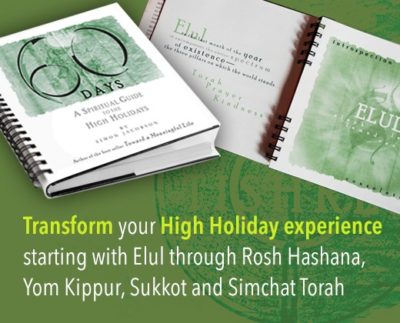
Transform your High Holiday experience starting with Elul through Rosh Hashana, Yom Kippur, Sukkot and Simchat Torah with best-selling 60 Days: A Spiritual Guide to the High Holidays.

Learn more about Yom Kippur.

Save

Save

Tags: , , ,
Posted in Tishrei, Soul & Mystical, Months & Holidays, Yom Kippur, Personal Life, Spiritual, Torah, Emotions & Psychology | 12 Comments »

Netzvim-Vayelech: Blackberry Unplugged

September 10th, 2009

Unloading Baggage

As the Hebrew year unwinds and we prepare for the New Year, this is a good opportunity to unload some baggage and make room for new possibilities.

So here is a selection of my informal accounting for the past week (I will spare you the more personal iniquities). I apologize for the randomness of this list; such is the nature of the “unloading” process.

BLACKBERRY FEVER

Ok, I finally succumbed to the pressure of friends and colleagues to use a Blackberry (if you don’t know what that is, feel blessed). “You gotta try it once, and you’ll be addicted;” “You can do EVERYTHING with it;” “It has saved my life so many times;” “Always in touch” – are just some of the milder accolades I have heard from otherwise intelligent acquaintances.

“I can wait to read my e-mails when I get to my computer,” I protested. “My addiction to the desktop is bad enough; I don’t need it intruding every other minute of my day,” was my feeble-sounding response to all my aggressive and progressive compatriots. I also resented the rudeness of sitting with someone at a meeting, who more than half the time is glancing at and clicking his mobile. When I would complain, I was told, “hey, don’t you know how to multitask? Can’t you chew gum while driving?” I wasn’t sure whether I was being compared to “driving” or to “chewing gum.”

My resistance was broken when I traveled this week to Frankfurt, and a colleague delivered to my door a fully loaded, ready-to-go, Blackberry (the impressive sounding “World Edition” no less, in case you were wondering), so that “we can stay in touch with you on your trip.”

Ok, I said to myself, I’ll check out the new gadget on the plane. First things first – we have to line up our priorities: I look for the games on the Blackberry menu. Sure enough – Brick Breaker appears on the screen. I play a game or two, get bored, and move on.

Was the Blackberry helpful on my trip? Yes, it was. I was able to quickly read and reply to various e-mails.

Conclusion: The handheld device is definitely a convenience, but hardly a necessity (at least for me). It can serve various functions – like getting even with the people using their devices while having a conversation with me. Or looking busy when you have no one to talk to in a room full of people. Or alleviating plain old boredom.

But overall, I’ll keep it around for times when I may need to respond quickly and am out of range of a desk or laptop.

Above all, I learned why these devices carry such an allure for our generation. That may be the best thing that came out of this experiment. I know have material to talk about Rosh Hashana and Yom Kippur – how we are all distracted by our new-found gadgets; how technology is making us feel connected, all the time, with all people, and all information – everything, everywhere, every moment – when at the same time, we feel ever more disconnected on a personal and psychological level; lessons we can learn from mobile devices, for example: by pressing a button in one corner of our lives we set in motion a series of events that reverberate around the world; how you can hold infinity in the palm of your handheld device.

Yes indeed, my friends, many sermons can be developed based on Blackberries, iPhones, Palms and our other mobile units.

UJC HEROES

Next on the agenda in the fast breaking news of the week is – roll the drums: the one and only Jewish Community Heroes campaign of the UJC/Jewish Federations of North America.

Some time last week, I receive a note from a friend who nominated me as a “hero,” and he suggests that I encourage all my friends to vote for me so that our organization, the Meaningful Life Center (MLC) can gain its deserved recognition and win the $25,000 award. “Why not?” I say to myself, and promptly have my staff post an invitation to all our Facebook friends, suggesting that they vote. Simple enough, or so I thought.

According to the UJC’s website, anyone can be nominated as a hero. They are “encouraging communities to nominate Heroes from all walks of life — the neighbor running non-profit bake sales, a teacher building a school for the underserved, the entrepreneur donating services to neighborhood development, the community organizer bringing people together.” This campaign is meant to celebrate “the selflessness and courage of those who put others before themselves. This is our community’s opportunity to shine a national spotlight on the unsung, whether their work impacts five people or 5,000. Over the next 3 months, anyone across North America can go online, submit nominees and vote for the real candidates they believe best embody the spirit of the award. We’ll honor five finalists this November at our General Assembly in Washington, D.C.  Of the five finalists, one will be named the Jewish Community Hero of the Year” and win a $25,000 award to be used for the organization represented.

As I am checking my e-mail on my… new Blackberry, I find that many of our friends are voting for me (very flattering), with a few detractors suggesting that this is not exactly the respectful thing to do (and they may be right, which is not very flattering). Some even suggested that this campaign will only create antipathy amongst the contestants (aka nominees). But then, relaxing in my hotel room in Frankfurt, I decide to check how the whole process is working, and I must admit that what I discovered was quite humorous.

For some reason, the UJC decided to allow anyone to vote as many times as they like, with the limit of once every 12 hours (maybe they figured that it would be too prohibitive to have each voter register once, which would also limit the publicity that this campaign would generate). So inevitably, of course, in the name of Jewish ingenuity, people vying for the prize are mobilizing their friends and anyone they can reach to vote as many times as possible to mount their numbers.

Some people have actually been nudging the MLC on a daily basis that we should join the fray. I kid you not when I tell you that someone has even offered to work full time to get us the highest numbers, in return for a 15% cut of the prize money!

Incredulous, no? But then he tells us that some nominees have turned this into a full time occupation… Oh, man, I feel like I’m in the twilight zone, and a nominee to boot.

Personally, I was not exactly going to instruct our staff to turn this campaign into a full time job of contacting all our thousands of friends on a daily basis and humiliating ourselves into asking them, to vote again and again. We have High Holiday services to prepare for, among our many other programs and events. Our plate is filled as it is – without entering into this mad campaign to win at all costs.

Then, someone whispers to us, that “insiders” have discovered that some Blackberries – back to the darn Blackberry – can vote again and again without waiting 12 hours. Just in case you want to know: No, we are not employing that method.

So, now this whole campaign is turning into somewhat of a farce, which may end blowing up in UJC’s face, as they discover that with every winner, they will make one person happy, but thousands unhappy. People will be clamoring for investigations how numbers were racked up. The UJC will get its publicity. The show will go on.

It’s not worse than Newsweek’s top 50 media Rabbis.

Frankly, I find it all quite cute and wish everyone only good luck.

This too is a study in human nature, and can teach us much about competition, money, and just plain obsessions. There you go – this is great fodder for those of you looking for more material (humorous or pathetic, you choose) for your High Holiday sermons.

Oh, well.

FRANKFURT 2009

And what about my trip to Frankfurt? Well, as you can see from the above, I don’t have much to report from this old German city. I anticipated awakening many strong Jewish feelings as I tread for the first time on German soil. Frankfurt in particular was home to one of the oldest Jewish communities, dating back to the 10th century. Many old Jewish books were published in Frankfurt am Main (their cover pages carry the acronym for this city: Frankfurt deh Main, the four Hebrew letters, feh, feh, dalet, mem). Early pogroms and the first Crusade ravaged the Jewish community in this city. Some of our great scholars and leaders lived in Frankfurt, including the Pnei Yehoshua (Reb Yaakov Yehoshua Falk), the Baal ha’Hafloah (Reb Yaakov Halevi Horowitz), Reb Nosson Adler, the Chasam Sofer (Reb Moshe Sofer).

But, nothing very eventful – apart from the event that I attended there – happened during my short visit to Frankfurt, Yes, I can elaborate on the elegance of my hotel room, with its German precision. But I’d rather not force it just now.

Suffice it to say, in King Solomon’s immortal words: “What has been will be again, and what has been done will be done again; and there is nothing new under the sun.”

But, “above the sun” – there is much news.

Whether it’s your Blackberry or your flash drive, whether you are in Frankfurt or New York, Sydney or Moscow, Jerusalem or Athens, whether you are a nominated hero or not – as we enter the New Year we all have a choice:

To be part of the problem or part of the solution. To go the way of all flesh, or chart a new course. To be timid or to be bold. To be what others want or to be yourself.

Do not deceive yourself into thinking that by playing safe and not choosing you have not made a choice; no one remains neutral. Not making a choice is also a choice.

What will your choice be? What will mine be?

A good question to ponder upon as the year wanes to a close.


Tags: ,
Posted in Tishrei, Rosh Hashanah, Weekly Parsha, Months & Holidays, Personal Life, Devarim, Social, Torah, Netzavim, Science & Technology, Vayelech, Personal Stories | No Comments »

Ki Teitzei: Religion and Dysfunctionality

August 27th, 2009

Preparing for the New Year

So what do you think of this latest study?

In last month’s issue of the online journal Evolutionary Psychology, a paper by Gregory Paul finds that countries with the lowest rates of social dysfunction—based on 25 measures, including rates of homicide, abortion, teen pregnancy, unemployment, and poverty—have become the most secular. Those with the most dysfunction, such as Portugal and the U.S., are the most religious, as measured by self-professed belief, church attendance, habits of prayer, and the like.

What this suggests is one of two options: Either religion leads to social dysfunction, or that dysfunctional people turn to religion for relief.

Quite a choice, if you asked me. Who would want to be part of religion that either causes you to be dysfunctional or is a desperate attempt to heal you from a dysfunctional life?!

It reminds me of the question someone once posed to me several years ago on a live cable broadcast of my class: “What is your response,” the questioner asked me, “ to the recent debate of the APA (American Psychiatric Association) whether religion is just a delusion or an actual form of psychosis?”

No joke. This was the question asked of me. I responded with a question in return to these brilliant psychiatrists: “Do you beat your wife with a bat or a chain?”

“What do you mean?” replied the proverbial doctor, “what nerve do you have to assume that I beat my wife, and you are only wondering what weapon I use?!”

“And what right do you have to arrogantly assume that religion is an aberration – with your only remaining question being, whether it is a disease or only a delusion?!”

“You have the right to not choose religion. But who gave you the authority to question other people’s beliefs?”

But then what do we do with Paul’s study, pompously titled The Chronic Dependence of Popular Religiosity upon Dysfunctional Psychosociological Conditions? If his results are indeed accurate, why is it that functional lives reject religion?

As an aside, a fellow recently shared with me his life experience. This man’s father was a scientific researcher, exploring the reasons that cause children to rebel against their parents. “My father,” he tells me, “would spend days and nights away from my mother and our family immersed into all his earth shattering research about functional and dysfunctional families, all the while that he in effect abandoned us all and left us fatherless, not to mention betraying my mother and the rest of us countless times… the few times that my self-absorbed father did interact with us was when he would arrogantly reprimand us for ‘disturbing’ his ‘vital work for the good of mankind,’ while destroying his own family… That’s my father and the ‘legacy’ he left us…”

I was reminded of this episode reading the NY Times Science section this week, in which John Tierney describes how guilt shapes virtue in children. He documents different experiments that psychological researchers performed with toddlers, some of them with the intentional goal of traumatizing a child and studying the child’s reactions. I always wonder about such articles. As brilliant as some of them are, I wonder what type of children of his own (if any) did this writer and researcher actually produce? Are they happy, loving adults? Did his brilliance spill over into his family life, or did it remain trapped in test tubes and research papers? All these experts writing about children’s dysfunctionality – are their children any better than the rest of societies? Not to take away from their great contributions, but you have to wonder whether testing children in laboratories and writing elaborate papers on their findings actually creates a better society, or is it like an advanced technology that celebrates and honors the achievements of the “discoverer” more than the welfare of society.

By no means in this an attempt to disparage science and scientists. It’s simply meant to place things in context – and isn’t that also part of the scientific method, to be thorough and look at the whole picture, rather than at part of it? If we are to help raise the quality of family life and children’s development, it’s vital to not only do studies, but also to actually be better parents and educators, living up to our responsibility as being (whether we like it or not) the only role models our children have in their earliest formative years.

You want to understand children? Instead of dragging them to a lab for tests and creating superficial settings, where we can never really know whether the children are reacting as they would in their “natural habitat,” observe and study your own children at play. Let them be themselves – love them unconditionally, nurture and embrace them – and then witness the results… (Of course, the converse is also true, but I would rather not mention the consequences of a dysfunctional childhood).

What connection does this have with Gregory Paul’s religion/dysfunctional study? Besides for providing me the opportunity to vent a bit, my point is that for all the value of “studies” and “research,” there are simply some things that can only be experienced through… well, experience. Can we truly understand a human being or a social group as an outside observer? Or even worse, observing the “specimen” outside of its natural environment?

Obviously, there is great value in objective observation. But its insight must be coupled with the “subjective” reality inherent in every human experience.

With that in mind, let us return to the issue of Paul’s finding that functional societies have a lower rate of religiosity.

Paul’s conclusion, like any theory, is open to debate, despite its data and evidence. For instance, are there other factors that come into play in a more socially functional country, which may affect its religious commitment? How much of a role does, for instance, prosperity play in the decreasing numbers of believers? How much is affected by our open society, our accelerating communications and technologies, our distractions and inundation with information overload, our material obsessions? How do we actually define dysfunctionality: Is it defined by poverty and homicide (as Paul suggests), or is it defined by divorce and misery, which is quite common even (or especially) among the affluent? And how do we actually define religion – religion has many variations and levels of intensity and commitment, from moderate to extreme? Are we talking about people who consider themselves morally religious, or those that are fundamentalists? Are all religious people more dysfunctional than their secular counterparts?

With that being said, however, this column is not interested in tearing down Paul’s observations. Even if his findings are correct, allow me to submit a third possibility – besides the two obvious and untenable ones mentioned above (that religion causes dysfunctionality or that the dysfunctional turn toward religion).

There is a well-known story about the famous 18th century Chassidic master, Rabbi Levi Yitzchak of Berditchev, who was well known for his empathy and non-judgmental character. One Rosh Hashanah he invited his neighbor to come with him to synagogue. The neighbor declined, saying, “Rebbe, I’m an atheist, I don’t believe in G-d. It would be hypocritical of me to step foot in a synagogue.” Rabbi Levi Yitzchak smiled and replied, “The G-d that you don’t believe in, I don’t believe in either.”

The same can be said about religion. Would the Berditchever believe in today’s religion? For that matter, would Abraham, Moses, Rabbi Akiva, the Arizal – and thousands of the Jewish giants in history – accept or even recognize the religious communities of our time?

I submit that a religion that leads to dysfunctional behavior is not true religion. Indeed, its is the antithesis of the guidelines dictated by faith, which demand that a person achieve the highest possible state of personal refinement and functionality.

The same can be said about religion that serves as a cure (or even crutch) for the dysfunctional.

No doubt that dysfunctionality exists amongst the many people today who identify themselves as “religious,” or follow certain religious rituals, dress and other codes. Some may even argue that the insulated and sheltered conditions of a religious enclave are conducive to abuse and dysfunction. Religious communities had been accused of minimizing or covering-up problems, due to pride and shame. Other reasons may include the fear of destroying the reputation of a family and the resulting difficulties in finding shidduchim (matches) for children. Regardless of the reasons, dysfunctionality does exist in so-called religious communities.

Equally true is the fact that that some people who grew up in dysfunctional homes have turned to religion for healing, nurturing and building a more functional life. Indeed, there is nothing wrong with that. It is no worse than someone turning to any healthy environment for their personal and psychological well-being.

But this is not the essence of real faith. Religion is not defined by those that distort its value or those that use it for their personal salvation.

The truths of a real religious system is that it serves as a blueprint for life for all people and all life situations – both for the functional as well as the dysfunctional. And who amongst us is completely functional? It is a comprehensive approach to life that addresses all scenarios.

It could very well be, that Gregory Paul’s findings demonstrates the growing resistance to false gods and religions, which is amplified in healthier and more functional societies.

Paul’s study, whether you like or dislike its results, presents us all with a powerful question: Is the religion we practice indeed a destructive force? Is it only for the dysfunctional an unhealthy? Is it a mechanical program that people are born into, and just go through the motions?

Or is religion a force that drives human progress? A system that shapes highly refined, sensitive, productive, evolved human beings?

I pose the following challenge to myself and the entire religious community: Can we demonstrate to ourselves, our families and the world at large that our faith can indeed create more functionality in our homes, in our schools and in our communities?

Yes, it may be easier to just dismiss the studies of secular scholars. There may even be basis to dismiss them due their own bias, sometimes to the point, dare I say, of “fanatical atheism,” with an agenda to undermine and mock everything religious. But even if that were true, dismissing their critique does not solve our problem. Just because secular people can be dysfunctional and self-righteous – or even more dysfunctional than people of faith – doesn’t justify dysfunctionality amongst the religious.

On the contrary: The person of faith has a higher standard to answer to. It is far more disturbing when a man or woman of faith is abusive, due to the expectation that faith places upon the human being – to live up to the Divine Image in which each us was created; to be the healthiest, most loving, majestic being that we possibly can be.

This, I propose, is the mandate of our times: To reclaim the true nature of faith and commitment. To revisit the belief system of Abraham, a pioneer who stood up to the paganistic tide of his times, and embraced a reality beyond anything humans can create. A man who committed himself and his family – in a way that would perpetuate for generations to come, till this very day – to live a life of virtue instead of vice, giving instead of taking, serving instead of being served; a life of selfless devotion to a cause higher than himself; a life of remolding his personality to be aligned with the Divine, instead of the other way around, fitting beliefs into personal models driven by self-interest.

Our calling is to marginalize (and possibly eliminate) so-called “religious” behavior that feeds the stereotype of close-minded, unevolved and condescending religiosity. And more importantly, reintroduce the alternative – faith and religion that allows man to actualize and shine in his full glory.

When Nietzsche famously declared, “God is dead,” he essentially issued a challenge to us all. Nietzsche may not have been aware of the Berditchever’s words, but in essence Nietzsche was saying that the “God” of his belief system was dead, not because he died, but because was never alive in the first place. That false God deserved to die. In other words: The God you don’t believe in, I too don’t believe in.

So now the question remains:

Will the true and real G-d please stand up? Will a health and growth driven religion finally arise?

And above all: Will we do what it takes to ensure that the true G-d and the true religion reclaim its appropriate and functional place in our lives?

What better time to address this than in these special days of Elul, days filled with compassionate and love, when we prepare for a New Year, with emphasis on NEW?


Tags: , ,
Posted in Weekly Parsha, Month of Elul, Months & Holidays, Religion, Personal Life, Devarim, Social, Home & Family, Ki-Teitzei, Spiritual, Torah, Emotions & Psychology, Medicine, Elul | 21 Comments »

Vaetchanan: Religion and Ethics

July 30th, 2009

The Night of the Tzimtzum

Dear Reb Simon,

For some reason I was very disturbed by the pictures in the NY Times and all over the media of Rabbis clad in Hassidic garb being marched in chains, under arrest for their alleged money laundering and other crimes. The screaming headlines, “Rabbis and mayors charged in NJ corruption sweep” (online the Times later changed the title to  “clergy”) have touched a deep chord in me and, I suspect, in many others.

My children, for whom I am trying to provide a good Jewish ethical education, have asked me about it. And frankly, I don’t have much to say. I haven’t shared with them the sad fact that in my teenage years, I was turned off and repulsed, as were many others of my generation, by hypocrisy coming from our own Hebrew School teachers and Rabbis.

I sincerely believe that it would serve us all well to hear your thoughts on this. You have demonstrated in the past your willingness and courage to address controversial topics that others shy away from. And I, for one, know much that has empowered me in my journey.

Thank you and may you have an inspiring Tisha B’Av,

Judy R.

Initially I was inclined not to react to this story, one of many similar scandals, which we have unfortunately become accustomed to, and would rather they simply go away. “What’s the point of addressing it?” I thought. We live in a corrupt world and crimes happen all the time. In this case they happen to involve religious Jews. So what does this tell us? That people of faith are not immune to temptation; they are no different than the rest of the world’s population. No one needs me to communicate this “revelation.” It is common knowledge.

I also have no interest in dwelling on negatives, or on condemning – or defending –individuals who may or may not have perpetrated the crimes they are accused of. The fact that this particular story includes a religious “mosser” (an FBI informer), who set up people of his own community, makes it more intriguing and embarrassing. But my soul did not come down to earth to expose or relish intrigue, or to pontificate about the vices of others. I have enough challenges of my own to deal with.

Especially when these events, as sad as it sounds, are “nothing new under the sun.” I have been trained, and would like to believe, that my writing should be dedicated to matters “above” the sun, trying to discover new ways to rise above the grimy streets of earth, trying to ignite new hope, new strength and new insights on how to transform this dark world into a brighter place.

But the e-mails, postings and phone calls kept coming in, reflecting how disturbed people were about this disgraceful news. I have learned not to ignore the call for clarity coming from so many different directions. As I thought about it some more, I began wondering: maybe this is not just an issue of (some people being shaken up by) the arrest of a few allegedly corrupt individuals, who happen to be religious. Perhaps there is something more fundamental going on which is affecting us.

To boot, one cannot ignore the fact that this incident took place in the sad Nine Days, when we grieve over our iniquities and the ruins they brought upon us. In explaining the purpose of fast days, Maimonides poignantly declares:

When a calamity strikes the community we must cry out, examine our lives and correct our ways. To say that the calamity is merely a natural phenomenon and a chance occurrence is insensitive and cruel.

I wondered, perhaps there is a deeper message that we all can learn from this latest scandal.

So here I am, sitting at a keyboard on Tisha B’Av afternoon – when the flames rose to their highest as they consumed our Holy Temple – writing about the essential theme of this saddest day in the calendar: Dissonance.

Dissonance may seem like a mild word, but it is hardly mild. Yes, it includes subtle inconsistencies, but it also includes fundamental schisms and contradictions – hypocrisies, duplicity and deception – in people’s behavior. You preach one thing and you do another; you smile to someone and then stab him in his back; you dress a certain way and then behave in direct contradiction.

Every lie is essentially dissonance. But the worst form of it is when the contrast is strongest: Pain coming from a loving source. Your life-long friend suddenly becomes your enemy over a spat. Families are torn asunder due to financial disagreements. It includes being abused by someone who loves you – a parent, a teacher, a respected authority.

The deepest of all wounds is the one inflicted by someone close to us. Strangers are strangers. Enemies are expected to be adversarial. But when the dagger comes from someone who was supposed to protect us from harm… that dissonance does not easily fade.

No wonder then that we are shaken when we see Rabbis – people who we respect for their increased piety, individuals we expect to be better than the rest, authorities we entrust with our education, our children, our values, our religious commitments – hauled off in handcuffs…

Talk about dissonance. Shock is our healthy response to the jarring observation of a seemingly good person acting badly. Like seeing a dark spot on a bright surface, the contrast is what disturbs us. That is, until we get used to it. Once we become accustomed to duplicity – that “what you see is not what you get” – out shock subsides, at the expense of our souls’ desensitization.

People’s different reactions to this scandal are in itself an “interesting” study in human nature. Some are defending the Rabbis, suggesting that they were set up and even blaming anti-Semitism for the arrests. Others correctly state that it’s premature to jump to conclusions; everyone is innocent until proven guilty. We have no right, they claim, to be judgmental. The majority of course is appalled by this incident. And many others argue that this just confirms that all religion is corrupt.

I would like to submit that Tisha B’Av gives us a completely different take on this, and shines the spotlight on each of us, compelling us to discuss the issue and act upon it.

Why do we fast and grieve on Tisha B’Av? The conventional answer, citing the Mishna, is due to the five tragic events that happened on this day, including the destruction of both Temples (Taanit 26b. See Five Roots of Trauma).

But the question is simply carried over to these five events: Why did they occur in the first place? Again, the conventional answer is, due to our sins.

And why do we sin? We sin because it’s easier to give in to self-interest and temptation than to do what is right and virtuous.

Our sages and mystics, however, are not satisfied with simply addressing the symptoms. They insist on digging to the root of the problem. They therefore retrace the steps, and deconstruct existence to its core elements, and in the process discover the root foundation of all our iniquities and crimes: Cosmic dissonance.

The great 16th Century mystic, Rabbi Isaac Luria  (whose yahrzeit is Av 5), revealed that existential dissonance and all the schisms we experience in life are rooted in the “secret of the tzimtzum” – the concealment of the Divine consciousness, which allowed for the emergence of our independent reality. The “withdrawal” of the Divine presence created in effect two “realities,” two perceptions and two types of consciousness: Pre-Tzimtzum and Post-Tzimtzum. The Higher reality (Daas Elyon) is a Divine consciousness that is all encompassing. The lower reality (Daas Tachton) is an existential consciousness that sees its own existence as primary and can barely sense a reality outside of its own.

From the higher perspective all is one large field of energy, and “there is nothing but Him.” From the lower perspective we each are distinct and separate entities, each driven by personal self-interest.

Take away this tzimtzum/schism – and all dichotomies melt away, but  all independent existence as we know it, ceases to be, as well. With the tzimtzum in place, every duplicitous act – from the most innocuous “white crime” to the most vicious inhumane act – is possible.

Since we are all integral parts of one whole, how, ask the mystics, is it possible, that one person hurts another; that one informs on others to protect his own skin; that people murder each other, that parents hurt their own children?… How is it possible – when we are all like organs in one body? Would one healthy arm ever hurt another if it transgressed?

The dissonance-driven tzimtzum is the answer. Due only to our not sensing that we really are one, can we easily hurt each other.

Tisha B’Av is the day – or shall we say the night – of the Tzimtzum. On this day we recognize, with brutal honesty and no silk gloves, the sheer power, and root, of dissonance in our lives: The dissonance between matter and spirit, earth and heaven, the human and the Divine.

This is why the sadness of Tisha B’Av is not only attributed to the destruction of the two Temples, but also to other events that happened on this day. We are not grieving for the destroyed Temple alone; that was merely a symptom. We are grieving for the causes – the human iniquities – that brought on the destruction and all the other tragedies of the day.

On this day of the year we refrain from eating, from partaking of any other form of indulgence, and stand in awe and humility before the great schism – the root core of all tragedies.

This dissonance manifests in a multitude of ways. Last year we focused on its “child abuse” incarnation. This year we shall focus on its impact on religion and faith.

Perhaps one of the strongest manifestations of tzimtzum-dissonance today is the fundamental gap that exists between religion and personal refinement, between rituality and spirituality. How many people considered to be in the “religious” category are simply religious by default? Born into religious homes, educated in religious institutions, not by their own choice, they continue to follow and conform to the rules, guidelines and expectations of their families and communities. Is this a religious person, or someone following a program by rote, mechanical Judaism, as it were?

This does not mean that religion is not to be equated with ethics, or that all people born into religion are mechanical. Quite the contrary: Religious faith expects and demands the highest standard of ethical behavior, and actually scorns upon “mechanical” religiosity (G-d despises “mitzvos anoshim melumodoh,” lip service and by rote tradition taught by men – Isaiah 29:13). Indeed, some of the most refined people you will ever meet are deeply religious, and their faith is what drives them to be the best they possible can.

Yet despite this supreme standard, history is witness to the inconsistencies and paradoxes in the lives of “religious” people. How often have we seen a so-called devout person fall; holy men and women stoop to disgraceful behavior? And then you wonder, were they true people of faith in the first place, or mechanical saints, or even worse: just putting on a show?

And this dissonance takes on another bizarre shape as well: At the other end of the spectrum you will find people who, by conventional standards (whatever that means), are extremely “not religious” (and even anti-religious), yet they are more sensitive and refined than many “religious” people you meet.

I don’t believe the divide between “religious Jews” and “non-religious Jews” is accurate today. I know many Jews who do not keep Shabbos and eat kosher, but are more refined, spiritual, ethical and virtuous than their “religious” counterparts.

Who then is more religious: The bearded man with payos, a yarmulka and kapote, who devoutly keeps Shabbos and will go to obsessive lengths to find a kosher meal, yet cheats others, beats his wife and visits questionable environments, or one without a beard, skullcap and religious garb, who may not keep shabbos or kosher, but is impeccably caring, scrupulously honest, helps anyone that comes his way, is kind and giving, sensitive and virtuous?

Who is the more religious and devout of the two?

Some would reply, the former. But that would be wrong. As if suggesting that outer garments and behavior are more important than virtue and love. The Torah’s mitzvos don’t just include Shabbos and kosher; they also include love your neighbor, honesty, ethics and so on. In fact, loving another is considered to be the most primary of all mitzvos, as Rabbis Akiva and Hillel declare.

So why is religiosity defined more by externals than by internals? There is no adequate answer to this mystery, except that this is yet another manifestation of the dissonance that we are honoring on Tisha B’Av

By no means is this a new phenomenon. Talking about Tisha B’Av-dissonance – what do you think was going on 1941 years ago when the Romans destroyed the Temple? Thousands if not millions of religious Jews – and then, everybody was observant – were roaming about, devoutly following their beliefs, but… not far from the surface a simmering, baseless hatred was toxifying their environment and communities. The Talmud makes it very clear that the Temple was destroyed not because the Romans were so powerful, but due to Jewish sinas chinam, baseless despise from one person to the other!

In the last Haftorah, read always as a prelude to Tisha B’Av, the prophet Isaiah doesn’t mince words when he relates G-d’s blunt statement about the dissonance of the Jews in the Temple:

Who has required that you trample My courts when you come to appear in My presence? Stop bringing meaningless offerings; they are offerings of abomination to Me. New Moon, Sabbath, and the Festivals – I cannot bear iniquity along with solemn assembly. My soul hates your New Moons and your appointed feasts. They are a burden to Me; I am weary of bearing them. When you spread out your hands, I will hide My eyes from you. Yes, even though you multiply your prayers, I will not hear; your hands are full of blood (Isaiah 1:12-15). Your princes are rebellious, and companions of thieves. Every one loves bribes, and chases after rewards. They do not judge the fatherless, nor does the widow’s cause come to them (1:23).

How is it possible that in the shadow of a glorious Holy Temple, where the Divine service was held day after day, the Menorah burning steadily, offerings brought on a constant basis, with the Holy of Holies at its center – how at the same time could the Jews so callously hate each other?! Surrounded by Divine revelation, how could they be so inconsistent, bearing iniquity along with solemn assembly, to the point that G-d “hates” their holidays and prayers?!

The same question can be asked of Adam and Eve in Paradise: Here they were in a Divine Eden, all their needs taken care of, a place of spiritual revelation (the Midrash says that the Divine presence rested in Eden). And yet, they still could not control themselves and gave into the temptation to eat from the forbidden fruit of the Tree of Knowledge of Good and Evil… How is this paradox possible?

The same question can be asked of countless men and women in subsequent generations, who served G-d on one end, and then transgressed on the other.

How could such profound dissonance be possible?! The answer my friends, is the insidious tzimtzum, which has shaped the universe from its genesis. No one, not today, not in the beginning of time, not at Sinai and not at the Holy Temple, not Moses and not the lowliest man, is immune to the tzimtzum’s effects.

This is not an excuse for any sin, nor is it an explanation of the recent Divine desecration in New Jersey and New York. It simply is a way of putting things into context: We are all guilty of dissonance in one form or another. The tzimtzum has affected us all. And even when some have fallen and deserve to be called to task, we must always humbly remember that we live in the same world with them, and we too are part of the equation.

Our collective dissonance is aptly captured in the Talmud ‘s proverbial thief who prays to G-d “before he goes out to steal” (Berachot 63a). On another occasion Isaiah says in the name of G-d:

These people come near to me with their mouth and honor me with their lips, but their hearts are removed from me. Their reverence for me consists of rules learned by rote from men. Therefore, I will continue to remain obscure to this people, obscurity upon obscurity, and the wisdom of his wise men shall be lost, and the understanding of his geniuses shall be hidden. Woe to those who go to great depths to hide their plans from the L-rd, who do their work in darkness and think, “Who sees us? Who will know?” You turn things upside down, as if the potter were thought to be like the clay! Shall what is formed say to him who formed it, “He did not make me”? Can the pot say of the potter, “He knows nothing”? (Isaiah 29:13-16).

Armed with these Tisha B’Av principles let us now return to the issue at hand – religion and ethics.

What should be our reaction when we see bearded, kapote-clad, pious Jews being hauled away in handcuffs for alleged crimes?

Firstly, we ought all be pained and hurt by the great Chilul Hashem that this creates. Chilul Hashem means desecration of G-d. When a person who appears like a man of faith (even if that were not the case) is publicly accused of a crime, it in some way desecrates faith and G-d Himself. Instead of making G-d beloved in the eyes of the beholder, it makes G-d and G-d’s expectations of us “look bad” or even worse, irrelevant.

Without passing judgment on these individuals – that is not our role; due process will determine their verdict, and everyone is innocent until proven guilty (I fervently wish they are exonerated) – but regardless: the desecration has been done. Chilul Hashem is not about right and wrong; it’s about perception. The great Talmudic sage, Rav, would not buy meat on credit so that one should never suspect or accuse an esteemed Rabbi of stealing meat (Yoma 86a).

It would be bad enough even if it were a one-time thing that a “religious” Jew was accused of a crime. That too is a Chilul Hashem. But the damage is infinitely compounded by the fact that we are living in a non-neutral climate. The status quo impression is that religion is riddled with hypocrisy, falsehoods, abuse and corruption. That religious people are no better than the rest of the population. Hollow bar and bat mitzvah lessons, coupled with Woody Allen humor, tripled by rabid anti-religious best-sellers (recently by Hitchens, Harris and Dawkins), have hardened the stereotype into stone that religious people are full of themselves, without many redeeming features…

It would be bad enough if there was no basis for this negative attitude. Unfortunately, many of the impressions and stereotypes about religion are all too true and are continuously fueled by religious establishments. I should know – I grew up in a religious environment, and in my work and travels, I have quite often been on the receiving end of the wrath against religion. Speaking in different milieus, I have often been attacked with cynicism: “Oh yeah, we know you Chassidim… You preach about morality, as if you’re holier than thou, and behind the scenes you are just as bad, if not worse than everyone…” And even if I get through the first block in this unyielding obstacle course of relentless stereotypes, people will say: “OK, maybe you’re different. I like you as individual. I can relate to your teachings and approach. But you are an anomaly, an exception to most religious people. I cannot relate to, and I even despise the religious community, with their condescension and judgmental mentality.”

So, now with these latest images being beamed across the world of Rabbis in cuffs, you can imagine that the pre-existing stereotype, and its resulting chilul Hashem, are reinforced, and any work and progress achieved to bring some healing and reconciliation is set back by miles. One fool can burn down a palace built by a hundred prodigies.

So first, we have to acknowledge the very real chilul Hashem created by this episode – its consequences, the responsibility carried by the perpetrators, and above all, the great care that must be taken in the future to prevent more of the same.

But we cannot suffice with that. The root cause for such behavior is the profound schism that exists between Torah life and secular life. I’ve read some Orthodox Jewish columns stating that the problem is Orthodox insulation and lack of respect for secular law. I humbly disagree: If Orthodox Jews were truly secluded, then they wouldn’t be interacting with the business world, and wouldn’t be tempted by illegal moneymaking methods. But with all due respect, they are not insulated, and neither are most people in today’s open world. They may feel insulated in their minds, but in reality they, as much as anyone, are investing their time, money, ingenuity, profit making and so on in the real material world. They are very much engaged in the ways of this world, and the more money they make the more engaged they become. Where exactly is the insulation? Yes, the Orthodox eat, pray and celebrate with their own; many live in secluded communities where secular people are not welcome. But when it comes to business, which occupies most peoples’ time, their minds and hearts are immersed in navigating the rules of the marketplace, and are very much influenced by the secular forces at work, whether it be technology or advertising, politics or media.

The problem is not insulation; the problem is lack of integration. It’s one thing if you go off living in a desert, oasis or mountain – like the Biblical Patriarchs did as shepherds – with little or no interaction with the world around you. Where your income is not dependent on clients, customers, employers, employees and co-workers. But when your sustenance is reliant on the modern economy, and you are immersed business wise, the only choice to not becoming overwhelmed or compromised by the temptations of the marketplace is to learn how to fuse your business with your faith.

In fact, G-d never intended that we be isolated; that was the grave mistake of the scouts, which not incidentally took place on Tisha B’Av, in yet another expression of dissonance (see Holy Land). The purpose of existence is that despite the tzimtzum induced schism between matter and spirit, we bridge the two worlds (see Orthodoxy vs. The World).

On the other end of the spectrum, we need to acknowledge the profound stereotype – and the resulting double standard – that exists around religion. And here the secular world need take notice: Is cheating more acceptable if one does not pose as a religious person? We understand that religious appearance compels higher responsibility: to live up to the higher standards that you project and judge others by. But should secular people be held less accountable because they do not project holiness? And as intelligent people, we need to be accountable for our stereotyping and religious bashing as well. Just because the religious communities are giving us fodder for ridicule, do we have to bite?

Above all, what needs to be addressed – and this is perhaps the largest and most fundamental issue of all: Are we part of the problem or part of the solution?

Yes, it’s easy to point fingers. Today we point them at the “Rabbis” in handcuffs, and tomorrow at the “secularists” in chains. Many easily succumb to the “I told you so” temptation: “Ahh, you see, this only confirms what I always knew. All the religiously clad Jews are thieves.” Or the other way around:  Religious people patting themselves on the back when they see “non-believers” transgress, stating almost the same slogan as those hurled at them: “Ahh, you see, this is how “frayeh” (secular) people behave. They are all poishim (sinners).”

This, my friends, is the unchanging world “under the sun,” where nothing is new. It would terribly monotonous if only it were not so tragic. Rule of thumb: Most people will gravitate to justifying their own pre-conceived notions. They are drawn to ideas and events that support whatever position they have held all their lives.

And this, my friends, is the tragedy of Tisha B’Av. This is the “tzimtzum” at work in full glory: Separating us all from each other, pitting individual against individual, community against community.

At the same time, deep within the tzimtzum driven dissonance of Tisha B’Av also lays its cure; in the throes of the flaming abyss of this sad day, the redemption is born.

And what is the cure? To travel “above the sun,” and look at ourselves in a new way. Take that laser-sharp microscope that we use to analyze others and turn it around. Focus it on yourself.

Tisha B’Av awakens us to finally realizing that we are all in “one boat,” we are all part of this dissonant universe, living under the shadow of the great “tzimtzum,” which conceals our inherent unity and our own inner seamlessness. All of us are potential if not actual liars and thieves. All of us are capable – and often more than that – of behavior inconsistent with our inner consciences; all of us do not live up to our own abilities and standards.

Appreciating the tzimtzum/dissonance of Tisha B’Av makes us aware – as in the idiom: awareness is half the cure of a disease – that we are also part of one integral unified whole. When one of us falls and succumbs to dissonance, all of us have fallen in a way. Whether it is a person wearing “religious garb” or other “garb,” whether it is someone who is internally “religious” or not. When any one of us does not live up to our expectations, instead of seeing it as “someone else’s” problem, instead of pointing accusatory fingers and saying “aha,” we must realize that it truly is our own problem.

Dissonance anywhere is dissonance everywhere. Dissonance in one corner of the earth is dissonance in all corners. And they are all rooted in the same nasty place.

And the accumulative effects of this dissonance – especially as it manifests in the schism between the spiritual and the ritual, between blind mechanical Judaism and personal refinement, between dogma and introspection, between the external and internal dimensions of Judaism and Torah – is what has caused the menticide of our people.

The countering force to Tisha B’Av-dissonance is unconditional love and unity: Recognizing that we are an integral unit, each indispensable musical notes of one composition.

To sum up: What should our attitude and response be when we witness Rabbis arrested in chains?

1)      Recognize the desecration of G-d that this entails.

2)      Don’t be judgmental. You have your own discord to contend with.

3)      Sadness – over the fact that is the story of all our lives.

4)      Do something positive and loving. Extend unconditionally to someone in need.

5)      Celebrate our unity, instead of feeding our differences.

Let us conclude with a fascinating twist of irony: The sages tell us that in the near future Tisha B’Av will become the greatest of all holidays. In the most paradoxical fashion, the saddest of days has the energy to become the happiest. The most profound dissonance carries the impetus to create the deepest expression of unity.

After all that we have been through we have the power to make this a reality.

The question that remains is: Will we act on it? Will we be part of the problem or part of the solution?

Next week:  Explaining dissonance to children, how to respond to children’s questions about hypocrisy, religious corruption and the basic inconsistencies they witness when supposedly good people behave in bad ways and when hurt comes from those that are supposed to love us.

Tags: , ,
Posted in Weekly Parsha, Tisha B'Av, Soul & Mystical, Months & Holidays, Ve'etchanan, Religion, Beliefs & Concepts, Free Choice, Devarim, Spiritual, Torah, Av | 12 Comments »

Matos-Massei: One Small Step

July 17th, 2009

The Wounded Moon

The summer of ‘69, forty years ago, was a benchmark period in modern history: Events that shook the country ranged from Woodstock to Chappaquiddick, the Manson Family murders to the My Lai Massacre, the Stonewall riots to the release of Abbey Road. And of course, in July of that year, the human race took its first steps on the moon.

People watched in awe as Neil Armstrong announced that “the Eagle has landed,” referring to the space module of Apollo 11, and then when he tread on the moon’s surface, declaring “that’s one small step for man; one giant leap for mankind.”

Humans have been gazing at the haunted moon for ages. We have studied it, stared at it, blessed it, been illuminated by it, written poems about it, been drawn to it, tides have risen and fallen to its cycles, followed its light and waved to it – our silent, silver partner glowing in the sky. But now for the very first time, man actually stepped onto the lunar surface and waved back to Earth. The breathtaking descriptions of those astronauts seeing the rising Earth over the moon’s horizon still vividly capture our imaginations. Chills went up the spines of millions of people only a year earlier as they watched the images being beamed back to Earth from the lunar orbit, and as the astronauts of Apollo 8, led by Commander Frank Borman, read the first ten verses of Genesis as they watched the Earth rise for the first time in human history.

Four decades later the question remains: Was this “one small step” actually “one giant leap for mankind?” How exactly has mankind progressed during these forty years? Yes, technologies have boomed. Vast fortunes have been amassed as human enterprise shifted to the digital realm, erecting global trading floors, social networking hubs, and the modern online casino with the same fervor once reserved for physical monuments. We have today, iphones, blackberries, the internet, medical breakthroughs – we are connected like never before. But are we really connected? Have our relationships grown, have our emotional bonds prospered? We have today GPS, helping us navigate and finding any location, no matter how obscure. But do we know where we are going?

Some had theological quandaries over the landing on the moon. They wondered if humans had not breached the “contractual” boundary between heaven and earth: “The heavens are the heavens of G-d; the Earth was given to man” (Psalms 115:16). Others were concerned what this conquest would do to human humility.

Well, their anxieties can be allayed. We are no closer to heaven today than we were in 1969. If anything, we may be farer. With all our achievements we have also been humbled time and again. We have much to achieve. You may remember the 1972 ad for the observation deck of the newly built World Trade Center – an ad which now has a macabre ring to it – “the closest some of us will ever get to heaven”…

And what about the moon? How has it changed in these forty years? Look up to heaven and the moon seems unfazed by all this hoopla. Despite “the eagle” landing on its surface, the moon still goes through its cycles, waxing and waning, as it did when Moses first looked up at it from the streets of Egypt, when G-d commanded him “this new moon shall be for you the head of months, the first of the months of the year.”

For the Jewish people the moon has always symbolized a message of hope and renewal. Just as all seems lost, as the moon disappears, it is reborn. As dark as things may get, the moon reminds us of our power to renew ourselves (see The New Moon). The moon teaches us the mystery of process – of metamorphosis and change, of transforming an old state of being into a new one.

Indeed, the mystics describe this period in the calendar, called “The Three Weeks,” as a time of the “lunar wound” (pegam ha’levanah). The moon is the dimension of malchus, dignity, and the destruction of the Holy Temples and the other sad events that transpired during this time reflect a wounded dignity – when our inner sense of self and self-esteem has been hurt and abused (see The Destruction and Restoration of Dignity).

Each of us has an indispensable soul within, which is the ultimate root of all confidence and sense of purpose. A secure person is one whose malchus is intact – a glowing moon. Our convictions, hopes and greatest dreams flow form our inner malchus – a profound sense of dignity and majesty that stems from the Divine image in which we were all created. It is the feeling that “you matter” and you have the power to achieve anything you set your mind to.

When malchus/dignity is wounded our self-confidence erodes. The insecure person is one whose malchus is injured – a darkened moon.

But just as the moon wanes it also waxes. Just as it is about to disappear into oblivion, our own inner dignity can be reborn.

I don’t know about you, but last night I detected a slight smile appearing on the moon’s face, as if the moon was winking at us as we on Earth applaud ourselves on the 40th anniversary of landing on the moon.

Landing on the moon forty years ago didn’t really make that much difference to our own inner beings. It didn’t intensify or weaken our personal dignity (yes, it made some Americans proud that we beat the Russians to it, but so what?). The moon and earth – and earthlings – remained more or less the same. The moon was not hurt more, but neither was it healed, by a few men leaving their footsteps in its dust. The moon just continued to go through its cycles, as it has been doing for millennia and will continue doing, oblivious to our machinations.

However, if our “one step” on the moon can humbly remind us that the internal “moon” of our own inner malchus/dignity remains intact, and that it can actually experience rebirth and renewal, than this indeed is “one giant leap for mankind.”

Tags: , , , ,
Posted in Weekly Parsha, Soul & Mystical, Personal Life, Bamidbar, Spiritual, Torah, Emotions & Psychology, Science & Technology, Pain & Suffering, Matot, Massei | 8 Comments »

Pinchas: Lima 2009: Diary of a Wary Traveler

July 10th, 2009

The Search for Happiness

Tuesday dawn, July 7, 2009 –

Land in Jorge Chavez International Airport in Lima, Peru. After eight hours in the air flying southwest, from New York to Lima, I finally disembark, marveling yet again at a new country I have never visited, with a culture and language of their own, yet people not unlike anywhere else, who shed the same tears and cast the same smiles as we do in New York and elsewhere in the world.

Something strange going on at this airport. Airport officials, vendors, attendants and just about everyone working in the terminals is wearing a surgical mask! It feels like being in a hospital. Are they allergic to Americans? Are they hypochondriacs, or are they protecting themselves from infections of the profane world?

I discover that none of the above is correct. It’s swine disease that they are protecting themselves against. So why the heck aren’t they distributing these masks to all of us? It seems weird that the traveling passengers walk around unprotected while all the “officials” are covered in masks, as if saying that “we need to protect ourselves for you alien carriers?” like in some surreal science fiction movie.

Oh well, it is after all 6:30 in the morning, and after a grueling all night flight, I may be dreaming…

A driver takes me to my hotel. Rumor has it that in Lima many people have drivers, and even the drivers have drivers… I’m wondering whether I got a driver or a driver of a driver. Is this my ego speaking or is it my Divine soul trying to understand why some of us are drivers and others are being driven?

Arrive at Libertador Hotel, in Lima’s quiet financial district – an elegant place with spacious suites, good showers and comfortable beds (just in case you were planning a trip here and need a recommendation).

On the lobby’s big screen I see the live broadcast of the Michael Jackson memorial, being beamed across the globe on CNN and other cable networks. They estimate that two billion people are watching this. Two billion.

Throughout the day this memorial was played and replayed again and again. And when that became too exhausting, the programmers began feeding the airwaves with a non-stop diet of interviews. Every doctor, chauffeur and plastic surgeon – every possible consultant and expert – was marched on the screen, in a steady farcical flow of one pundit more ridiculous than the previous one, speculating on everything from Jackson’s cause of death to his parenting, from his skin to his nose, medical advisors discussing various medications, analyzing rumors and speculations, with about as much wisdom that anyone watching could equally dispense.

I came to Lima to participate in a conference on Happiness. Is this – the addictive display of Michael Jackson’s life – making people happy? I understand that his music and dance – as a brilliant performer – lifted many hearts, helped people escape for a while from their troubles. I see the people crying over Jackson’s untimely death. But have we taken this “celebrity worship” too far? Are people playing out their own lives through celluloid heroes, replacing their own challenges, escaping from their own struggles, by watching the “movie” of other lives?

And what about sensitivity to those that passed? Is there a point when we can leave Michael Jackson rest in peace? His bizarre life, all under the spotlight, must have been difficult enough. “Leave him be, and go live your own life,” was one of my many thoughts in a Lima lobby.

It’s just staggering to think about the amount of hours the networks dedicated to this story. Even more staggering is the amount of hours people everywhere have spent – wasted – on watching these displays. Is there any practical benefit coming out of all this? Are relationships being mended, marriages strengthened, families built, psyches healed? Is anyone becoming more refined, more giving, more anything – besides for more informed about Michael’s intimate details?

Trust me, I’m not being judgmental and critical. I see the allure and can easily fall into the same addictive trap. That is the hypnotic power of the visual. What is even more hypnotic is when these images and stories are being watched by almost everyone and everywhere you go. Did I come to Lima to become educated about mass hysteria and mass hypnosis?

My thoughts turn to the words of my colleague, David Fischman, who shared the podium with me in this conference on the nature of happiness.

David is an acclaimed author, having penned five books, including The Secret of the Seven Seeds: A Parable of Leadership and Life (Jossey-Bass, 2006). A civil engineer by training, David is a well-known and highly respected personality in Peru. He is dedicated, as he shared with me, to use his skills to serve and better people’s lives.

This conference, which was held in a large, packed hall in Lima, was moderated by a famous Peruvian sports announcer, who asked us each two questions: “What is happiness?” and “How does one find happiness?” After each question we each had thirty minutes to respond.

Among the many fascinating studies and statistics that Mr. Fischman presented, one struck me in particular: by age 10 the average child in the Western world has seen one million advertisements. Denmark, Fischman pointed out, was rated in a recent study as the country with the happiest people, and is also the country with the least amount of public advertising. Fischman suggested that perhaps happiness is directly linked to the amount of options we are offered. Those with higher exposure to advertisements hawking all types of wares, covet more and are therefore become more miserable not be able to fulfill all their desires. In Denmark, where they are not that exposed to advertisements and all the options they offer, people are more content with what they have. Confirming the idiom: Happiness results from being at peace with wanting what you have, instead of having what you want.

So where does that leave Americans, who are inundated more than most with an insatiable diet of products and services? With 24/7 cable and internet platforms streaming images of Michael Jackson experts or whatever. How happy are people in the most prosperous country that ever existed (the United States)? How content are those most exposed  – addicted, is more like it – to the sophisticated marketing machines, pumping a unquenchable diet of pictures and stories assaulting our psyches, violating our souls, convincing us that we need this and that, opening us to options we could never have fantasized on our own? You can imagine that the US doesn’t come out on top of the happiness scale. (But don’t feel so bad: Pakistan and Iraq rated lower).

So we are addicted consumers, who feel freer than ever in our endless choices, and our ability to buy anything we want. But are we actually free, or are we buying into a very manipulative marketing force – a modern-day, sophisticated version of “snake oil salesmen?”

And how does this bode for our relationships? Since we have before us an infinite menu of options, with the delusion that they are all available to us, how committed can we ever be to one person?

Interesting isn’t it? Is it possible that our success and comforts are also our undoing? Can it be that our unprecedented high standard of living, our technologies and ease of access to anything we can possible desire – and even to things that we would never have dreamed of desiring – can also be the cause of our misery?

And if so, is the only option frugality? The simple life?

But before this makes anyone too, ahem… unhappy or depressed, please bear in mind that happiness is not a result of how much we possess or don’t possess. True, there are those who have very little but are very happy, and those that own much and are miserable. But there are also people with little who are very unhappy and prosperous people who are very happy.

What I shared at the conference is that happiness is not a verb, but a noun. It is not driven by actions, acquisitions – going out and buying something. Objects can make us happy for a while, but happiness is a state of being. And each of us is inherently a happy person. We were born happy. Just witness children. And then due to sad attitudes of those around us we learn to become unhappy, and the inherent happiness in our souls gets buried beneath layers of despondency driven by many forces – insecurities, fears, and yes, also all those options that marketers are selling us, promising… happiness.

The key to happiness is thus accessing your inner self and realizing that whatever you acquire in life is a blessing and an opportunity. A blessing: a humble recognition that despite your efforts, your gifts are blessings that should never be taken for granted and never seen as a sole result of “my own strength and personal power” (Deuteronomy 8:17). An opportunity to use your gifts and resources to serve – to help others and improve your corner of the world.

Instead of being a victim, standing on the receiving end of all the “news,” “ads” and “messages” being streamed into your brain and heart, recognize that your happiness springs from within, and that all the options that come your way are meant to be used to fulfill your higher calling.

So prosperity is a blessing. Our high standard of living a gift. Our technologies and comforts an opportunity – a spiritual opportunity to sublimate the universe in which we live.

How much exposure, then, do we allow ourselves and our children to the “merchants” and “peddlers” of the world? The less the better. Especially in our earlier, formative years, we need to first build up our inner sense of purpose – our internal compass – before we can navigate well. At that stage it is critical not to be overwhelmed by the barrage of external “noise” of money and the marketplace, which drowns out and interferes with the “subtle” sounds of our own souls. We must first discover the end before learning about the means, lest we confuse the two. Before we expose ourselves to the “voices” out there – and G-d knows, there are many such voices clamoring for our attention – we must first discover our “inner” voice.

In the world in which we live we inevitably are exposed to far too much “information” –coming at us from every direction: Our streets, screens, stadiums, telephones, mobile devices, books, newspapers, tee shirts, billboards. The list goes on and on. We therefore ought to bear in mind both indispensable messages:

The more you minimize your exposure the happier you will be. The sages tell us: Be satisfied with the minimum (mistapek b’muet), and: Who is wealthy? the one satisfied with his lot.

On the other hand, whatever does come your way – and whatever you do acquire in your life pursuits – always remember: These are gifts and opportunities bestowed upon you not merely for your personal gain; but to transform your world into a sublime environment.

Best regards from Lima, Peru.

Tags: ,
Posted in Weekly Parsha, Personal Life, Bamidbar, Torah, Business, Work & Money, Pinchas | 14 Comments »

Korach: Can A Circle Marry A Square?

June 25th, 2009

Enter the Square But Remain A Circle

Last week’s article, Circle and Squares, discussed how circles and squares are found in every aspect of life – both on earth and in the cosmos, in our psyches, our physics and our metaphysics. The purpose of existence is to fuse the two; to join both structure (the linear square) and beyond structure (the circle), the finite and the infinite.

Two questions remained lingering: How is it possible to synthesize two opposites – the square and the circle? And perhaps even more pertinent: Can a circle marry a square?

These questions will be answered by first gaining a better understanding of the circle/ square dynamic. One place where circles play a vital role is in a Jewish wedding ceremony. Two circles mark the ceremony: The Chupah (canopy), which encircles and encompasses both bride and groom in its all-surrounding embrace. And the spherical wedding ring placed on the bride’s index finger.

According to Torah law marriage entails two distinct stages: The first stage, called kidushin or eirusin, is the engagement and betrothal, when a couple committs to each other, establishing a formal and exclusive connection. They have sanctified their union and bound themselves to each other. The couple, however, are still two distinct individuals. The second stage, nisuin, is when they actually become one entity – they become elevated (nisuin from the word elevated) to a higher state of being; instead of two they are now one.

Stage one is traditionally achieved through the wedding ring. Stage two is accomplished through the chupah, encircling both bride and groom.

The wedding ring is a legal commitment, represented by a monetary exchange. But it still is only a ring on a finger; a small gesture, not an all encompassing commitment. The chupah, on the other hand, covers and surrounds bride and groom completely – embracing their entire bodies and beings.

The Tzemech Tzedek (Ohr HaTorah Berocho p. 1845) wonders about the difference between these two circles marking a wedding ceremony: In mystical terminology the circles represnt the level of makif, a transcendent energy that surrounds, but does not fully enter. Since both the wedding band and the chupah are circular, what, asks the Tzemech Tzedek, distinguishes between them?

He explains the difference with the imagery of the square and the circle. Though in the general cosmic structure the circle precedes the square, the energy first surrounds then permeates, yet when we break it down into finer detail, the “circle-square” structure repeats itself continuously throughout the process. The first initial circle proceeds to evolve into a “line” (yosher), which in turn conceives a new “circle,” followed by another square and circle, ad infinitum. By way of example, think of the transmission process from teacher to student. Initially the ideas are “over the student’s head,” surrounding but not yet fully entering his grasp. Then as the student acclimates himself to the ideas, he assimilates, integrates and internalizes them, the circle becomes, in effect, a square, entering the “box” of the students mind. But these same ideas (which have been internalized in a square for the advanced student) remain over the head of a less advanced student. And so it goes, level after level, in which the “square” (internalized) energy on a higher level, remains a removed “circle,” hovering above the level below. “The internal (penimiyos) of a higher level becomes the transcendent (makif) of the lower level.”

We thus have two types of circles: A circle that precedes and is higher than a square. And a circle that is lower and follows a square. Visualize a large circle, which contains a square within it, stretched to the edges of the circumference, and then a smaller circle inside the square, and another smaller square inside the circle. Keep going as far as you imagine. Like reflecting mirrors you’ll have a certain picture of the inner workings of existence and of our beings.

Using this imagery the Tzemech Tzedek explains the difference between the two stages in marriage: The first circle is a “relative circle” – it is only a circle compared to the levels beneath it. This is the circle of the wedding band. The circle of the Chupah is an “absolute circle” – one that totally encompasses and equalizes all those that stand under the chupah, i.e. everything inside the circle.

What is the psychological and personal application of this concept? Why do we need these two stages and what is the difference between them?

These two stages – two circles and the box in between – capture the two components necessary in a healthy and enduring relationship:

Love is a deceptively simple word. What the elaborate wedding process teaches us is the inner engineering of love. By dissecting it we can make it work better, identify the areas that need reinforcement, and those that may be hurt and need healing.

Love actually consists of two overriding dimensions: 1) Closeness and intimacy – internalization of the relationship. But it also requires 2) a dimension of mystery and awe – a surrounding type of aura of your partner that remains beyond you. Eliminate (or compromise) one of these two dimensions and the relationship will wither (we’re not talking about a relationship of convenience, but a one of passion and life).

A relationship requires both the circle and the square (line) – the transcendent energy and the internal one.

Breaking it further down, the circle itself divides into two dimensions: If a relationship consisted only of the two elements, closeness and awe, the two would possibly never converge. Ultimately, the goal in a full relationship is the unification not just of the two people but also of their “circular” and “square-like” dimensions. And this is achieved by the so-called “relative circle. From one (the higher) perspective the “relative circle” is actually a square, but from another (the lower) perspective it is a “circle.” In psychological terms: You sense mystery in your beloved, but in time you gain entry and can somewhat internalize it and grow in the process, only to discover, like the shedding petals of a flower, new and hitherto deeper mysteries lying within.

The wedding ring serves this role, to remind you of the ungraspable “circle” in your bride, but also to tell you that with devotion you can access its power. The chupah serves the role of reminding you that there are always new mysteries, and that ultimately there is a dimension that transcends both of you.

We see from this that the concept of marrying ”circle” and “square” is not only possible but actually a necessary component in every marriage.

The question however remains: How? How is it possible to unite these two opposites?

This brings us back to the chupah. Its transcendent power, which equalizes everything inside its “circle,” elicits a sense of utter bittul – a nullification and suspension of self and self-interest.

Bittul is the ultimate secret to enduring success and to all lasting relationships. When the two people in a relationship both have bittul, and are driven not merely by personal gain and “what is in it for me?” mentality, but they both share and surrender to a vision that is beyond them both, to build and home and family, to generate an energy in this world that transcends their immediate needs – this opens them up to receive the full blessing and benefit that comes showering down from the “great circle,” which transcends all ups and downs and all gradations, changes and vicissitudes in life.

When a new couple stand under the chupah they are in effect declaring exactly that: We submit to the ultimate mystery that hovers above us like the canopy over our heads.

Yet, love cannot remain a hovering circle. It must also enter their beings and effect their lives. When the bride and groom look at the ring on her finger, it reminds them of the “circle” entering life, affecting one finger (a line), and traveling onward. Slowly, one step at a time, the circle energy permeates, only to reveal another circle. An so it goes in a healthy relationship: Two people on one journey – a perpetual journey, that brings them close as “one flesh,” while also exposing them to the mysteries beyond.

With this bittul – one that transcends the very difference between the infinite “circle” and the defined “square” – a circle and a square can come together. When each partner feels that “it’s not all about me” and my personality, but we have a mission to accomplish together, then their differences become their assets: complementary forces driven to achieve a higher goal. At the same time, the love becomes internalized, infusing them with warmth and nurturing, nourishing their souls and bodies to thrive and grow.

So for all you lovebirds, remember the secret to enduring and healthy relationships: Bittul. Go beyond yourself and you will find true and everlasting love. If you are a circle learn and appreciate the virtues of the square. If you are a square learn and appreciate the virtues of the circle. Each has something to give. Each has something to learn. Each is an equal part of a mysterious puzzle that is conceived in the cosmos but plays itself out on earth.

In such a world, with such an attitude, a circle and a square can indeed marry and enjoy a happy life together. Living happily ever after.

*  *  *

The Parsha connection:

If the scouts were circles, Korach was a square. Or at least, that’s how he presented himself. After witnessing the debacle of the scouts, how they were so wrong with their circular approach to life, wanting to remain removed and insulated from the material universe, the “wise” Korach argued the other extreme: We must enter the land of the “squares,” and play by their rules. “Who needs leaders?” Korach argued, “when the entire nation is holy and G-d is amongst them.”

But Korach was also terribly wrong. Squares can’t survive without circles, just as circles can’t prevail without squares.

Indeed, each of the three Hebrew letters comprising the name “Korach” are square shaped: Kuf. Reish, Chet, each one with its own distortion of the symmetrical square letter heh (from G-d’s Divine name): Kuf is a square with a protruding left leg. Resh is a square without a left leg. Ches is a closed square, with no release point. The only way a square can survive is either to be completely closed (like a closed mem), or through a spout of bittul, the heh, which has a balanced left leg, with a space between it and the roof of the box.

Korach was firmly grounded in the world of the squares. Wealthy, powerful, shrewd, well-connected – Korach had mastered the “square” game. While the scouts were not ready and not willing to enter the material land, Korach was all too ready and all too willing. He had it all worked out.

True, the scouts sinned in their wish to remain spiritual and not enter the material. The other extreme, however, is equally problematic. Ahh, you want materialism too much – no that will not do. Enter the land, but enter with trepidation. Engage the world, but engage it with a measure of detachment. Immerse in daily pursuits, but never immerse too much; even on earth, reserve a space for heaven. Even on the ground keep your head in the skies, looking up, yearning, aspiring. Never get too comfortable in this “square” land.

Know that you were sent here, against your soul’s wishes. “Al korchach atah chai,” you were coerced to live. Because your soul’s natural inclination is to reach upward. Spirit ascends unto spirit. “The spirit of the animal descends downward,” as does the animal’s eyes, however “the spirit of man ascends upwards.” Like a flame, always rising, forever licking the air above. Were in not for the grounding wick, the flame would expire in its upward reach.

Our souls are like flames. “The Divine flame is the human soul.” And like a flame, our souls gravitate upwards. Even as we enter the “squareness” of existence, we must never forget that we come from a greater place. We live here, occupy space and time on this material plane, but we come from beyond. The saddest thing to see is when we lose our innocence, when we become resigned and give up on our hopes and dreams.

Yes, you have been sent here. Not to remain sheltered in the circular world of spirit. But even as you fulfill your mission, always retain your desire to break out, your drive to get out of the “box” and rise toward transcendence.

Enter the “square,” but remain a circle.

With dedication and bittul you can join the two together.

Tags: , , ,
Posted in Weekly Parsha, Love & Marriage, Bamidbar, Personal Life, Korach, Torah | 4 Comments »

Shelach: Circles and Squares

June 19th, 2009

Dear Rabbi Simon,


The visual imagery that you painted in last week’s article provides an excellent palette for artists. I am an artist inspired by the inner mystical infrastructure that shaped everything around us, and I am still mulling over your words. I sense that they carry many fundamental elements necessary in seeing the world as it is, beneath its surface skeleton.

What really struck me was the image of the “square robe.” It brought to mind Rothko’s  “blocks” or “squares” – the way he depicted existence at its core, once deconstructed.

But I was wondering whether you could clarify one key point. Though hardly a connoisseur, I have dabbled in Kabbalah here and there, and recall learning about the concept of the “great circle” (iggul hagodol). In the words of the Ari (Rabbi Isaac Luria): The Divine infinite light filled all of existence, not allowing “space” for anything outside itself. Only the Tzimtzum – the total concealment of the Divine light – made room for our independent reality to emerge. I quote an English translation of the Etz Chaim:

“And behold, this contraction was equally balanced around that middle empty point in such a manner that the vacuum was circular, an even circle, in complete balance and sameness all around, with no square angular protrusions. It was not in the shape of a cube, which has straight angles, since the Infinite also withdrew His Light in a circular form equally on all sides. The reason for this is that the Infinite Light was symmetrical with a complete symmetry, so that it felt compelled to contract itself equally on all sides.

It is a well-known fact that geometrically, a sphere or circle is the most balanced and uniform figure. There is no figure of such symmetry as the circle, certainly not the rectangle, with angles jutting out, nor the triangle, nor any other figure. It was therefore necessary for the middle point to be contracted in the form of a circle. In the Zohar Parashah Bo, “a vessel in the circle which is Yod” [see also Parashath Pekudei of R. Nachman where it is stated that the hall and their contents are circular].

There is a further reason: for the sake of the emanations that in the future will come forth in the place of that empty void space. The point is that the circular emanations are all equally “close” to the Infinite, which completely and evenly encircles them, and the light and abundance that they require are drawn equally from all sides of the Infinite. This would not be so if the emanation were square or triangular or any other shape, for if one side or angle protruded beyond the others, they could not receive the Infinite Light equally.”

The Ari unequivocally insists that the “space” left by the tzimtzum was specifically a “circle” and not a “cube,” in order to allow for a symmetric distribution of light. How do we then reconcile this deliberate “circle” with the concept of the “square robe?”

Noam

Dear Noam,

What can I say? Your question goes right to the heart of the complex metaphysical engineering of existence.

In an attempt to unravel and decipher these fundamental dynamics, it may be best to begin from the “bottom,” from the practical and psychological application of these ideas, and from there work our way up to the more abstract dimensions of these concepts.

Some people are like squares. Others like circles. Webster defines a square as “a person who is conventional or conservative in taste or way of life.” But we use the term today far more liberally. A “square” is often used in a derogatory way – oh, that guy is so square – signifying a person who is very linear and limited and cannot see “out of the box;” one who is bound by structured rules and schedules, and disturbed by anything spontaneous, different or fresh.

The circle, by contrast, is a personality that thrives on the abstract and intangible. “Circular” personalities are exciting, spontaneous, flexible. But they are also not necessarily grounded. Like a circle, you never know where they stand. For all the monotony of a “square,” you can depend on him. His coordinates are defined and you can identify where he stands at any given location and time. A circle, on the other hand, has no beginning and no end, no top and no bottom.

In the world of colors, the square is black and white, perhaps even a bit gray. The circle is colorful, kaleidoscopic, ever-changing.

Our great dream is to find a spouse or a friend who has the best of both worlds. Reliable, steady, solid. A straight shooter. Yet also fun, enchanting, adventurous. But is that possible? Can ever the twain meet? Aren’t the two personality types diametric opposites? The straight line – the square – is reliable and consistent precisely because he is a square. And the spontaneous one is that way precisely because he is circular. How then can we expect to fuse them together?

Circle and square define much more than personality types. Many foundational principles of life can be understood and appreciated in terms of circle and square.

Eastern and Western thought, for instance, can be distinguished, in certain ways, as the difference between “circular” thinking and “linear” (square) thinking. A strong feature of Western philosophy lies in its elegant structure, driven by rigid logic. This mathematical structure stands in stark contrast to Eastern philosophies, where logic and definitions are actually dissuaded. In many schools of Eastern thought the search for truth and reality is to be found not in our mortal attempts at making sense of the universe with our limited minds and our myopic rules, trying to fit things into our convenient “boxes,” filing them into organized “files,” forcing knowledge and discovery to fit into our “comfort zones.” It is to be found by transcending – by getting beyond – our logical tools and experiencing a higher reality, where we become at peace with paradox.

Both sides of the brain can also be compared to the square and the circle. The left-brain processes experiences as localized events, itemized, detail by detail. The right-brain thinks in terms of everything being part of a unified field of energy.

In science too, Newtonian physics is often compared to the “billiard ball effect.” The laws of the nature work like clockwork, absolutely predictable and deterministic. No matter how many times you hit a billiard ball, if you do so each time in the same exact way, with the exact same speed, angle and motion, its effect will always be the same. Quantum mechanics, on the other hand, is “ruled” by states of “probability” instead of “certainty,” laws of “indeterminacy,” principles of “uncertainty” (which disturbed Einstein, who dismissed it as “spooky action at a distant” and saying “God doesn’t play dice with the universe”). And not because we lack data about the microscopic world of sub-atomic particles; but because fundamentally, as counter-intuitive as it may be, on a quantum level the “system” does not work as an organized, structured “system” at all, but rather as an “undefined” state of “probability.”

“Square” thinking distinguishes between a subject and an object, an observer and that which is being observed. “Circle” thinking sees them as one, an underlying unity connecting all the dots.

So, the big question is which is the right approach? Both have legitimacy, both work, both have helped us develop extraordinary technologies. And if both have their virtues and both are necessary, how can such two opposites ever meet?

Just as the question looms about relationships, whether we can find a person with both ”circle” and “square” qualities, the same can be asked about East and West, left and right, classic and quantum physics, defined pieces or one unified whole, and many other applications.

Was Kipling right when he wrote: “Oh, East is East, and West is West, and never the twain shall meet”? Or can the two meet?

This week’s Torah portion presents us with a powerful answer.

*   *   *

The chapter begins with Moses sending scouts to check out the Promised Land. They return with a terrible report, driving fear into the entire nation.

The scouts were circular souls. As free spirits, they were unwilling to enter a mundane land, where they would have to toil and labor in an overwhelming material world, a “land that consumes its inhabitants.” Instead, they preferred to remain in their spiritual “oasis,” Divinely protected in the wilderness from all the harsh elements.

They were, of course, gravely mistaken, and their sin brought on severe consequences that persist to this very day. But there error was not in their intentions; they were driven by the “circular” energy of spirit, which in itself is noble and sublime. However, it was also selfish. The purpose of existence is not to remain in the lofty worlds of circles and spheres, but for the soul to descend into the “square” and defined universe, a material world of structure, governed by the linear elements of time and space. The purpose of all life is to infuse this “square” world with the boundless spirit of the “circle.”

Thus, we have our answer: It is indeed possible – and actually necessary – to integrate the “circle” and the “square.” Only when they join together can we fulfill our calling.

Now, let us return to the metaphysical “circle” and “square.”

In its core root these two archetypes and two central approaches to life originate and were formed by two spiritual gradations in the earliest primordial stages of the cosmic order.

As the Zohar writes (I 5b) about a “circle and square,” which refers to two dimensions of Divine energy: One called “iggulim” (spheres) – an all encompassing energy, the “infinite light,” which, like a circle, is boundless. Its purpose is to maintain the Divine integrity of existence, and infuse in us a sense of awe and “bittul” (modesty, humility), which opens us up to reach beyond our own limited self-interest and allows us to assimilate a perspective beyond our own limited faculties.

The second is called “yosher” (straight line) – a specific, finite energy, which defines the parameters of existence.  Its role is to give us individuality, shape our defined personalities and allow for any deeper experience to be fully integrated into our beings (and not annihilate them). For more on this see 0’s and 1’s.

Initially, as the Etz Chaim explains, an indivisible Infinite light permeated all. Unity prevailed. To make room for an independent consciousness, the tzimtzum concealed the Divine light, creating a “space,” a vacuum. We thus have the first ”great circle” (the iggul hagodol) – the light that symmetrically surrounds the “space” within. This “great circle” is the root of all the “circles” to come, and all the “circles” of our life experience. Into this “black hole” would then enter a “narrow line and thread” (kav v’chut) of light, originating from the “circle of light.” This “line and thread” (yosher) is the root of all “square” structures in existence.

But the plot thickens.

In the teachings of the Arizal two types of tzimtzum are discussed. One, the “circular” tzimtzum elucidated in Etz Chaim. This tzimtzum is purposely and explicitly in the form of a circle, and not a cube/square. The reason was cited earlier, in order to maintain an equally distributed connection to the Infinite energy.

But there is another tzimtzum in the form of a “square.” This lesser known tzimtzum is discussed in Emek Hamelech (quoted last week’s article), who describes it as the “square garment.” Its function is to “dress up” the “thin line and thread” and set into motion the “finite” structures (see Vayehi Bensoyah Ha’aron 5669. Ha’oiseh Sukosei 5674).

Which is ultimately more important, the square or the circle, and which is higher?

Rabbi Aaron Halevi, the great student of the Alter Rebbe, explains that the “square” tzimtzum preceded the “circular” one, in order to establish the power of the finite. But in most other places, and the Emek Hamelech himself explains that the “circle” tzimtzum is first, allowing for the “space” of existence in general, followed by the “square” tzimtzum.

These two approaches can be reconciled by the Tzemech Tzedek’s explanation, that there are two orders and images: One of a square within a circle, and the other of a circle within a square (Ohr HaTorah Berocho pp. 1845. See also Biurei HaZohar 52a — explaining Zohar II 180a).

In simpler terms perhaps this can be explained as follows: These two orders reflect two different approaches to the ultimate integration of the finite and the infinite, as well as determining which is ultimately the more important dimension. According to the interpretation that the square precedes the circle, the primary focus is on the finite square, on the structure of existence. As explained in other discourses, that the source of the finite is higher than the source of the infinite. The second approach, however, places more emphasis on the circle and the bittul it elicits, with the finite square being a secondary element.

To take this a step further: Perhaps there are circumstances when the main focus has to be on the “square”, and in other instances when the converse is true.

However, regardless which is primary (and whether the circle is to be included in the square or the other way around), what is absolutely clear is that we are charged with integrating both elements – the “square” and the “circle: The circle is needed to transcend and experience the infinite. The square is needed to ground the process in the finite structure.

This is the reason why last week’s chapter, which describes how the Holy Ark led and protected the people during their journey in the harsh wilderness, is bracketed between the two letters nun. In the world of the finite, as it evolves into the harsh “wilderness,” we need both elements to protect us: The “circle” dimension as well as the protection of the “square garment.”

The scouts clearly did not learn the lesson from this “square garment” in the previous chapter. They only embraced the fact that the Ark protected them, the ”circle” dimension, neglecting to appreciate that equally important is grounding the “circle” in the parameters of life on earth.

To conclude on a practical note: Whether you are more “square-like” or more “circle-like,” both personalities are necessary, and both complement each other.

The question remains: How is it possible to synthesize such two opposites?

And perhaps even more pertinent: Can a circle marry a square?

To be continued next week.

Posted in Weekly Parsha, Personal Life, Love & Marriage, Bamidbar, Shelach, Torah | 8 Comments »

Bamidbar: The Blessing of Diversity

May 21st, 2009

Jerusalem 2009 Part II

Old City, Jerusalem. May 2009 –

Friday before dusk I wander down to the Wall – the Western Wall – where Jews from all over the city and all over the world will be coming to pray the Shabbat services. As I make my way down one of the many winding backstairs that lead from the Rova (the Jewish Quarter in the Old City of Jerusalem) to the Wall, I discover, halfway down, a little convenient corner where you can span the entire 180-degree panorama, seeing people streaming to the Wall from all directions, framed against the backdrop of the Temple Mount and the various structures that occupy the desolate space.

I perch myself in this cleft and stare at a fascinating spectacle: As the brilliant sun sets over the ancient roofs and haunted trees of the city, Jews are arriving to the Wall from every which way: the Dung Gate (Shaar ha’Ashpah) to the east, the Damascus Gate (Shaar Shechem) to the west, the Jaffa Gate through the Arab shuk to the southwest, and down the main stairs from the Rova to the southeast.

Men, women and children of all backgrounds and dress. Tourists, groups from Gambia, Germany and Oklahoma City, mixed in with locals and visitors, Jews wearing kipot (yarmulkes, head-coverings) of every possible size and fabric; Charedim with kapotos (long coats) and shtreimlach (fur hats), of different colors and shapes, women with turbans and sheitlach (wigs), others dressed in modern suits and skirts, some with hats, black or otherwise, others with no hats  – every persuasion and denomination well represented – all gathering in the large square that stands in the shadow of the looming Wall.

Where else can you see a sight like this? There are thousands of synagogues around the world, but each one is generally attended by and caters to a particular group. You don’t usually find much diversity, at least in dress and customs, in most synagogues. But here, everyone sees this as their personal shul. It doesn’t hurt that there are no walled structures to divide the people.

And then, through the large gate to the right, hundreds of Israeli soldiers come marching in, clad in their distinctive green uniforms. I’m told later that this is one of their “off” Shabbosim, when they gather at the Wall to pray with the multitudes. But they stay initially apart, singing some particular songs, about Jewish perpetuity (Am Yisrael Chai) unity (shevet achim gam yachad), faith (anachnu ma’aminim bnei ma’aminim ve’ein lanu al mi lehisha’en ela al avinu she’ba’shamaim; Yisrael, Yisrael betach b’HaShem, ezram umeginam hu), and the one that brought a lump in my throat – kol ha’olam kulo gesher tzar me’od (the entire world is a small narrow bridge): As they finished the first stanza of the song, they instinctively huddled up together, several hundred of them, and in unison, raised their voices to the highest decibel, and sang the second stanza, ve’ha’ikkar, lo lefached klal (and the main thing is not to fear at all)…

Suddenly, the soldiers all turned their attention to a young man, not in uniform, sitting at the side, motioning him to join them. In order to get a better view of what was happening I climbed down all the steps, down to the plaza. The young man they were beckoning was in crutches, clearly a casualty of war, and his fellow soldiers were lifting him up on their shoulders and dancing to the tune of anachnu ma’aminim bnei ma’aminim ve’ein lanu al mi lehisha’en ela al avinu she’ba’shamaim – we are believers, children of believers, and we have no one to depend on except our Father in heaven.

There were not many dry eyes amongst those witnessing this sight.

The soldiers then made their way to the Wall and mingled with the other praying masses.

Four, maybe five thousand people were gathered at the Wall that evening – and as diverse as the colors of any rainbow.

Near me, at the top of the plaza a young man and woman were seemingly oblivious to the entire scene. As I got closer to them I saw that they were wearing media credentials from Israeli TV – no cameras or anything, just these two. I said to them (in Hebrew), “Isn’t it beautiful to see this gathering of so many Jews from so many different backgrounds?” One of them snickered, “Don’t be deceived by appearances. Beneath the surface the different groups dislike and disrespect each other. And each group on their own is riddled with corruption and pettiness. Yes, this is great scene for photo-ops, but I wonder how wholesome the lives of these different people are when they go back home.”

Whew! Like a sudden splash of cold water, this jolting dose of cynicism – if you ever needed one – doused all my warm and idealized “romantic” descriptions…

Oh yes, I am quite aware of the problems our families and communities are facing today. I wish I didn’t know what I did about the divisiveness between different groups, each claiming a monopoly on their version of Judaism. In the work I do, I am reminded almost on a daily basis of the damage done by self-righteous, cloistered communities, who are great at judging others, at meting out retribution and at condescension. Systems that ignore abuse and care more about image than truth. Many children and adults have been deeply hurt and wounded by some of our “established” structures. And it is not always a source of pride or easy to defend the trappings of conformity that dominate certain religious circles.

Not to suggest that the Jewish world is in any way unique; most of these problems exist – and are even inherent – to any group, especially one that is driven by strict parameters. Just look at the damage done to our economy by greed and self-interest. Yet for Jews, at least from the high standard to which I uphold Judaism, anything that reeks from narrow-mindedness is particularly disturbing. From the universal perspective of Judaism and its expansive vision of life – one that has introduced some of the most fundamental principles of freedom and civilization to the world – it is shameful and very demeaning to see the divisiveness of different communities and their own provincial “small-town politics” (we call it “klein-shteteldike politik” in Yiddish) or worse.

No one need remind me of these and other unpleasant realities. But there is something about the broad diversity of the Jews gathering here at the Wall – a certain magic – that cannot easily be dismissed with the sober awareness of internal discords that plague the community.

And then I remember the puzzling and paradoxical Talmudic statement: “G-d has done charity with the Jewish people by spreading them out amongst the nations.” Charity?! The dispersion amongst the nations is considered to be an aberration, a curse – “because of our sins were we expelled from our country” and exiled amongst the nations. Every day we pray for “kibutz goliyot,” the ingathering and return of the exiles. How then does the Talmud consider this scattering as Divine charity?!

One simple yet profound answer lays in understanding the initial root of exile. Why was the Holy Temple destroyed and the people expelled from their land? Because, says the Talmud, of baseless divisiveness (sinas chinam). The people took for granted the holiness in their midst and were no longer united by its power. They were therefore no longer worthy of living together in a unified Jerusalem and Temple.

When people are humble and sublimate themselves to a higher calling, their powerful commitment permeates their beings to the point that it tempers their self-interests, not allowing it to rip the people apart. The people then have established a healthy climate and deserve to live as a unified community – diverse but united by a cause greater than, and one that transcends, individual interests.

However, when this dedication and resulting unity is not in place, then the curse would be far greater were they to remain together. Their differing interests would ultimately bring them to be at each other’s throats until they would self-destruct. In a corrupt environment, those in power – not driven by humility – will hurt all those under their control.

G-d therefore did a great tzedakah – charity – by dispersing the people, not allowing them to destroy each other, and not allowing any one individual or entity to control the entire community. Instead, groups of Jews migrated to different countries and regions, each building their own individual community, each with their own infrastructures, authorities and customs – all based on the general guiding principles of Torah – with no one community or group controlling the destiny of the other communities.

In pure times, such dispersion is a curse. In corrupt times, this dispersion is a blessing. A life saver, actually. The way to clean out disease is to diversify the gene pool. Many monarchial families, for instance, suffered from horrible diseases (namely hemophilia) due to their inbreeding, by marrying cousins and other imnmediate family. When disease has entered the system it’s critical to not “recycle” stale air, but to broaden and diversify the genetic pool through marrying strangers.

Now we stand almost two thousand years later from the time when the Romans destroyed the second Temple. All that remains is a partial wall – the Western Wall. Throughout these two millennia, communities have been built all over the globe – spreading, diversifying further and further from generation to generation. This dispersion in itself is a curse and it has not always led to positive things; but built into it is a profound immunity system: Like organs in an infected body, each organ works on building up its strength, and no one organ, no matter how diseased, can destroy the others. On the contrary, as an organ gets stronger it helps heal the other organs as well. When the disease of exile descended upon the world, G-d in His kindness dispersed the people, with each community contributing, strengthening and building up one dimension of the larger organism, and no one community, no matter how corrupt, can destroy the others.

Now, here we stand before this Wall, and under its stony gaze gather Jews from every possible background – Sefardim, Ashkenazim, Chassidim, Litvish, Orthodox, modern Orthodox, non-affiliated, and everything in between, over and under, each group subdivided into many more splintered groups; Minyanim galore: Carelbach, Yeshivat HaKotel, Mizrachi. The list goes on and on.

Each group, no doubt, has their challenges. But collectively, as we look from heaven – from the Divine perspective – we can see a great charity: Each community contributes one piece of an elaborate mosaic. Some are strong in their devotion, some in their academia, some in prayer, while others in good deeds and charity; some in love and kindness, others in discipline; some in chesed, others in gevurah or tiferet, some in netzach, others in hod, yesod  or malchus. Some in their non-compromise, others in their compromises; some in joy, others in introspection. Some synagogues are great for Simchat Torah – and even their Rosh Hashana looks like Simchat Torah; and others have their Simchat Torah look like Rosh Hashana.

Like different musical notes in a large composition, each community, group or even individual, contributes his or her unique note.

Obviously, there are some who may have wandered away from the standard – from the basic Torah axioms necessary to keep the organism alive. Diversity is not enough to preserve Judaism. The diversity has to be based on unwavering principles and solid foundations that are not changeable. Like music, even when you play your unique note it does have its parameters as a musical note. But even when the music may have been compromised, we can always learn things from each other. Many lessons can be gleaned from the very challenges that we all uniquely face.

And each one, with their piece of the mosaic, with their note, doing their part, contributing to a greater good – we create a healthier whole, which ultimately will allow us to return, each from our corner of the universe where we have survived and developed our particular methods of growth, and reunite in one unified, indivisible Jerusalem, with the Holy Temple at its center – this time indestructible, because it grew and was bred from the diversity, and having withstood the “disease” that caused the exile in the first place, now the organism will have built an immunity to all forms of divisiveness.

I gaze at the sight before me – the Jews from all corners of the world who have gathered here. Despite their own differences and even intolerance of each other – despite themselves and their own awareness (or lack thereof) their very diversity, coming together at this Wall, is a testimony to the Divine kindness and foresight, reflecting a higher truth that would preserve the nation through its harsh exile.

I gaze at the sight before me and see a microcosm of times soon to come when we will, in our rich diversity, stand as one, in a united Jerusalem.


Tags: ,
Posted in Bamidbar, Weekly Parsha, Israel, Religion, Beliefs & Concepts, Bamidbar, Personal Life, Social, Exile, Spiritual, Moshiach & Redemption, Torah, Racism, Personal Stories, Current Events | 10 Comments »

The Meaningful Life Center


