July 7th, 2017
While hobbies might be regarded by Western culture as a luxury, they have the potential to be the cornerstone of fulfilling your purpose in life. Pursuing hobbies that bring you joy and give you a sense of holistic satisfaction is never a waste of time. In fact, hobbies can profoundly improve your productivity in all areas of life, and this is why:
Hobbies Bring Out and Develop Your Gifts
You have been blessed with talents and skills for a reason: The world needs you to use them to the greatest extent that you can. To make a unique contribution to life and to illuminate your corner of the world. While we often get stuck doing what we have to do — and not what we prefer to do — to make a living, hobbies bring out and allow us to develop our personal gifts and the interests we gravitate to. Investing time and effort into hobbies strengthens our abilities to give from our hearts in soulful ways. They are the way to be who we truly are, and means of turning our higher selves outward.
Hobbies Help Us to Focus on the Purpose of Our Lives
A company cannot function without a mission statement. Without focus on our personal mission statements, we too can become confused and out of sync. Your dominant interests — the things that bring you the most satisfaction in life — are a vital clue in the search for who you are. Investing time in pursuing hobbies is time that you are investing in your purpose in life. Distractions abound, from technology and entertainment to material success. Your hobbies hold the key to who you are as opposed to what you do. The time you spend on your hobby is time when you are away from all distractions from being your true, highest self.
One Last Thing…
To take your hobbies to the next level, use them for the good. For example: If you are an artist, create art that promotes a higher message. If you are a musician, inspire people with uplifting songs. If you are an athlete, build community through sports. If cooking is your hobby, feed the hungry. Doing good is the link between heaven and earth, and what transforms your hobbies from simply activities that you enjoy to truly transcendent experiences.
Go deeper into this subject: Finding Purpose in Pursuit of a Hobby, Seven Steps Toward a Life Without Apathy, An Exercise to Find Out Who You Are, The Journey Begins
Tags: hobbies, your mission, passion, purpose in life
Posted in Your Mission, Your Purpose, Soul Gym | No Comments »
July 6th, 2017
A mysterious event in this week’s Torah portion reveals a phenomenon new to modern psychology—that we must listen to our body’s voice, which carries messages, memories and potent power.
One of the strangest episodes in history takes place in this week’s Torah portion. The gentile prophet Balaam is commissioned by Moabite King Balak to curse the Jewish people. Balak felt threatened by the Jews. He wanted to defeat them in battle and drive them away.
Initially G-d does not allow Balaam to go. But after Balak’s emissaries beseech him G-d permits him to go, saying “But only do exactly as I instruct you.”
Balaam got up in the morning, saddled his female donkey and went on his way. G-d plants His angel in the road to oppose him.
When the donkey saw G-d’s angel standing in the road with a drawn sword in his hand, the donkey went aside from the road into the field. Balaam beat the donkey to get it back on the road. G-d’s angel then stood in a narrow path through the vineyard, where there was a fence on either side. When the donkey saw G-d’s angel, it edged over to the side, crushing Balaam’s foot against the wall. [Balaam] beat it even more. G-d’s angel continued ahead, and he stood in a narrow place, where there was no room to turn right or left. When the donkey saw G-d’s angel, it lay down [refusing to budge] for Balaam. Balaam lost his temper and beat the donkey with a stick.
G-d then opened the donkey’s mouth and it said to Balaam,
“What have I done to you that you beat me these three times?” “You have embarrassed me [or: been playing games with me],” shouted Balaam at the donkey. “If I had a sword in my hand just now, I would have killed you!”
The donkey replied to Balaam, “Am I not your [faithful] donkey, upon which you have been riding from back when until this day. Have I ever been unmindful to you?” “No,” replied Balaam. G-d then opened Balaam’s eyes and he perceived the angel standing in the road, with a drawn sword in his hand. [Balaam] kneeled and prostrated himself on his face.
G-d’s angel said to him,
“Why did you beat your donkey these three times? I have come out to oppose you, because your errand is obnoxious to me. When the donkey saw me, it turned aside these three times. If it had not turned aside before me, as it did now, I would have killed you and spared [the donkey].”
Balaam said to G-d’s angel: “I have sinned! I did not know that you were standing on the road before me. If you consider it wrong [for me to go], I will return home.” G-d’s angel said to Balaam, “Go with the men. But do not say anything other than the exact words that I declare to you.”
The narrative continues with G-d compelling Balaam to bless the Jews instead of cursing them, to the chagrin of Balak and his cronies.
This story with the talking donkey is puzzling from beginning to end. If G-d didn’t want Balaam to go to Balak, why didn’t he just stop him from going? If for whatever reason G-d wanted to block his way with an angel, why did he hide the fact from Balaam and allow the donkey to see the angel – after all Balaam, not the donkey, was the prophet?!
A Torah axiom states that G-d does not perform miracles in vain. Why then was this miracle of miracles necessary, to have the donkey see the angel, resist moving on, until the donkey ends up speaking?! This miracle would have been totally unnecessary if Balaam had seen the angel himself. Why the need to open the donkey’s mouth?!
The plot thickens: the Mishne states (in the Ethics of our Fathers) that the “donkey’s mouth” was one of the ten unique things created at dusk on the sixth day of creation! In other words, G-d planted this episode from the beginning of time by creating the “donkey’s mouth” for the day when the donkey would speak to Balaam!
Why is the “donkey’s mouth” so significant?
Briefly:
Torah speaks in the language of man. Beneath the literal meaning in the Torah narrative lay layers upon layers of deeper dimensions. Within the “body” of the story lies it’s soul – profound spiritual and psychological insights that illuminate the nature of our psyches and provide direction how to deal with the challenges of life. Every character in Torah, every episode of its narrative, parallels a facet of our personalities.
The story of Balaam and his donkey is the story of our own lives, with a multitude of lessons.
The Hebrew word for donkey is “chamor.” [A female donkey (jennet) is called “osson.” “Pered” is the Hebrew name for a mule (or a hinny), a hybrid borne of a horse and a donkey. But the general name for donkey, male or female, is “chamor”].
The Baal Shem Tov explains that “chamor” also means matter. In Exodus the verse states: “When you see the donkey of your enemy being overburdened by its burdens, don’t ignore it. It’s incumbent upon you to help relieve its burden.” Interprets the Baal Shem Tov: You observe “chamor” – your physical body and the coarse materialism of life – and you see that it is your enemy, opposing all things spiritual, and feeling overburdened by the sublime responsibilities of the soul. You may then consider ignoring the body so that it does not distract you from fulfilling your calling. You may even want to punish your body through asceticism and self-affliction. Says the Torah: No! You are responsible to support, refine and elevate the “chamor,” even if it is ostensibly your enemy.
Balaam the prophet represents the paradox of a spiritual man locked in a decadent lifestyle. Each of us has two dimensions: A sacred side and a profane one. A person may be deeply spiritual, yet also profoundly corrupt. Indeed, the Talmud says “the greater the person, the greater his evil inclination.” An extraordinarily gifted person always has equally powerful unique challenges. Left without discipline these gifts can be abused. And when they are, it is very difficult to get through to the person. Because the smarter he is, the better are his excuses and his ability to cover his tracks. He can mask his subjectivity with brilliant smokescreens.
At it’s extreme, you have Balaam: A prophet willing and delighted to use his Divine power to curse an entire nation.
Spiritual corruption or distortion is worse than other forms of corruption, because it uses a very positive force for negative ends. In other instances of corruption, you can always hope that a person’s conscience and spirit can be aroused. But once the spirit has been corrupted, and the soul has been taken hostage by destructive forces, what recourse is left?
The same holds true for any abuse perpetrated by a person who is supposed to love you: A parent, a sibling, a spouse. With strangers we have our guard up. If a stranger is abusive, s/he cannot hurt you that much because you don’t necessarily expect much from a stranger. But abuse coming from a loved one hurts us in the deepest place: the place of love. A parent, for instance, is supposed to love you, and as a child you are vulnerable before your parent. Thus, when the parent is abusive, it touches the very core of our beings: our souls. The worst abuse is the one that scars our most vulnerable places. Nothing is worse then love itself – and the source of love – being (ab)used in a cruel way.
So what is the antidote to this epitome of distortion? If the gifted person, or the one who is supposed to be providing love, has become corrupt to the point that he cannot even listen, how then do you get through to him.
The dilemma is also from the perspective of the abusee (the survivor): Once someone has been hurt in a deep part of his spirit, he doesn’t allow anyone in. So how can he be reached?
Yet, G-d in His infinite wisdom precedes the cure before the illness. Even when the soul may be unable to hear the message, the body has its own voice that speaks to us.
In modern psychology there is a phenomenon, which we shall call “psychological hypothermia.” When a child suffers severe abuse from a loved one (especially if its ongoing), the child will go “out of body” to separate himself from the experience. One of the reasons for this is presumably because the child cannot tolerate the possibility of a loved one hurting him. He therefore disassociates from the experience, as if it didn’t happen to him.
Hypothermia is “a decrease in the core body temperature to a level at which normal muscular and cerebral functions are impaired.” When a child, for instance, falls into ice-cold water, and his temperature drops to dangerous levels, the child will go into a state of shock, which shuts down the primary life functions to the point that the child may appear dead, in order to preserve the bare minimum energy for the vital organs. In other words, in order to survive the conscious faculties have to temporarily stop functioning.
The same is true psychologically. For survival purpose, sometimes we have to detach from an experience, to the point that we may be unaware of it in our conscious minds.
Yet – and this is the big yet – even as our conscious spirits may be unaware of the experience, our bodies remember them. Every experience in our lives is etched into the memory of our bodies. That is why we talk about experiencing “knots” and “tightness” in our bodies. Psychological feelings do not remain in the mental domain; they seep into the body, causing all sorts of physical reactions (“knots in the stomach” is one mild example). Anxiety oozes toxins into your body. Strong traumatic experiences tie up your body in knots.
In severe cases, the personality shift that happens at the time of abuse remains long after the experience. A child may grow into an adult that has actually shifted his personality, and is living, in some ways, like another person, often having “out of body” experiences. So severe was the initial abuse.
But, even when the soul, for whatever reason, is unable to consciously acknowledge an experience, the body has stored it away, for the day when it will be safe to emerge.
And therein lies the true power of therapy and growth: To help an individual find safety and security, so that he or she can then work on “untying the knots,” and allowing himself to access the soul that he had to hide away so long ago.
By no means is this a simple process. It can even be torturous at times. Yet, in a strange way this phenomenon is a testimony to one of the greatest resiliencies of the human being: G-d allows a child to survive even the worst experiences, and then gives him the strength to reconnect with himself when the times is right and the situation safe.
Even when the soul is not conscious of the memory, because the abuse came from a soul connection – a loving person – the body is endowed with a wisdom that does remember. And it holds the secret till the day when the soul will be able to hear the message.
This is the inside story of Balaam and his donkey. G-d could not get through to Balaam on a fundamental level. He saw that Balaam was intent on going to Balak and helping him implement his malevolent plan. But even when the soul cannot be reached, the body can. So it is the “chamor” – the body – that sees the “angel,” and it is the body that cries out to the person prodding him to open his eyes.
What is most fascinating about this concept is that usually we associate awareness with the soul. Yet, Jewish mysticism teaches that the body too was created by G-d. It therefore contains unique Divine energy of its own. Indeed, the body carries enormous power stemming from the Essence of G-d, which in some ways is superior even to the energy of the soul!
But often when our bodies speak to us, beckoning us to act, we may ignore the voice. Or worse: We may “beat” the body, as Balaam beat his donkey, because it is becoming a nuisance and distracting us from our misguided plans.
So, we have many voices available to us. In healthy situation, and in many instances, it is the voice of our souls that we should be heeding. Yet, at times our bodies carry important messages for us.
The question is: Are we listening?
Tags: abuse, body and soul, spiritual and material, Pinchas, balak, spiritual healing
Posted in Personal Life, Emotions & Psychology, Pain & Suffering | 2 Comments »
June 29th, 2017
When the Question is the Answer
And the living shall take to heart
Who is as the wise man? And who knows the interpretation of a thing? A man’s wisdom makes his face shine, and the intensity of his face is changed –
Ecclesiastes 8:1
Ah, a face.
The human face is one of the great mysteries. What makes a face a face? Is it the look, the features, the eyes, all the above, none of the above, or both and perhaps something more.
A face can tell it all, or it can hide it all. Is there anything as comforting as a kind face, reassuring as a warm smile and electrifying as sparkling eyes?
And is there anything more disturbing than a scowl, unsettling than a dirty stare, dismissive than a frown and alarming than a frightened face?
Then there is the sheepish look, the proud look, the bright face and the ashen one. The blush and the flinch, the pride and the shame, the joy and the pain. The entire spectrum of life experience, the tangible and not so tangible, is captured in our facial expressions.
When we want to see another’s reaction the first place we look is usually at the face. The reason is perhaps because as newborns our first sights are the faces of our mothers and fathers.
A face tells a story. A face is a story. Many stories – many volumes. A face is a study in the mysteries of human nature. It reveals and it conceals all at once.
Can we ever know the depth of feelings that lie behind a smile or a grimace?
The Hebrew word for face can perhaps shed some light on the mystery. “Panim” means both “face” and “inside” in Hebrew. Strange. A face seems to express the external surface, as in “the face of the matter.” Indeed, one can put on a false face that does not reflect what lies within. One can smile while feeling miserable inside.
Yet, the Hebrew language – a language of the soul – defines the true nature of a face: Even as we may use it to conceal, it reflects the inside of a person. Those sensitive to the “panim” within a person can read the face’s inside story.
Mystically speaking, each of us was created in the “Divine Image.” What does that mean? Isn’t “Divine Image” an oxymoron? If it’s Divine then it should not have the capacity to be contained in a mere image. As G-d tells Moses: “no man can see me and live.” The second commandment explicitly prohibits the carving of a “graven image” of the Divine. In creating man did G-d transgress His own commandment?
The mystic’s answer is this. In creating man, G-d manifested His inner “personality” in an outer image called the human being. While the essence of G-d remains beyond any manifestation, a dimension of Divine energy takes on the shape of a “supernal man” (“odom ha’elyon”) in whose “image” and “figure” each of us is created. As Ezekiel begins his prophetic vision: “upon the figure of the throne a figure in the shape of a human.”
Prior (conceptually, not in time) to existence, there was no “inside” and “outside.” Everything was within the all encompassing and all-pervasive Divine energy. What is today “outside” was then “inside.” The Great Tzimtzum turned the inside out and the outside in, creating a duality in which we have “outside” experiences that can seem divorced of their “inside” souls.
But with the creation of man, G-d revealed His inside in an outward manifestation. In effect, the human being is a walking revelation of the Divine.
Free will is our right to choose to reveal the inner Divine or to allow the outer packaging to dominate.
***
The Midrash in this week’s Torah portion discusses the face in some of its extreme contortions.
Moses challenges G-d, the Midrash relates, with the biggest question of all. “How can one be purified from the impurity of death?”
G-d did not respond.
“At that moment, Moses’ face turned yellow (pale).”
Only later, continues the Midrash, in the section that discusses the red heifer [this week’s Torah portion], did G-d say to Moses: “When I communicated to you the laws of ritual impurity, you asked Me, ‘How can this person (touched by death) become pure?’ I did not respond. Now I will give you the answer.” And G-d proceeded to convey the mitzvah of purification from the impurity of death by mixing the ashes of a red heifer with fresh water and sprinkling it upon the contaminated human being.
What kind of answer is this? And if it’s an adequate answer, why was G-d initially silent? Why wasn’t the answer given immediately?
This passage in Midrash is actually an interpretation of the verse in Ecclesiastes, “Who is as the wise man? And who knows the interpretation of a thing? A man’s wisdom makes his face shine, and the intensity of his face is changed.”
In this verse King Solomon is describing the mystery of life and death, and the way humans deal with it. We can all feel wise when things are “going well.” The world in which we live is so structured that the surface obscures all that is going on within. On the surface level, we may feel that we are in control and know the “interpretation of a thing” — or two.
Until… until something shakes our comfort zone and wakes us from our reverie. Then, suddenly, we realize that the deepest truth of all is the query: “Who [really] is as the wise man? And who knows the interpretation of a thing?”
This does not negate the wisdom that we may have. “A man’s wisdom makes his face shine.” Yet, experiencing the pain of death – the disconnection of a soul departing its body and leaving its family and friends to travel to another domain – teaches an even deeper wisdom, as “the intensity of his face is changed.”
Moses, the quintessential man of G-d, the collective soul that contains within itself the experience of all souls, personally undergoes this transformation.
Moses was wise. And his face showed it. He had to cover his face because the people could not look at its radiance.
But then Moses became even wiser. He learned that the greatest wisdom of all is silence. That quiet place was revealed to him only when he asked the question – the greatest question of all: What do we do with death?
We live our entire lives believing that our actions have meaning; that the prices we pay to live virtuously, and the sacrifices of our parents and grandparents, are all worthwhile because every good deed, every effort, lives on forever.
Death, however, challenges the entire premise of our significance. Death seems to declare that no one is indispensable. The very word “death” means “the end,” finality. We think the party will never end – boom! It ends whether we like it or not.
Moses was a great man, the greatest of them all. His greatness shined most – as all greatness does – not in “good times,” but in the bad. In the abysmal throes of Egypt, after the tragedy of the Golden Calf, in the darkest moments, Moses did not slink away helplessly. He looked the blackness in its face and did whatever it took.
Now, Moses confronts the issue if death. He is not afraid to face it, but he is also wise enough to know that he needed different tools (or no tools) to address the “dark side” of life. Moses does not confront death intellectually, academically; he takes it to heart personally and cries out: “What can possibly purify the impurity of death?!” How can one ever heal from it. How can it not shake the very core of our beliefs?
The first step in dealing with it is bravely asking the question and feeling the pain. Moses’ face changed color. [Another place in the Midrash simply states that “Moses’ face changed”].
The face. “The intensity of his face is changed.” The same face that glowed after Moses descended with the Tablets, now changes as he looks death in the eye.
Then, G-d taught Moses the true answer: Silence. Nothing but silence can contain the intensity of the schism between life and death. We are returned to the silence of the Tzimtzum itself. Before the tzimtzum, reality was “buzzing” with infinite light (ein sof) and all its delights. Suddenly, a silence descended: G-d withdrew the conscious awareness of Divine energy, to allow for our independence to emerge.
Imagine the most brilliant master unceasingly expounding on the infinite reservoirs of all wisdom and knowledge, then suddenly falling silent.
The stillness must be so deafening – louder than any sound. The energy expended in withholding the flow is infinitely more powerful than the energy required to release the flow.
This silence replays itself in every death. And replayed itself before Moses when G-d did not respond to his question about acquiring purity from death. The non-response was the greatest response of all.
Later, G-d continues, saying: Now that we have been silent together. . . after we have stood in awe of the mystery, now we can talk. And they talk.
G-d shares with Moses the mystery of cycles. All cycles. The cycles of life and death; the cycles of life itself and even the cycles of death and beyond. Everything in existence – even silence and tzimtzum – is part of a cycle.
The secret of the cycle is that it is one continuum of energy. Every form of energy requires movement. Energy cannot be generated in a vacuum; it needs two opposite poles that cause tension and then resolution. Opposites attract.
Take, for example, the life force energy within our bodies. Our heartbeat is the result of two movements: Contraction and expansion. Our breath involves inhaling and exhaling. Tension and then resolution, only to lead to a new cycle, and yet another.
This mystery is captured in the balance of mixing water and ashes (fire) — the mitzvah of the red heifer. Fire is the tension and water the resolution. Together they are the source of life itself.
We are alive when we have a healthy balance of angst and resolve. Yearning, reaching for something greater. Then integrating it. Too much tension (as in anxiety or worse) or too much resolution (as in animal bliss or worse!) results in hyperactivity or stagnation.
Yet, when all is said and done, the silence still remains. And it continues to permeate the conversation. Moses makes this abundantly clear in the continuing dialogue. After hearing G-d’s words about the red heifer and the water and ashes, Moses remains stunned: “Is this the way to achieve purity?” G-d replies: “This is the supra-rational law; it is my decree and there is no existing creature who can comprehend this decree.”
Discussions help us forge ahead, but they don’t turn us into G-d. They don’t – they can’t – allow us to intellectually enter into the “heart of darkness,” into the essential core of the tzimtzum. These places, by Divine decree, remain impenetrable with the use of conventional (or any) tools.
Quiet. Awe. Stillness. These are gifts.
The Midrash doesn’t tell us directly whether Moses’ face changed back to its originl color, with its glowing radiance. But we can assume that it did (as one commentary states). But I would like to believe that even when it did, it never was the same.
Because, yes, the greatest answer of all is the question itself.
Posted in Weekly Parsha, Bamidbar, Chukat, Torah | 1 Comment »
June 28th, 2017
G-d is One — Deuteronomy 4:6
Everything we do must be directed towards discovering the underlying
unity within — The Rebbe
A fundamental aspect of the Rebbe’s intellectual approach was to establish a unity between apparently unrelated areas of thought by uncovering their conceptual roots. In his discourses, he created a tapestry of philosophy, psychology, and sociology, showing the intimate connections between the revealed and the hidden, between the practical and the mystical. He would often begin a talk with a literal interpretation of a Biblical passage, then show its philosophical and psychological implications, trace the idea back to its conceptual roots, demonstrate how it is mirrored in the human psyche, and finally offer a practical application of this concept in the daily business of life. Creating such unity, the Rebbe stressed, from the most sublime philosophical point to the most tangible actualization, is vital in the quest for a meaningful life.
Kabbalah and the search for unity
How do we unite heaven and earth, soul and body? How do we integrate the sacred and the mundane, the spiritual and the material?
The Kabbalah (Jewish mysticism), and specifically the branch known as Chassidus, addresses this issue with what is called the “cosmic order,” which consists of a series of stepping stones uniting spirit and matter. There are many layers to reality. The material world experience as we know it is just the surface level, within which exist many dimensions of spiritual energy waiting to be released. By appreciating these inner layers, we can learn to make order out of disorder, to gain insight into the unknown forces that determine all movement and behavior. Because all the different creatures and forces of the universe were created by one G-d, disunity on the surface evokes a feeling in us of a unity within, and our souls reach for it.
We have been charged with the responsibility of taking all the elements of our material world—our families, our work, our daily concerns—and channeling them toward G-d, the one true unifying element both within and outside ourselves. Leading a unified life means leading a life of harmony, a life in which we have brought G-d into our every moment.
Is there a way to make sense of the world?
King Solomon is renowned for being able to take the most profound, sublime thoughts and bring them to life for minds far less developed—three thousand steps less developed—than his own. This, in turn, enabled the recipients to retrace the steps, one by one, until they achieved the original high level of discourses.
Solomon’s wisdom is a metaphor for the sort of wisdom that went into G-d’s creation of our physical world. After the radical “jump” from a non-existence to existence, G-d began creating all existences in their most spiritual, sublime forms. He then caused them to develop, in many stages, ultimately producing our physical world. He invested every material element or force with a higher, more spiritual one; water, for example, is the physical embodiment of love and kindness, while fire represents the physical dimension of power.
Although almost everyone in our world is able to see the physical outer layers of reality, very few can glimpse into the spiritual essence that lies within. And yet G-d has enabled man to peel back the successive layers of the container to reveal the light.
As we raise our sensitivity to the spiritual forces within us, we learn to love and unite with others in a way that does not compromise anyone. Instead of noticing the differences between people, we learn to see the common threads that tie us together. Instead of looking at the world selfishly, we learn to see more deeply within ourselves and discover the light within, which in turn allows us to bring out the harmony in the diverse sprawl of humankind.
The ultimate mission: Oneness
Not so long ago, it was accepted as scientific fact that the world was controlled by hundreds of independent forces and elements. But with advancements in science, it was determined that the atom was the principle building block of all matter, and that matter and energy are actually the same substance, only in different forms. In the same way, by peeling back successive layers of the container of our physical world, we can begin to glimpse a unity within.
Today we have the opportunity to integrate our reality and G-d’s reality, to see how they are really one. We are all in a position to achieve the ultimate reality: peace between your own body and soul. Between you and G-d. Never before have we had a better opportunity to communicate so easily and form a unity between man and man, community and community, nation and nation. Finally, in our generation, we can conclude the process that was begun at the outset of history: bringing peace and unity to all mankind.
Have you ever wondered where Heaven meets Earth? The entire process of creation was meant to challenge us with this task, with bridging the divide between our reality and G-d’s reality. By creating unity in your life, you generate a domino effect that ripples through the entire cosmic order, uniting forces that have been wrestling with each other for thousands of years. And this is the most gratifying experience of all. Our lives become truly meaningful when we know that it is our duty to marry Heaven and Earth, to fuse the human and the divine. So where does Heaven meet Earth? Right at your doorstep.
ACTION
Creating unity begins with yourself: dedicating time to focus on the higher goals in your life, your vision that unites the different fragments of your daily experiences. Become sensitive to your soul and to the soul and inner energy in everything around you.
When you get in touch with your soul and achieve personal unity, that helps you unite with those around you as well. Find new ways to bond with those close to you, and create bonds with new friends.

Buy the best-seller, Toward a Meaningful Life starting at $13.99, from our MLC Shop, Amazon or Kindle. Or sign up for our weekly email to receive a dose of meaning every Thursday night.
Tags: kabbalah, Toward a Meaningful Life, body and soul, unity
Posted in Kabbalah, Excerpts From Toward a Meaningful Life, Spiritual, The Book: Toward a Meaningful Life | 1 Comment »
June 28th, 2017
Kabbalah is the soul of Torah.

Torah has internal and external dimensions. The external dimensions, which you could think of as the body of Torah, are the laws and stories. The internal dimension, which is the soul of Torah, is Kabbalah (or Kabala or Cabala, depending on how you spell it). For instance, “Thou shalt not steal” is the external dimension of Torah. Understanding what the deeper dimensions of stealing are, and what spiritual damage can be done by stealing, is the internal dimension.
Kabbalah is a mystical map. Kabbalah is the spiritual DNA of the universe.

Kabbalah gives us an internal map of existence. It is a map of the inner workings of the stuff in the physical world that we experience every day. It is a tour guide through the unseen dimensions of the universe. Just like a cartographer writes a map physical spaces and places, a Kabbalist writes a mystical map. Everything in the material, physical world has a spiritual counterpart. Kabbalah is all about the spiritual counterparts.
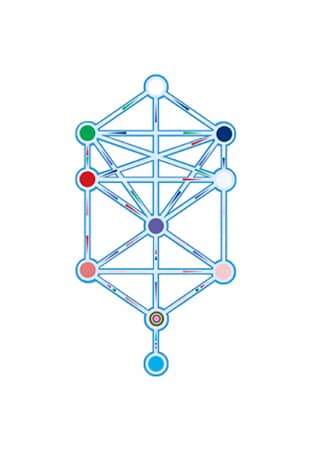
When many people think of Kabbalah, they think of the Kabbalah tree of life. The tree of life is one of the spiritual maps that we spoke of in the previous paragraph. It is a map of the spectrum of the intellectual and emotional dimensions of human experience, which have corresponding spiritual counterparts. The intellectual and emotional dimensions in the tree of life are known as “sefirot”. The following image is an artistic representation of the sefirot:

“Tree of Life” by Avraham Loewenthal
If you want to learn Kabbalah’s meaning, the “Kabbalah tree of life”, and about spiritual DNA, Chassidic master teacher Rabbi Simon Jacobson offers webinar for beginners that will give you an overview of what these things are: Discover Your Spiritual DNA.
Kabbalah is an experience more than it is a study. It is the experience of reception.
Kabbalah is much more than an academic survey of facts. The word itself, in Hebrew, means “reception” — to receive. It is more about living than understanding. That is why it must be taught in person by a master Kabbalist, and not studied alone. In this context, “reception” means the reception of student from teacher of the Zohar, the 2000-year-old esoteric book of Jewish mysticism, written by Rabbi Shimon Bar Yochai.
Learning Kabbalah is called “Entering the Garden”.
Certain journeys in life must be earned. Learning Kabbalah is one of them. The phrase “entering the garden” comes from a famous story in the Talmud:
“Four great, great sages entered the garden. They went into an ecstatic state, a state of mystical and spiritual ecstasy, and three of them did not survive, did not come out intact. One came out insane, one died, one became an apostate. He was overwhelmed and confused and unable to relate to certain things he witnessed and experienced. Rabbi Akiva was the only one who “entered in peace, and exited in peace.” – Rabbi Simon Jacobson, from Kabbalah: The Inner Journey
Kabbalah not something to play with. It is an experience of a greater nature than what most people are ready to undergo. Before you enter the garden, you must be ready to receive. That means that you are mature enough to enter the garden, and that you are spiritually grounded enough to channel the wisdom of Kabbalah. Be wary of commercialized group Kabbalah classes: True Kabbalah is meant to be studied one-on-one and in-depth, with a personalized learning approach. Kabbalah magic is also bit of a myth: Learning the spiritual dimensions of the world does not give a person magical powers. What it gives a person is a deeper relationship with G-d.
Kabbalah is a deeper explanation of your relationship with G-d.
Reality has many layers. Kabbalah helps a person to connect to their soul, and to develop a deeper relationship with the Creator. The purpose and benefit of learning the spiritual dimension, the soul, is to unite Heaven and Earth.
“We have been charged with the responsibility of taking all the elements of our material world—our families, our work, our daily concerns—and channeling them toward G-d, the one true unifying element both within and outside ourselves. Leading a unified life means leading a life of harmony, a life in which we have brought spirituality into our every moment.” – Toward A Meaningful Life
To sum it up: Kabbalah is the study of the soul: The human soul, and the soul of Torah, and the soul of everything in the material world. To learn more, experience our Webinar “Your Spiritual DNA“.
Tags: Soul Gym: Kabbalah Definition
Posted in Kabbalah, Soul & Mystical, Spiritual | 2 Comments »
June 28th, 2017
Mike Feder: Good evening, here we are again for another edition of Toward a Meaningful Life with Simon Jacobson. I’m your host Mike Feder. Tonight’s show is going to be on the Kabbalah, but first, before we do tonight’s program, let me tell you that we got a big response to last week’s show, “Men and Women,” or “Battle of the Sexes,” which is such a powerful and complex subject that we want to do a Part Two. So, after tonight’s show, the show next week will be “Battle of the Sexes: Part Two.” So we want you to think about that and send us your questions for this program, and write down the number in the studio here at WEVD because we want you to call in about this subject, “Battle of the Sexes.” The number for listener call-in lines is 212-244-1050, so get your questions ready for next week.
Tonight we’re going to talk about Kabbalah. Here’s my initial question and I don’t know anything about this, so I’m just going to sit here and learn about this.
The question is, what is Kabbalah, and what is the history and the origin of it? And let me throw in an ancillary question, which is, what is mysticism?
Jacobson: Kabbalah has become a very intriguing topic of late. I see the media interest in it accelerating and you often hear about the different celebrities involved in Kabbalah, so it’s definitely a subject that I find—in my travels and in my classes, and places where I speak—people are definitely very intrigued by it.
The word Kabbalah itself can draw a considerably large crowd to any discussion. And I’ve been wondering why that’s the case. Is it because of its exotic nature, because Kabbalah is associated with the school of mysticism and its secrets, and these unknown secrets are suddenly being opened up? Or is it for some other reason, which I think we can explore as well in this show.
But I think your question is most appropriate, which is to begin at the beginning: What exactly is Kabbalah, what does it mean, what are its origins, and how does it compare to Jewish mysticism in general?
So Kabbalah is a word in Hebrew that means literally, “reception,” to receive. This refers to the reception of student from teacher in a long, unbroken chain of esoteric teachings of Jewish mysticism, the most classical text of Kabbalah known to most people being the Zohar, authored by Rabbi Shimon bar Yochai who lived approximately 2,000 years ago.
But Kabbalistic texts have existed throughout the ages. The book considered to be the first Kabbalistic text is the Sefer Yetzirah, the Book of Formation. Some attribute its authorship to Abraham.
Then there’s a book called Raziel HaMalach, which is talking about an angel called Raziel. And some attribute that book to Adam.
So you see, Kabbalah is something that goes back to the beginning of time, and it’s always been taught only from teacher to student; never in a formal, organized way, which we’ll also discuss—what exactly the traditional conditions are for the study of Kabbalah.
But let me describe the Kabbalah itself, which also addresses the question, what is mysticism? So to use the Zohar’s analogy—and I think it’s appropriate to use metaphors and analogies from Kabbalistic texts themselves which will be an educational experience in itself—the Zohar says that everything in this universe has a body and a soul, including the teachings of Torah.
So there’s the body of Torah and there’s the soul of Torah. You can compare it to the body and spirit of anything. You have, for example, a body of a book (the words, the physical paper), but the spirit, the soul of it, is between the lines.
So in essence the body of Torah is the legal Talmudic dimension, which tells you what the laws are: Thou shalt not steal, thou shalt not kill, keep the Shabbos, eat kosher, keep the laws of Passover, Rosh Hashanah, Yom Kippur. So that’s called the body of Torah.
The soul of Torah doesn’t discuss how you do it, but why you do it. What cosmic impact it has. What personal impact, what spiritual impact. So essentially it’s the spiritual dimension, that when fused together with the body part, create one entire whole.
The Kabbalah is, in essence, the study of that spirit, of that inner dimension that corresponds to every aspect that exists in the exoteric, so there’s a parallel in the esoteric. On the external, there’s something corresponding on the internal level.
In that context, Kabbalah not some new creation or new study, but really is part and parcel of what Torah is all about. However, there are, so to speak, limitations or, better said, specific criteria of how one studies the Kabbalah. Because of its spiritual nature, it makes it more difficult to master and more difficult to relate to.
There’s a famous line that they usually say about Kabbalah which is that those who know, don’t say, and those who say, don’t know.
Because you’re dealing with a subtle, sublime dimension of things, so it’s not the same as when you’re dealing with things on a very legal, law level, commandment level.
“Thou shalt not steal” is pretty obvious; everyone understands that. But the Kabbalistic dimension gets into what the implications are: What spiritual damage is created when a person does steal, besides the ethical elements? What are the deeper dimensions? Does it put the universe out of whack in some way? How does it affect the relationship between two people?
So Kabbalah deals with a much more complex area; as complex as the legalities are, it gets much more complicated when you’re dealing with the sublime, which is more the invisible.
Feder: Is that what mysticism might be then?
Jacobson: To put it in the context of mysticism, I don’t know how mysticism is translated in other schools of thought—each one has its own interpretation—but the Kabbalah in one way is what I just described as the soul of the Torah.
I would add one thing, which will make it more universal and parallel with mysticism in general: the Kabbalah in a sense is also the building blocks, the spiritual DNA of the universe. Understanding the Kabbalistic system in a way is understanding the matter, the stuff, of which existence is made of, because the Kabbalah discusses the inner workings. So if a physicist would give us the physicist’s map of the universe, and a chemist would give us the chemical map, and a biologist would give us the biological map, a Kabbalist, a mystic, would give us the mystical map, which means that for everything in existence, there’s also a spiritual counterpart.
I’ll just use the classical example: fire and water, two of the most basic elements. In the Kabbalistic system, they’re building blocks, which we’ll discuss a little later. The building blocks of existence, of the universe, consists of ten spheres. Which gets complicated because these ten multiply many times over, but for instance when you say “water,” water is the physical manifestation of a spiritual counterpart called chessed, which is love.
So Kabbalah sees the physical world as metaphor and beyond metaphor. The soul of water is love. The soul of fire is discipline, fear. This also explains the colors of water and fire, blue and red respectively, each color having a corresponding dimension and personality.
Essentially, the Kabbalah is giving us a deeper internal map of existence, of phenomenon, of experiences around us. So when you talk about Kabbalah you should also add that it’s hard to quantify because the Kabbalah itself has many schools of thought (I’m talking about its origins), and I could break them down into categories:
There is Biblical Kabbalah, for instance, the Zohar is structured around the portions in the Torah, so the Torah has 52 portions, the Zohar has a section on each of those portions. So it essentially gives you the Kabbalistic interpretation of the Biblical stories.
But there’s another part of the Kabbalah which could be characterized as philosophical Kabbalah, an example of that would be the works of Reb Moshe Cordevero (the Ramak), a contemporary of the Holy Arizal (Rabbi Isaac Luria) who, in the 16th century, wrote a classical book called The Pardes, which means, The Garden, in which he discusses the philosophical dimension of Kabbalah. He explains issues such as G-d’s unity, of good and evil, etc.
And there’s a part of the Kabbalah which is very technical, called the kavannah, or inner intention of what a person should think about when he or she prays, the inner meditations, how each prayer, whether it’s the Shema or another prayer, it has a deeper meaning behind it.
So I just gave you three different, so to speak—not necessarily conflicting—schools of thought within the Kabbalah: Biblical Kabbalah (also called Classical Kabbalah), Philosophical Kabbalah, and Applied Kabbalah which is connected to how to pray and how you do a mitzvah, what you should think about, what you should meditate on when you give someone charity, things of that nature.
And then there’s a final category called Kabbalah maaseis, which literally means Kabbalah in action, but it’s applied Kabbalah where people used the mysterious names of G-d and different amulets not to perform magic, but to suspend the laws of nature. For example, they say that the Maharal of Prague built the golem, a “dummy.” It’s a famous story that in Prague the Maharal took dust from the ground and created this, so to speak, “Frankenstein,” but not a monster, but someone that protected the Jews at that time.
Feder: So there is an element of “magic” involved in this.
Jacobson: Well, that is the area of Kabbalah which should be most avoided because, first of all, do we have anyone today who really masters that? It can be very much abused, and it’s an area that I’d rather not discuss because I know so little about it. As I said earlier, those who know don’t say, and those who say, don’t know. So I’m in the category of if I say anything, you would clearly point out that I don’t know anything, so I’d rather not…
Feder: You mean, when it comes to the magical aspects of it…
Jacobson: Right. And also, as I said, if a holy person knows how to use that, it’s one thing, but for the rest of us it becomes a little more sensational than real, so it’s important to avoid the sensational part of it.
So essentially Kabbalah is a very vast, wide body of work…
Feder: You could spend your life studying this every day, right?
Jacobson: Yes. A body of work that goes back thousands of years, and different areas of Kabbalah touch upon different areas of interpretation as I described.
For those listeners who are academically inclined or are familiar with or interested in knowing some of the books involved, as I said, the Sefer Yetzirah is considered to be the first work, or the Raziel HaMalach as I mentioned earlier.
The Zohar (sometimes called the Holy Zohar) is the classical work of Kabbalah which was written close to 2,000 years ago, but there are other books that follow the Zohar, for example, the Sefer HaBahir, meaning, The Book of Illumination. (By the way, Zohar also means illumination). Often the names of Kabbalistic books are very connected to light, illumination. First of all, light is one of the metaphors used for Divine expression.
Now, after the Sefer HaBahir, there’s a book called the Sefer HaTemunah, The Book of Portraits, the Sefer Hakanah. Then a Torah commentator, Nachmanides, was a famous Kabbalist (I’m just going through the centuries), and then, one of the most famous of Jewish Kabbalists is Isaac Luria, who lived in the 16th century, known as the Holy Arizal, who lived in Sefat, in the northern part of Israel. He is considered to be the preeminent, not exactly modern, (in the last 500 years) authority on Kabbalah. In a sense, it passed on through him, who was considered to be a holy man, a mystic, and interestingly, his students were some of the greatest leaders, the people who codifed Jewish law (Joseph Caro), his other contemporaries.
Isaac Luria was the one who really revealed dimensions of Torah that were hitherto unknown, particularly in the area of understanding the cosmic dimension: how G-d creates a universe, how a human being interacts with G-d. One of the classical concepts that the Holy Ari revealed was the concept of tzimtzum.Tzimtzum means contraction of light, where he gave an analogy to understand how an infinite G-d could create a finite universe, and how do you bridge the gap of two such dichotomous, or antithetical realities like heaven and earth. He explains it with the concept of a tzimtzum, which is similar to a teacher who condenses or contracts his brilliant ideas in order to allow a small, narrow stream of information to flow to the student.
So that’s a metaphor used to understand this type of relationship. Now although this stream of light condenses it, it in no way compromises it, because within that information lies all the intelligence and brilliance of the master teacher.
Feder: You have to decode it.
Jacobson: Right. Decode it and climb the ladder. I want to continue regarding the Arizal. The Arizal had many students who continued to perpetuate the teachings, and these students became more and more known; as a matter of fact, the Arizal had a famous student named Reb Chaim Vital, who really was the one who wrote down all the teachings that he heard from his great master.
It’s interesting to note that the Arizal only lived to age 38, and most of his teachings took place in the last year or two of his lifetime.
So Reb Chaim Vital continued perpetuating these teachings and as the generations pass (the last 500 years), the birth of the Chassidic movement—when we talk about the chassidim, the Rebbes, the Baal Shem Tov—is, in a sense, a continuation of the Kabbalistic tradition with a Chassidic dimension in it, but it continued to perpetuate what is considered to be the inner dimension, the esoteric dimension of Torah thought.
Feder: And this developed in Central and Eastern Europe?
Jacobson: Right. And in essence it’s seen today by Torah authorities that though Kabbalah has to be studied in a restricted way, there are certain elements of Chassidic thought, based on Kabbalah, that are a necessity today to survive in a world that is so materialistic, and as we see today, many people are turning toward spirituality. It’s difficult today to just demand or ask many young people today to just follow dogmatically and blindly rules and laws… it sometimes requires the esoteric or spiritual dimension: for example, what this does for the neshamah, or soul. Even for people who are completely dedicated to tradition, though perhaps Kaballah itself is not what should be studied, there are elements of it which are gleaned and discussed in Chassidic teachings which are considered to be a mandatory study because it helps a person connect their Judaism, their commitments, their traditions to G-d and to having a personal relationship with G-d.
I think this is a brief overview, as brief as one can be in describing an entire body of work.
Feder: That’s concentrating a lot of material…
Jacobson: It would be like asking me, “What is medicine?” I just want you to understand that if someone didn’t know what medicine was, how would you capture it? So medicine, obviously, is the study of the body and how it works, but medicine has many schools of thought: you have neurology, the circulatory system, etc.
It’s the same with Kabbalah. Kabbalah is the study of the soul—to sum it up.
Feder: Which is in everything, right?
Jacobson: Exactly. The human soul within the human being and the soul within existence. And essentially as complex as the study of the body is, the study of the soul is equally as complex, if not more so because of its sublime and invisible nature. You can’t study a soul in the sense that you can’t put it under a microscope.
Feder: Okay. Let’s take a quick break here. You’re listening to Rabbi Simon Jacobson, and this is Toward a Meaningful Life with Simon Jacobson. My name is Mike Feder and we’re here every Sunday night from 6-7pm and you’re listening to WEVD, 1050AM in New York City.
This show is an outgrowth of the Meaningful Life Center in Brooklyn, and this show is also based very much on Rabbi Jacobson’s book called Toward a Meaningful Life, in which almost every subject that you hear discussed on the air here is discussed in the book.
We really want to thank everyone who has emailed us or written or called us. Here are some of the ways you can get in touch with us, and we want to hear from you. The most important thing is the telephone number: 1-800-3MEANING or 1-800-363-2646. You can also email us at wisdomreb@meanigfullife.com. You can always write to us at The Meaningful Life Center, 788 Eastern Parkway, Suite 303, Brooklyn, NY 11225.
I’d like to also tell you that we have a new website where you can download transcripts of this program, and previous and future programs. It’s www.meaningfullife.com.
Let’s just plunge right back into this because it is so fascinating to me. I just want to tumble in with these questions.
One or two questions to anchor it factually: I was looking in this “tome” I have, the Oxford Dictionary of Religions, which suggests or implied (and this may be totally wrong—every article doesn’t have to be right—because there may be some other influences that are not just exclusively Jewish influences that are in the Kabbalah) that there may be an interaction of various mystical traditions, perhaps even Christian or Eastern that may have gotten involved in this, because the truth is, a lot of what you’re explaining sounds very much like the core and essence of a lot of major religions in the world, where there’s a soul and a force which infuses everything.
Jacobson: My response to that would be that first of all, Judaism in general, is quite an ancient religion and tradition, and the other major religions either directly or indirectly follow Judaism. Christianity and Islam particularly, both historically in time, but also their basis is that first there was the prophet Moses, and so on and so forth.
So I would say that they have been influenced by Jewish thought rather than to say that they influenced Jewish thought, because Jewish thought preceded that. And I’m not pulling rank here, but the fact is, that Islam and Christianity came later.
Feder: But Eastern religions?
Jacobson: Regarding Eastern religions, interestingly (and I’m not trying to monopolize anything), but the fact is that the Bible says the following statement: Abraham sent some of his children and students to the East and sent them with many gifts.
The consensus is that the gifts were wisdom. Now, you’ve heard the term Brahman? Many attribute that to Abraham (Ibraham).
Feder: Is that like an actual word root there?
Jacobson: Yes, definitely. Actually Brahman is a rearrangement of the letters in Abraham. Because the source of Abraham—even in Islam you say Ibraham.
Feder: Ibra-him.
Jacobson: So Brahman is very much connected and associated with that. Now, this by no means is trying to suggest that there’s no legitimacy to the other systems, but I frankly see parallels between different mystical systems as a tribute that there are certain eternal truths that are ingrained in our systems.
You, Mike, may never have studied any type of mysticism yet there are certain truths you may have come to through your experience—either good experiences or painful ones…
Feder: Just by being a human being.
Jacobson: Right, exactly. And the fact that you meet someone somewhere who says, you know, that’s a very mystical concept or idea, just from my point of view, just testifies to the truth that truth resonates, and you will find it many different places, sometimes through individual search, sometimes in a more formal way.
I would say that Kabbalah is a formal text and scholarly work that documents it all, but much of it does exist, and you will find parallels of it, in other systems. And my style is not to go ahead and make comparisons, i.e., which is better, etc., but the point is that truth is truth and it resonates.
The similarities that the universe is not just a material machine, but there’s a spirit behind it, is obviously universal to all spiritual/religious schools of thought and that’s great.
Now regarding the actual discussion itself, how that soul is understood, you will find differences in different schools of mysticism. But the Kabbalah is a very self-contained system and doesn’t really depend upon or lean on other systems. It has its own rules and its own approach, and I would rather leave it to the student to compare and say, okay, how does that compare to other schools of thought…
Feder: Since you mentioned such a good answer to that question, since you mentioned student, you said before, and I think everything you’ve said before more or less answers this question but I’ll ask it again, that this is the kind of thing that’s traditionally studied person to person, in other words, this is taught from a master to a student. This is not the kind of thing that you get a whole bunch of people in a classroom or auditorium like in a university and you lecture them about it. Now why is this?
Jacobson: Good segue. As I mentioned earlier as well, Kabbalah means reception. And it’s interesting that a mystical study or esoteric scholarship should be called reception. Now there are seemingly other names that you can give it. But I think there is an inherent component in the word reception that really captures the power of Kabbalah and that is, that it’s not just an academic study of facts. It really is an experience more than a study. And experience, as we know, cannot be passed on through fax machines and computers and books alone.
Feder: Or lectures.
Jacobson: Right. You need the human touch. So it’s not incidental—you know, in some systems it’s incidental, that is, the only way that a student can study is that there needs to be a teacher. But in Kabbalah it’s inherent that it be studied teacher to student, because that teacher knows what’s between the lines—the spirit, the experience—so it’s almost like a guide who’s teaching you how to live it, not just how to understand it.
Kabbalah is much more about living than understanding. That’s why the Kabbalists were also very careful whom they taught because they didn’t want it to become detached from a person’s life. In other words, the most vulgar thing, the most abusive thing for a Kabbalist would be if someone studies it and behaves contrary to what they studied. In other words, personal refinement goes hand in hand with the study.
Feder: So in other words, a student, and this is the same in other traditions, has to prove that he or she is truly interested and sincere before he is accepted.
Jacobson: Right, exactly. And that’s the only way that that student would be worthy. So that’s one concept, the idea of a “chain” of teacher to student and human experience that’s passed on, that goes beyond words, that can’t just be documented on paper.
An additional point is that the Kabbalah also means that the state of mind that you have to be in when you’re studying it is not of an arrogant, egotist who’s a master…
Feder: Ah. Receptive.
Jacobson: You feel like you’re receptive. You have to feel like you’re a receptacle. And interestingly, that would lead to the final point I want to make which is that essentially the Kabbalah is meant to teach us how we all become receptors, that we are all really here on earth to be a channel for higher truths.
See, most of us, or all of us initially in our lives, are self-contained individuals—with an ego—and our main agenda is to take care of ourselves. So essentially, you’re here to serve yourself.
One of the primary teachings of the Kabbalah is, no, you’re not here to serve yourself, you’re here on a mission to serve a Higher cause. And your personality, your talents, your strengths, your unique faculties are really all channels for something greater and higher.
Now, creative people talk about this a lot, about being a channel for higher wisdom, for example, they say, I allow it to travel through my arm, my hand.
Feder: A lot of writers say that they take dictation rather than think it themselves.
Jacobson: Right. But in the Kabbalah it’s more comprehensive in that all your life is dedicated to that. You sit down at a meal, you walk in the street, you’re running your business. So even if you’re not a Kabbalist, the message of Kabbalah is that you’re here to be a channel, you’re not just here to sustain yourself, to make money, to eat, indulge and have fun. You’re here to be a channel, a receptacle, Kabbalah, to be like an open container, to be receiving something greater and it should be channeled through you into this world, and in some way transform your little corner.
That is, in essence, one of the most important and relevant messages of the Kabbalah to each of us. So in that context you understand why it’s so critical to be taught in the right environment, or else, it lends itself to exotic sensationalism.
The fact is, people often ask me about palm reading, fortune telling, seeing the future, stars, astrology, dream interpretation, reincarnation. Now, take any one of these topics, and people perk up. And I always wondered why. Is it because they’re so academic and intellectually curious?
I would say that most people perk up because it’s exotic. It’s exotica, it’s unknown. It’s the curiosity that each of us has in the area that’s unknown. That’s one part of it. Another part of it is that in some way if it’s not dealt with maturely, it’s almost like a distraction, like a cop-out. That if you knew that you were a frog in a previous lifetime or something else, then it almost explains your life. Or if you knew your future destiny it frees you of responsibility in a way.
Feder: So you’d be fatalistic and you wouldn’t aspire to anything higher or change.
Jacobson: And unfortunately, or really fortunately, life is not that way. We were empowered with free will. It may not be wise for you to know your destiny and exactly what will happen in the future, or where you come from, what you were in previous lives.
If that knowledge helps you to be a better person and live your life in a more responsible way, it’s one thing. But I would tend to think that many people, when they know that, do not necessarily become more responsible, it’s a flight into a world that is exotic, unknown.
As I heard once, a person once asked a Rebbe to interpret some of his dreams. And the Rebbe said, I have enough problems figuring out what to do when I’m awake before I get into dreams.
Now there’s much about dream interpretation
Feder: In the Kabbalah?
Jacobson: In the Kabbalah, definitely, and you find it even in the Bible with Joseph interpreting Pharoah’s dreams. It’s a certain language, a certain secret language of the soul, the psyche.
Feder: You think Freud picked some of this up?
Jacobson: Freud definitely looked into those books (I don’t know if it was specifically the Kabbalah) but you definitely see references to Jewish mysticism in his writings.
The thing I wanted to say was that even though there’s much about astrology and the stars and the powers of the cosmos, nevertheless it has to be carefully taught or else it merely compensates…
Feder: So you’re saying that there are places in the Kabbalah where these things are taught?
Jacobson: Yes. Any true authority will not just teach it easily, because he or she will risk the fact that people may abuse it by just that curiosity of knowing, for example, what my future holds, what my palm reads rather than really assuming responsibility. So it is really a mature study that can only come, and is coupled with, a very mature attitude that this does not replace or compensate for, is not an alternative to, real hard choices in life.
Feder: So the study of the Kabbalah is not for children or young people really.
Jacobson: Children and not just chronologically. It may be for a child who’s an adult, meaning, it requires a mature approach to life, number one, that you’ve taken hold of your own life, your control of it, your choices are refined, you’ve shown responsibility.
For someone who has not really assumed responsibility for their own lives in a very serious way, if they go to a true Kabbalist, he won’t laugh but he won’t teach them any Kabbalah. It has to be earned. In the Talmud, the metaphor for an ecstatic experience is “entering the garden.” You can’t just enter the garden easily.
There’s a famous story in the Talmud where four people entered the garden. They went into an ecstatic state, a state of mystical and spiritual ecstasy, and three of them did not survive, did not come out intact. And they were great, great sages. One came out insane, one died, one became an apostate. He was overwhelmed and confused and unable to relate to certain things he witnessed and experienced. Rabbi Akiva was the only one who “entered in peace, and exited in peace.”
It teaches you something. You see, a person has to earn certain journeys in life. If you don’t earn it, then you go there and you come back and it’s not really you, you can’t internalize it. I don’t want to compare it, but it’s similar to getting a high through an alternative foreign substance. You haven’t really earned it, you’ve almost jump started something and entered a place that you haven’t earned the right to enter into.
So you see things that you don’t appreciate or don’t know what to do with when you go back to your life, which is why there is burn-out. You can’t ground it, you can’t internalize it.
Kabbalah is not, G-d forbid, a drug. But in a similar way it is an experience that is of a greater nature, which has a certain awesomeness. You have to be receptive to it, you have to be ready to receive it, you have to also be mature enough to say, you know, I’ve heard enough and I don’t want to jump in.
Feder: I’ll stop here for a while, right?
Jacobson: It’s a question of growth.
Feder: It’s interesting that you used the word “burn-out” before. In every religious tradition that I’ve ever heard of, people who are not prepared, and that’s most of us, if they see the “face of G-d” in any religious tradition, or are brought too close to the great profound meaning of something, it often either kills them or blinds them. These are experiences that are written about in every major religious tradition.
You have to be ready for it.
Jacobson: Right. That’s why the Mishneh says that the “Maaseh Merkava” should be studied only individually, not in groups. The “Maaseh Merkava” means the “vision of the chariot” which is one of the Kabbalistic visions in the Bible that you find in Ezekiel, the prophet who had this vision. And he saw a chariot with four faces and describes it in detail. It’s actually a lot of Kabbalistic metaphors that are understood only within Kabbalah, and that study of the maaseh merkava is not meant to be studied except individually, not in groups, because a group tends to dehumanize, depersonalize the message and it’s good for scholarship for it’s not good for experience, because experience is always individual.
Feder: So the experience gets diluted too much.
Jacobson: Right. That’s why these things are not studied in groups, but rather individually, teacher to student, face to face. It’s a very personal type of journey.
Feder: So there are people now who are studying Kabbalah. As we speak, there are people out there in the world who are studying this, right?
Jacobson: I can’t speak for everybody, because some people may be studying it which means they may think they’re studying Kabbalah but it doesn’t mean it’s Kabbalah.
Feder: You mean they might be reading a book someplace…
Jacobson: It may even be an authentic text but not necessarily that they understand or appreciate what they’re reading. Now I’m not here to judge anyone or to pass judgment on any school of thought. I think there is an inherent immune system in the Kabbalah.
As I said, those who really know don’t say and those who say don’t really know. So does that mean that every teacher doesn’t know? If he says everything, then he probably doesn’t. If it’s too sensational, too commercial…there are certain signs that usually signal that something’s wrong. The real mystics in history, the real humble people, the real masters, would be the first to say I don’t why you’re coming to me… So as soon as you see that it’s more of a sensationalistic thing, a publicity thing, a celebrity thing…
Feder: But you started out the program saying that it’s become a popular thing, like a fad. What is that all about?
Jacobson: I just made it as a statement, I didn’t say it in a positive or negative light.
Feder: But it is true.
Jacobson: Yes. That’s a fact; that you can’t argue. My attitude to that, as I’ve often stated, is that for good or for bad it brings attention to it, and it’s a good opportunity to get people thinking and get people to fully understand it. Clearly, whenever anything is on that type of popular level, there’s always going to be distortions—it has to be that way.
Again, I’m not here to speak about any individual or any particular school of thought, but I think there are certain questions that anyone studying Kabbalah should ask of the teacher. Number one is the issue of receptivity: who did you receive from?
Feder: In other words, whom did you learn from?
Jacobson: Right. Who’s your teacher? Who have you humbly sat before? Without that, this isn’t an ego trip, this isn’t an individual creation. Kabbalah is not owned by any individual, and it can’t be sold by any individual; there’s no monopoly, no royalties. It’s a wisdom that is inherent in existence, part of G-d’s creation, and therefore cannot be monopolized by any one person.
In addition, the humility of the teacher is critical; what kind of humility that teacher has, what modesty they carry.
So though there may be people who know the information, it doesn’t necessarily mean that they are what I would call a Kabbalist. A Kabbalist is not just a knower of information, it’s a true receptacle, a true humble teacher or actually a student, who simply allows himself to be a channel for that type of wisdom.
Feder: So the teacher is always a student.
Jacobson: Always. As a matter of fact, in Hebrew, the word for a true teacher is talmud chocham, which means the student of a wise person. You don’t call him a wise man, you say a talmud, the student, the disciple of the wise.
Feder: Now you presumably have studied this with someone.
Jacobson: Well, that depends on whether or not you consider me to be a Kabbalist or just someone with knowledge about the Kabbalah. I didn’t make any such claim. I think it’s a good topic to discuss on a show, but I would not categorize myself as a Kabbalist. I would say I’m familiar with Kabbalah and I can tell you that I studied it and read about it, and had a master, particularly the Rabbi Menachem Mendel Schneerson, called “the Rebbe,” who was clearly a mystic and a Kabbalist, but if you look at how he taught, he never really sat down and taught Kabbalah, it was always integrated within a system of life, how to live your life. If you were to ask him if was teaching about Kabbalah, he would always say no he’s not teaching Kabbalah, he’s teaching you how to live your life. But within that was woven Kabbalistic teachings.
So in that context I could say that I studied Kabbalah, but out of curiosity I read the books and I’m familiar with the body of work. But I would not call myself a Kabbalist.
Feder: In other words, if someone came to you and said I’d like to study that with you, you really wouldn’t…
Jacobson: I would invite them to my Wednesday night class where I try to weave it in as well. But I would not call it a class on Kabbalah. But if someone calls it that, that there’s Kabbalistic teachings taught there, that’s fine with me but if you asked me what Kabbalah is, it’s far beyond…
Feder: Now in this book of yours, Toward a Meaningful Life, upon which this show is based, and just to mention the book Toward a Meaningful Life by Simon Jacobson is published by William Morrow and you can go out and buy it and read a copy of it. Would you say that there are some Kabbalistic teachings that have found their way generally into it?
Jacobson: Oh, definitely. It may not be overt because I stayed away from using prohibitive language (Hebrew and description of concepts that require an advanced understanding of these teachings), for that matter anything too esoteric, because I wanted to make it more accessible, but particularly in the chapter on G-d and the chapter on Unity you could almost call them an introduction to Kabbalah. I’m big into introductions. I could say I could give a good introduction into Kabbalah; whether I could teach Kabbalah is another story.
An introduction to Kabbalah may even be more valuable than even studying Kabbalah because it’s appreciating what the system is; for instance, I mentioned earlier this idea of building blocks—the idea of the ten spheres, the four worlds—it’s a fascinating map of life that Kabbalah draws, and it helps make sense of our lives and understand deeper forces at work in our lives.
Feder: This brings up an obvious question, since we’re talking about studying this subject. Do you have to be Jewish to study Kabbalah? I mean, if you were truly seeking, and ready, could a person come from any tradition to learn Kabbalah?
Jacobson: It’s a difficult question to answer because I have to go back to what the Kabbalah means. I remember once there was a traditional Jewish person at my class who said, “How could you be teaching any Kabbalistic concepts in this class?” There are prohibitions not to teach it to people under 40, and certain other restrictions that I mentioned earlier. So I responded by saying, “Every morning we say in the Jewish prayer, in the liturgy, ‘Modeh Ani,’ we acknowledge G-d for returning my soul to me.”
So if your five-year-old child were to ask you, “What is this thing ‘my soul’?” Would you tell your child, you can’t study that until you’re 40 years old?
Obviously not, that’s ridiculous. A soul is something we carry from birth, before birth. It’s part of our lives. To give children a spiritual education doesn’t mean you’re making them into Kabbalists. So your question is a good question but I want to split it into two. I think that if most people knew the basics of spirituality today, that’s really what’s missing. Not Kabbalistic teachings, per se. Kabbalah is a more intense study once you’ve accepted that there’s a soul and there’s a G-d, and you have a relationship with that G-d. I believe that when I meet people today that people are missing the basic element of spirituality altogether. That’s not Kabbalah. You don’t need Kabbalah for that.
You can say obviously that it stems from Kabbalah, but it’s like the A-B-C’s. It’s the first thing and you don’t even go further. Kabbalah comes in once you know all that and then you want to know, “How do you pray to G-d, How do you build the relationship to G-d?”
So let’s take love, for example. Today we’re just trying to establish a relationship that works, let alone a deeper exploration of it. Kabbalah is a deeper exploration of it. So when you ask me the question, this is how I would respond: Yes, to that universal dimension that all of us need, the basic principles and fundamentals of spirituality in our lives, that part of Kabbalah is for everyone and should be taught and should be encouraged because it is the key to being a productive and a responsible human being, a spiritual, transcendental human being.
But regarding the deeper dimensions and the deeper explorations, there are prohibitions and limitations and that would be case by case, and depending on whom.
There are great non-Jewish leaders in history. Bilaam, for example, was a prophet. He clearly had knowledge of Kabbalah, so it’s not an exclusively Jewish study, but on the other hand, even among Jews themselves there are limitations. It’s not like anyone can just study it.
So really when we’re talking about the basic elements of spirituality, they are for everyone. The deeper exploration depends on the individual: where they’re at and what they’re doing.
Feder: Well, it’s interesting growing up in what’s considered a Conservative or Reform background, and perhaps millions of American Jews are brought up in this tradition. I had never even heard the word Kabbalah my entire life until I was studying religions in college. I was not brought up to even know that word or that tradition.
Jacobson: I had a student (a student! He’s older than I am) but he came to one of my classes and he said to me that until he came to this class he never knew that Jews believed that there’s a soul. I mean this, it’s not a joke. He never heard the word soul until he heard it was in Buddhism as a teenager. He didn’t hear it at his bar mitzvah, he didn’t hear it in his Hebrew school classes.
I don’t mean the actual word, of course he heard the word soul, but it was never used, it was never an element in experience. He never heard: okay now this is going to be a soul, a neshamah experience. It was always very traditional, very technical, “Just do it,” type of thing. And it was more that you have to fear G-d: if you don’t do it, G-d will do this or do that.
Feder: I remember that part.
Jacobson: So unfortunately, with such a rich spiritual tradition of Judaism, many Jews today are finding their spirituality elsewhere, because what they were taught in schools was exactly the way you described it. It was a very dry, hollow, non-resonating experience. And the soul searches for nourishment. If it doesn’t find it in its own backyard, it will look elsewhere.
Feder: You know, you’ve mentioned your class several times this evening. I’m wondering, if people are interested should they call up and find out where it is?
Jacobson: They can just come. Everyone’s invited to the Wednesday Night Class in New York City, every Wednesday night at 8:30pm, at 346 W89th Street at Riverside Drive.
Feder: On the Upper West Side.
Jacobson: You sound like you’re an Upper West Sider.
Feder: I might be.
Jacobson: You sound so proud. But there’s no discrimination. Anyone from the Upper East Side, the Lower East Side is welcome. It’s a very eclectic group and I think most people would find it interesting. It’s very open, as opposed to radio you can directly argue and you can’t be hung up on there.
Feder: Okay, so now we’re coming in toward the end of the show. So let me share with you that we have underwriters, people who support these programs, and the name of the underwriter of tonight’s show, the person who has brought this show to you is Richard Blackstone, and thank you very much for making this show possible.
Jacobson: And I second that. Mr. Blackstone, I really appreciate all his work in supporting what we’re doing here.
Feder: Now, I should also say that speaking of underwriting and helping to support all the work and the work of the Meaningful Life Center, we have received many requests from people asking how they could donate to the Meaningful Life Center, which of course brings you this radio show every week.
The Meaningful Life Center is a non-profit organization dedicated to bringing a sense of peace, light, inspiration and meaning into the world. All its activities are made possible by donations from people like you who are listening to us right now, people who receive the Center’s publications and tapes, who listen to this program and visit our website.
When you contribute to the Meaningful Life Center, you become, in effect, a partner in the work that Simon Jacobson is doing. So we’re asking you to consider funding these radio programs. It’s a great opportunity to perhaps honor someone you love, and bring inspiration to thousands of people when they hear these programs.
You can dedicate a program to the memory of a loved one, someone’s birthday or wedding, or any other occasion. We really do need your help. We want people to feel like they’re part of this and to bring this radio show to people.
A donation of any amount from a dollar—but we’ll accept a hundred thousand dollars—is appreciated. You can call 1-800-3MEANING (1-800-363-2646) to take your pledges of support. And when you pledge, when you help us out, make sure to ask to receive our newsletter Meanings. And remember, we don’t have any commercial sponsors here. We like to bring you as much information as possible without being interrupted by commercial sponsors, so we count on you, the listener, to make this show possible.
I think that does it as far as our business. Now, we have just a few minutes left. The Kabbalah, being such a complex, profound and difficult thing—and you’ve really given us just the briefest description of it tonight, and you say it’s a concentrated thing that has to be decoded, so here’s my question.
We, the people who don’t study it, the people who are living our lives, who are going to take the subway home tonight, or are going to go someplace, or wake up tomorrow morning and go to work. What does this great thousands-year-old body of wisdom, perhaps as old as human beings themselves, what can it do for us, for people listening to this show, and for me sitting here. What can we take with us into the world? I mean, it’s there to be studied, but we’re not going to be studying it tomorrow or the next day.
Jacobson: These shows that we’re doing here today, Mike, and the ones that will follow, in a way, have many Kabbalistic roots in some of the teachings that I’ve been steeped in and that I base some of our discussions here. They have elements of Kabbalah and certainly the spiritual dimensions of our discussions. I intend to dedicate many shows to different topics that are Kabbalistic, and I believe that we should a few weeks from now perhaps dedicate a show to reincarnation, afterlife: topics that people struggle with, death, life, and not in a sensational way, but in a meaningful way.
But to answer your question, I’d like to reiterate or perhaps rephrase something I said earlier. The Kabbalah’s main teaching is that we’re not alone in this world, and we are channels for higher energy. Each of us has something to contribute that’s unique: we’re on a mission. And we are receptacles to use our strengths, our talents, our unique opportunities to reveal a deeper spiritual dimension in everything we do. In a sense, to spiritualize the material world we live in. That means from when we take the next bite of food in our mouths, it’s not just an act of sustenance or indulgence, but rather a spiritual act, as Kabbalah will teach, that there are spiritual sparks in that food.
Feder: So every single thing we do, day in and day out, on a daily basis is a sacred act in a way…
Jacobson: Exactly. One of the Kabbalistic teachings is the concept of redeeming or redemption/elevation of the sparks. This means that we tarin ourselves to see and experience spiritual “sparks” in every fiber of existence, in all phenomenon, in every interaction — the sparks are scattered all over. Every time you meet a new person or someone that you know, there’s a spark to be revealed or redeemed in that experience. Every time you eat something, every time you travel somewhere, there are sparks to be revealed. This recognition changes, in an unbelievably gratifying way, the way we life our lives. There are no random things. Wherever you go and whatever you do, there’s a spark there for you to bond with, for you to connect with. In addition to that, it also gives a sense of urgency, a sense of purpose to things that we do. It’s not just, what difference does it make if I act this way or move that way.
Feder: Or I can waste a few hours.
Jacobson: Right. Every little act takes the world for a cosmic spin, so to speak. In addition, another Kabbalistic teaching is that a human being is a small universe. Today we live in a world where quantity and quality have ceased to be compartmentalized. We understand that a little quantity can change a major quality; one dot in a computer program can wreak havoc. One mutation of a cell, G-d forbid. A butterfly effect: one little vibration in one corner of the world can cause who knows what.
So we understand today that matter and energy are interchangeable. This is an essential Kabbalah teaching, that matter can be converted into energy. That even a small little act of kindness changes the world in some way. The fact that we don’t always see it is that we’re small people ourselves. Our vision is myopic, narrow. But there are deeper things going on, and it’s also a way of looking at the world around you, including your experiences, and seeing it through, and seeing that there’s a bigger picture emerging. So Kabbalah, coupled with, fused with, the entire body of tradition, the body and the soul, create a full dimensional experience.
A person can do something, can follow a law, but it they don’t respect the spirit in it, or they don’t have the spirit, they’re missing an important dimension. On the other hand, Kabbalah alone—spirit without the actualization in a concrete act—in turn is only a spiritual experience and doesn’t make an impact on this world and is therefore not sufficient.
So I would encourage people to continue to listen to this show, and to pursue in other ways (look at our website and the links) to explore the fascinating treasure and journey which is the Kabbalah, and Kabbalah in the context of all of Judaism, and all of tradition, including its universal message that we are here on a mission, and we are here to fuse body and soul.
Feder: Thank you.
Posted in Kabbalah, Spiritual | 3 Comments »
June 28th, 2017
Toward a Meaningful Life with Simon Jacobson
Radio Show Transcript – April 23, 2000
Rabbi Simon Jacobson: I want to wish all our listeners a happy Passover, the festival of freedom and liberation. I wish us all the power and ability in this window of opportunity to access our own inner souls, which provides the strength to liberate ourselves. When you become enslaved by the material oppression of life—the need for instant gratification and the other forces that hold us hostage—the only respite and true freedom is when we access our inner souls.
I want to thank those of you who called in last week for participating in a very productive show. The calls were very different, but they showed that both in little and big ways, we face questions that affect our sense of freedom and that even at a most personal level, freedom and truth are intimately connected.
Last week I discussed the general approach to emotions. Clearly, emotions are a very powerful and positive force in our lives. It’s what makes life life. Experience, passion, the driving forces and ups and downs of our lives are what make life so beautiful and important.
At the same time, emotions have the emotional trap of almost obsessive subjectivity, where we become blinded, and I cited the verse that bias and subjectivity “can blind the eyes of the wise and distort the tongue of the tzaddik (a great righteous person).” What I addressed primarily last week were two things: The first point was that knowledge is freedom; that it’s key to open up our minds to wider and broader perspectives if one is to ever find some type of emotional freedom. If not, we become locked in our own patterns, in a rut, in habits that we usually pick up from childhood and on.
The second point was that in order to access that type of objectivity without compromising the emotional tapestry of our lives, it’s also important to have a mentor, an objective friend, someone who’s sensitive whom you can honestly share your thoughts and feelings with, someone you trust, because he or she can be a sounding board that helps you see yourself in a different light.
In this same spirit of the season of freedom and liberation, I’d like to address tonight how one actually looks and examines one’s emotions, because the issue here is not to become an objective person entirely. We’re not trying to become computers here. A brain is a beautiful and powerful thing, but the brain without a heart, without an emotional life, is frankly not only dry, it’s dead.
One of the Chassidic Rebbes once said that there is nothing as cold and as dead as a mind. So a mind is a good analyzer, a good analytical tool that processes information, but there’s an analogy about the mind and the heart that says the mind is like the captain of the ship, but the ship that goes through the ocean is your emotions.
What is it to be a captain if you can’t travel? Emotions are the travel and the journey we’re on. But the captain of the ship needs to be there to help us navigate and see our way to focus, to direct, to channel our emotional experiences.
So tonight I’d like to discuss particular emotions, the spectrum of emotional experiences that we have. It’s interesting that in the Kabbalah, Jewish mysticism, there is a map of the emotions. It’s a map that divides the emotions into seven categories, seven particular attributes and faculties. We have many emotions but they become one big jumble if we do not distinguish between one emotion and the next.
The reason I’m doing this this week is that we are in the Festival of Freedom, Passover, and in Jewish tradition there is a custom, a mitzvah actually, that’s called the “Counting of the Omer.” The Counting of the Omer is a custom that was done when the Jews left Egypt. Following the Exodus from Egypt during this period of time 3,312 years ago, they counted the days in anticipation of receiving the mandate, the Torah that they would receive 50 days later.
They counted 49 days. The Counting of the Omer is a commandment in the Torah: Following a special offering that was brought to the Holy Temple every year, on the second day of Passover, the verse in Leviticus says, “You shall count from the day that you brought the omer as a wave offering,” which was brought on the second day of Passover. Following that they counted for 49 days.
Now the number 49 is significant because it’s seven times seven. Seven weeks with seven days in each week. As we all know, 7 x 7=49. Each week corresponds to one particular emotional attribute. So these 49 days were perhaps the original 49-Step Program before the Step Programs were instituted in our generation. They were a refinement process that the people then used as a stepping stone to analyze and inspect and review their emotional lives.
To do so effectively, particularly when you’re dealing with subjectivity, requires a meticulous approach where you take each emotion, look at it, and examine it. They did this for seven weeks. Each week was dedicated to one of these seven emotions, and within each of these seven emotions, each one breaks down further into another seven (another 7 x 7=49).
I created a little workbook called, The Spiritual Guide to the Counting of the Omer, which describes exactly what goes on during these 49 days, and how to use it in a personal way. I’ll give more information on how to get it later on. The book outlines the 49 steps with an exercise for each day.
What we’re going to do now is map out the emotional spectrum of our lives. This may be the first time some of you actually hear a map of what your emotions look like. Remember, you can’t look in the mirror to see your emotions. You can’t go to a doctor. Your emotions are invisible. So what do our emotions look like? Are they white, or blue, or black, or are they tall or short? How do we define our emotions? Here is a map that defines our emotions in seven different categories.
Before we begin, let’s go to Louise on the air.
Caller: A good holiday to you. I have two questions. First, the Ashkenazim and the Sephardim seem to have different requirements and prohibitions about foods to be eaten during Passover and I wondered how that comes about. Correct me if I’m wrong, I think that Sephardim are permitted to eat things like rice and peas and Ashkenazim are not. I’m puzzled. If these are holy requirements, Biblical requirements, why do they differ from one group to the other? That’s my first question.
Jacobson: Thank you for your question. I’m trying to discuss a particular topic, so I hope you don’t mind Louise if I’m brief and try to connect it in some way to the topic of emotions.
Louise’s question, for those of you who may not fully follow, is that on Passover there’s a prohibition against eating anything leavened, bread and bread products, actually anything made of grain or barley or oats, and so on. There’s also an additional custom followed by the Ashkenazim (people who came essentially from central Europe) that they also don’t eat what’s called kitniyus. Kitniyus means things that come from certain bean families, including rice and peas—things similar to the grains. That’s why, at a certain point in history, they decided to include these foods in the prohibition, in order not to create confusion. There was a problem with people confusing kitniyus with grains, and so in order to avoid that problem, they also prohibited that.
In Sephardic countries (Sephardim are Jews who came either from Spain or the countries controlled by the Moors, and the Arab countries including Yemen, Saudi Arabia, Egypt, and so on), as it is with other customs, that was not an issue. Either it was not an issue because people never confused the two, or because beans didn’t grow there, or whatever it was, so the Sephardim never accepted upon themselves that prohibition. The diversity within Judaism is quite beautiful—you can have two different groups, depending on where they lived, and even though Judaism does have its absolute prohibitions, there are areas where there is room for diversity. That’s my brief answer to you. But thank you for the call.
How to connect beans with emotions I don’t know, but let’s go back to my topic about the seven emotional attributes.
Jewish mysticism, the Kaballah, discusses the human psyche, by explaining that a human being is more than just a body. We have a spirit, and each of us has a unique personality. Yet there are common denominators, which connect us all, and the first common denominator is that our conscious experience (we’re not discussing the subconscious here) divides into two: the intellect and the emotions. The intellect is the mind, and the emotions are our emotional impulsive experiences.
The emotion that always comes to mind when someone says “emotional experiences” is love, and of course its antithesis, which is hate. Those are emotional experiences. But the fact is, besides love there are six other emotions that comprise our human experience according to Kaballah.
I’ll spell them out for you in Hebrew and then translate them into English. The first of the seven is love, chessed, in Hebrew. Chessed is lovingkindness, benevolence—anything that’s included within the family of love, and the warmth and nurturing that comes with love. It’s a feeling in our hearts. It’s our first and most fundamental emotion.
The second is the alter-ego to love, which is gevurah, and that is justice, discipline, restraint, awe. If love is giving and flowing, there’s another emotion which is withdrawing, focusing, disciplining, channeling.
Emotion number three is tiferet. Tiferet is translated as beauty, harmony and compassion. It’s somewhat of a synthesis of the first two, but it’s beyond that: tiferet has its own power, the power of compassion that goes far beyond love. You can have love for those who are close to you, those whom you appreciate. Compassion is for strangers and people who may not deserve it: mercy, or in Hebrew and Yiddish, rachmanut.
Emotion number four is netzach. Netzach literally means victory, but the emotion involved is endurance, fortitude, ambition. Netzach is the driving force behind every ambition.
Emotion number five is hod, and that translates into humility, splendor, and the emotion of humility, yielding. If the alter-ego of gevurah is chessed, where chessed is a flowing love and gevurah is the channeling, the measuring of it, then if netzach is ambition and drive and fortitude, hod is humility and yielding that balances the ambitions within us.
Yesod is number six. Yesod literally means foundation but it’s an emotion called bonding. When you bond with something it’s not just that you’re experiencing it, you actually bond with it.
And finally number seven is called Malchut. Literally it means nobility and kingship, but on the emotional spectrum, it’s sovereignty, leadership, the independence of a human being, the feeling that we are sovereign, that we have something to contribute, something unique about us.
These are the seven emotions as outlined in the Kabbalah. I’m sure there are parallels in other systems, however the Kabbalistic system is very comprehensive, and I’d like to elaborate on these. The period of time we’re in right now is really a time of examination. For instance, now we’re in Week One, which is the week of love. We look at how we love. Now the value of this examination is such that it allows us to step back and be somewhat objective about it. Now we can’t be entirely objective about our feelings, but we can examine them. There are ways of asking yourself certain questions that can help you look at these different dimensions within yourself and see: Are they tempered? Do we experience them to excess? Are we lacking in a certain area? Is there another area that requires balance?
Examining it is the first step to emotional freedom because you’re beginning to look at something with emotional objectivity.
So after spelling out the seven emotions, let me give you a few examples to show you how powerful the system is in helping a person become emotionally health and grow in the areas of personal growth and personal self-actualization.
If you asked many people the question, “Do you grow emotionally?” many of us would say that we grow intellectually. We grow perhaps financially and in other ways. But the cliché is that once you’ve matured, there’s no more room for emotional growth. What you have is what you have. Who you are is who you are.
But the truth is that’s not the case. Because of its subjective nature, it’s more difficult to grow in the emotional realm than the intellectual realm because the emotions are not about knowledge. Everyone can understand knowledge—the more you read the more you study the more you learn. There are subjects you may be completely unfamiliar with, but with emotions it doesn’t seem like there’s anywhere to go. Once you’ve developed a certain emotional approach to things, is there a place to grow? And the answer is definitely, because the emotions are a reservoir of resources within us: by looking at an emotion you can begin to see, “Can I become a more loving person? Do I love too much?”
And that brings me to an example of how one examines one’s emotions. I’ll use love, the one that we’re focusing on in this period of time, in this 49-Step Program.
Love is an emotion that we all need. We need to receive love and we need to give love. One can even say it is the most powerful and the most necessary component in life, the foundation of all human interaction. It is both giving and receiving, and allows us to reach beyond ourselves. In one word, it’s a form of transcendence.
Now, when we love, whether it’s our family, friends, spouses, or whomever it is that we love, love is not just a simple matter. We see that in the name of love people have been hurt as well. I remember going to speak somewhere and the host asked me, “What are the top ten favorite topics that people like to hear about?”
And in my experience, traveling and communicating to different audiences, I said, “Topic number one is always love, relationships, sexuality. The second favorite topic is pain and suffering.”
So he said to me, “Those aren’t two different topics; there the same thing.”
He obviously saw love and pain and suffering as two sides of the same coin, which is often the case. You often find many people who are afraid to love because they are afraid of being hurt. Many of us have gotten hurt from love, we saw what kind of damage could be done in the name of love, and we don’t want to be vulnerable again, so we protect ourselves.
So love is a very nice emotion and we all aspire to have a very healthy love, but love also has another side to it which is when you love, you can be hurt. Examining love is extremely important because in a way, I would say, love is perhaps the single most important ingredient in our lives, and the single most important source of misery in our lives, particularly when we can’t find the love we need or we’re lonely, or we’re hurt, or we’re hurt by our parents who presumably loved us—or they did love us and didn’t know how to love.
And what about ourselves when we turn to people around us and we don’t know how to love? Or we don’t know how much to give, how much not to give.
So examining this emotion called love is not just a simple matter, like, I want to know whether I love well or I don’t love well. It requires looking into details. That’s why the seven steps, the seven weeks break further into seven subcategories. Within love itself there are all seven which I mentioned. So love has the love within love, the discipline within love, the compassion and beauty within love, the endurance within love, the humility and yielding in love, the bonding in love, and finally the sovereignty in love. For love to be effective it requires looking at all seven elements.
In other words, when you love, there are certain things that are necessary. The first thing of course is do you love well? Do you have the capacity to love another person? Do you have problems with giving? Are you stingy or selfish? Is it difficult to let someone else into your life? Do you have room for someone else? Are you afraid of being hurt by vulnerability?
These are questions that are addressed in the first step of looking at the way we love. If the answer to any of those questions is yes, I have that type of difficulty, then you have to look at why. Why would people have difficulty loving another? Is it because they’ve been hurt? Is it because they may be so self-contained and think no one understands them?
That’s the first thing that you need to examine. As I mentioned earlier, to examine our emotions also requires, first, looking into a book that may discuss this in some objective light, and second, talking to someone who can be objective and in some way help us see ourselves in a different light.
Then there’s the other side of love. Let’s say you are loving. Are you loving too much? That’s where you need the second dimension, which is called gevurah, discipline. We see that parents who love their children too much can also harm them, because they may spoil them. The children begin to expect everything; they begin to have an exaggerated sense of entitlement. So we see that love requires measure, discipline and channeling.
Look at raindrops. Rain is a benevolent gift from heaven that allows things to grow. But if the rain came down in buckets it would flood the field and then nothing would grow. So a rain’s beauty is that it comes down in raindrops.
In Kabbalistic or psychological terminology, that’s called gevurah she’be’chessed: that within love you need gevurah, the discipline and channeling. If you look at the way you love, you will often see that one of these two is usually exaggerated. You may be loving too much without enough discipline, or you may have too much discipline and not be loving enough. It is a dance that requires a certain synthesis, a balance of knowing when to give and when to stop, when to allow it to flow and when to withdraw, without in any way undermining one or the other.
Those are two examples of how one looks at the emotions, particularly in this area called love. But the same is true with all the emotions that I described. Love also needs compassion and beauty. It’s not just that you love, but that the love comes with a certain balance, a certain synchronicity. And love needs endurance. There are many people who are very loving but the love doesn’t endure. It’s for the moment. They’re good at short-term relationships. They’re good if there’s a crisis. But endurance, to go through the difficult times, to have the consistency that’s required, is another element of love. So some people love very well but it doesn’t endure, it doesn’t stay too long. They get bored or something else comes up.
Love requires humility. Often love is a very selfish act. You love someone because you get something from the person and so you’re ready to give. So you have to look at your yielding ability. I’ve seen parents who love their children so much that you can say basically they love them to death. I don’t want to say the word “death,” but they can love them so much that they don’t have any yielding, they don’t allow the child to have its own independent personality and choices to make which can be very unhealthy. You need to have the ability to look at your own love and say, “Maybe I don’t have it all right.”
In the name of love, parents say, “My child has to do so and so because I love her so much, I know better.” That may not be healthy. So love needs yielding. It needs to be able to yield and be humble in the way we love.
Finally, there’s bonding in love—not just to love someone but to actually bond with them so there’s a deep connection. You spend time and you share a common vision.
And then there’s sovereignty in love. Love promotes and advances human dignity as opposed to being demoralizing. It helps us be better people. If your love causes someone else to be demoralized, there’s a problem with that love.
So this is a crash course for a one-week emotional exercise which, I must admit, can’t take ten minutes the way I just described it. It requires seven days of the week. To go through each one of these items is really a seven-step process.
The first day of the 49 days would be the love within love. The second day we concentrate on the discipline within love.
As I mentioned, I created a book called The Spiritual Guide to the Counting of the Omer, which has gotten a very positive reaction and I invite you to check into it. You can contact my office at the Meaningful Life Center to obtain this book. You can call us at 1-800-363-2646 (1-800-3MEANING) or email us at wisdomreb@aol.com, or write us at The Meaningful Life Center, Suite 303, 788 Eastern Parkway, Brooklyn, NY 11213. And finally, you can visit our website at www.meaningfullife.com.
Now, when we talk about emotions, the first thing that comes to mind for me are my own personal experiences, my own subjectivity. Each of us is subjective in our own way. As I mentioned last week, if you think you’re objective, that’s part of being subjective: it makes you think you’re objective.
When you look into your own experiences, the fact is, as much we can discuss them, emotions have a hold on us that don’t allow us to see outside—like being in a box where you just see it your way. The thing that’s so exciting about life—of meeting people and being able to communicate with them—is that even though each of has our own personal pride and our own personal investment in our choices, if you can find someone whom you can have an intelligent interaction with, and they can stimulate and challenge you without undermining you, it really brings out more objectivity than we could ever allow on our own.
One of the beautiful things about the Seder table, which is the Passover tradition on the first two nights of Passover, is that one of the big emphases is on questions, encouraging children to ask questions, inviting them to ask.
If you think about it, the questions in the Haggadah are much more pronounced and much more tangible and identified than the answers. You have to really search for the answers to some of those questions that are asked. This is true with the “Four Questions” that the children ask at the table, or just in general: many things are done during that evening in order to provoke questions.
It struck me that on a very simple note, one of the greatest celebrations of freedom is the ability to ask. Just the ability to ask. Forget about the answer. The power of being entitled and empowered and given the permission to ask a question, to challenge, to be skeptical in a healthy way, curious, is a real freedom, a real freedom of knowledge.
You’ll always find silence in Fascist regimes. People are silent. You cannot demonstrate. Free expression is not allowed, and so on and so forth. That ability, which is celebrated on Passover, is the ability to ask a question, “Sha’al avicha v’yageidcha,” “Ask your father/parent and he or she will tell you.”
The ability to ask the “Four Questions,” is in itself freedom. There’s a statement from the holy Sages that says, “The question of a wise person is half an answer.” That doesn’t mean that within the question lies the answer, it means that the way you formulate a question—it may take sometimes a lifetime to find out what your question is—when you know your question, you’re already halfway there.
So the ability to ask questions is a freedom that is perhaps the greatest first step in any freedom—the ability to ask and therefore to search for answers. That’s what struck me on a personal note.
When we deal with emotions—especially in the area of abuse, they say—the silence is worse than the abuse. The cover-up is worse than the crime, because it’s the silencing, the invalidation, the undermining, the shrouded secrecy of any problem in our family life or in our personal lives. That in itself is the greatest enslavement.
Knowing that you have an illness is half the cure. That being said, when we look at our way of dealing with our emotions, our feelings, and so on, that ability to ask questions, to allow yourself to ask questions, to be engaged, is the first step to any type of freedom. That’s why even though we may not have full answers to these questions: “Do you love properly? Do you love with too much or too little love?” by asking that you begin to challenge yourself in a healthy way and you say, “Maybe I need to look at that. Maybe I need someone to help me look at that.”
We’ll go to Benita on the air.
Caller: Hi. This was very appropriate today. A few days ago I was shopping for Passover and I threw my back out. I had attended the first Seder and the second night Seder, and it was a wonderful experience, I had a wonderful time. I got up from the second night Seder and I couldn’t move.
To make a long story short, I wound up calling 911 and ended up in the hospital with my back thrown out. I had to go through tests and basically there’s nothing wrong except muscle spasms. I understand that it’s all emotional. I just wondered what you think about the connection between the emotions and physical pain? I’m still suffering here and I understand that there’s nothing they can do except give me muscle relaxes.
Jacobson: First of all, I want to ask you about your own state right now. What provoked that? Are you going through some anxiety in your life now?
Caller: I don’t think so, but I think that probably I’m just normally a very tense person and basically I react in a way where my muscles must constrict or tense up for me to experience this pain. Everybody was very helpful at the Seder—trying to tell me to go to chiropractors and see a bunch of doctors, and that just made it worse.
Jacobson: I understand. Do you have family? People who love you, whom you love?
Caller: Yes, very much.
Jacobson: I don’t mean to give you a full interview here, but I just want to know where you’re at. Do you have children?
Caller: Yes I do. And everything is both a source of joy and a source of stress in my life. I can’t really separate a lot of it. I have a lot of joy and also a lot of stress.
Jacobson: I understand that if you are sitting around the Seder table and people start giving you their chiropractor’s names, it is not exactly a source of solace.
Caller: Well I ended up in the hospital…there was a Jewish doctor there who sympathized with me.
Jacobson: So answering your question, there’s no question in my mind that emotions have a direct impact on our bodies. First of all, the spirit and body are like two partners in one’s life. It’s been proven that the body carries messages. With people who have suffered from PTSD, Post Traumatic Stress Disorder, a trauma at young age or in war or so on, their bodies clearly remember that. Even if the mind forgets, the body does not forget, and a lot of tension, the knots that tie us up, are often the result of implosion, which means it implodes instead of explodes. Instead of an outburst, especially if you’re silenced, your body begins to tense up under certain situations.
This is a normal reaction, for instance, if you’re in the street and there’s something that causes you to panic, the body becomes tense. So emotions clearly have an impact on our body and can cause back pain, headaches, and other pains.
The appreciation of the balance of these two forces, the psychosomatic effects of emotional trauma or emotional experiences, is being discovered more and more in medicine today. But you should be aware that it also works the other way around. Joy and pleasant things in our lives also have a physical impact on our lives.
As a matter of fact, the Talmud says something that was always ridiculed by skeptics, and now they see the wisdom of it. The Talmud says that there was a man, Aspasyanus who was a Roman emperor, and when he heard the news that he became the new emperor, because of his joy, he couldn’t fit his shoe on his foot. His actual body expanded somewhat because of the joy and celebration in his heart.
So you have to remember, Benita, that it also works the other way around. Bringing love and joy into our lives can untie knots. I don’t know the particulars in your own personal life so it’s hard to make a suggestion without knowing them, but I would say that it’s important to recognize your own emotional reactions, it’s very appropriate that you look at your own emotional spectrum in your life. I would highly recommend obtaining my workbook—and if you stay on the line I could put you in touch with people here at the station who can take your number. I think it would be good to go through this workbook because it’s very helpful. More importantly, I want you to give me information if you do explore your emotions, because I think it could help others as well. We’re trying to create some breakthroughs here, of finding methods that emotionally can nurture us and that have a direct, positive impact on our lives.
I think it’s important that you spend positive time with people who love you, and if there are any stressful situations that you can get away from, that’s very vital at a time when you feel this way. In addition, I extend to you my blessings for a happy holiday, but more importantly, a holiday that frees your body.
Look at it this way. It’s a wake-up call. Maybe your body is telling you that there’s something you need to look at. Like pain. People don’t like pain. But pain warns us that there’s something coming. So it could be that your body’s telling you that there’s something to look at here.
Caller: Do you think that it’s possible that when you feel stress, to take your mind off the stress and dwell more on the joyful part of your life? It’s very hard for me when I’m in a stressful situation to not be overwhelmed by the stress and the tension.
Jacobson: Well, if you’re able to do that, to take your mind off it and read a book or have a conversation with someone who really stimulates you or loves you, that’s great. Obviously, any type of medication that can help relax you, like muscle relaxants, are definitely useful—not to the point of over dependence—but to create some clearing, some space in which to pursue positive things.
I gather from your sharing this with me that this is new to you, that it hasn’t happened in the past.
Caller: It’s happened a little bit, but not to this extent. I’ve always been okay within 24 hours. It’s never been this bad where I had to go to the hospital. I basically was in such excruciating pain that I couldn’t move.
Jacobson: Did you have any of the bitter herbs on the Seder table?!
Caller: I did! And the first night I was fine because I was really relaxed. I was reclining as I was supposed to!
Jacobson: Well listen. Not to justify it, but perhaps you experienced some type of true freedom that’s opened up a new channel and created this new pain that’s only a momentary thing and I wish you the best to get beyond it. Thanks for your call.
We have Shifra on the line.
Caller: Yes Rabbi. I have your book in my hand, The Spiritual Guide to the Counting of the Omer, and I would like to say to the entire audience, I gave it as a Pesach gift to four families. The children are beginning to use it, and someone said you can use it all year round, that it’s not just something for this time of the year. It’s an experience of introspection, of learning so much about yourself, of going inside. Last year I used it and this year I’m going deeper and deeper, as though it’s an unending well.
The second thing that I would like to share, is that there are two expressions, active and pro-active, which means for me that one reacts immediately in most situations in contrast to becoming pro-active.
How can one transform, going from a reactive person to a pro-active person?
Jacobson: The first thing is to take charge of your life. Control in life comes through action. To be pro-active means to be active. To take control requires making a move. I believe that every one of us has human dignity, the divine image in which we were created, empowers us with the ability to make a move.
That move may be getting out of a situation that’s unhealthy, meeting a new friend, going to a new class, reading a new book, whatever it takes. It’s the emotions that trap us. As I stated earlier, it’s like a rut. People don’t have LP’s (long-playing record) anymore, except for collector’s items, but in the olden days there was a thing called a scratch in your record. A scratch in the record meant that the music would start playing again and again and again. Like a groove where you just go around like a merry-go-round.
The “scratch in the record” means that even though LP’s don’t exist anymore, we still have our emotional scratches, meaning, we go around in patterns again and again and again. I hear people tell me, “I can’t believe it. I was in an unhealthy situation, I finally got out of it, and five months later I’m back into the same situation. What is this?”
But that’s the nature of the beast—the emotional beast. The emotional tentacles of the landscape called our experiences. To get out of that it’s critical that we make a move. I think that’s how a person becomes pro-active. It’s as simple as making a move. If you have a friend who’s unable to make a move, it’s important that you try to reach that person and say to them, “Let me invite you somewhere.”
Now some people are in a state of despair where it’s so dark for them that there’s no way out. What to do in that situation sometimes requires patience, sometimes you need to nudge them, and sometimes you need to kick them in the pants, it really depends on who they are and what kind of relationship you have with them. But making a move is the key.
Talking about love and emotions really means examining your life. I don’t want to use a cliché, but there is a well-known philosopher who said, “An unexamined life is not worth living.” Coming from a Torah perspective, that is essentially the whole theme of Torah thought. It’s looking at yourself and looking at your relationship with G-d.
When Adam hides from G-d in shame after eating from the Tree of Knowledge, G-d says to him, “Where are you?” or using the biblical, “Where art thou?”
Now G-d knew where he was. No one can hide from G-d. Why would G-d ask, “Where are you?” G-d was saying, “I don’t recognize you—because you don’t recognize yourself. I don’t see you.”
You can be sitting near someone and the person spaces out. You see them physically but you don’t know where they are, where their mind is, what their focus is. The key is to examine your life. Where are you headed? What are your objectives? What is your personal mission statement? Practical things that force you to take a look at yourself and not just go through the motions.
Thoreau writes, “Most people live a life of quiet desperation.” Are we ready to just resign ourselves to just being an observer in life? To do damage control? To do the least and play it safe?
Life is life. The key is to be able to look at life and embrace it. To celebrate it. You wake up in the morning and say, “I’m really excited about this life. I’m not looking over my shoulder all the time wondering who’s going to hit me next, or where the next curve ball will come from.”
I think that’s called pro-active. But it’s not good to criticize people who aren’t pro-active. Often it’s the result of fear, which is another emotion, an unhealthy emotion, that paralyzes us and doesn’t allow us to look at ourselves.
So that’s my answer to Shifra’s question but also the general theme of this show.
Now emotions aren’t exactly fun because they can be quite wrenching and quite powerful, as we all know times that our emotional lives can be a wreck. You rarely hear someone say, “My emotional life is just great.” Because emotions by nature are complex. They can be ambiguous, paradoxical. You can love and also be in pain at the same time. It’s such a jumble.
However, by looking at the way we love, and the other emotions that I mentioned on the show—love, discipline, compassion, endurance, humility, bonding and sovereignty—looking at them is the first step toward some type of clarity and freedom.
Is it magic? No. Nothing is magic in this life. But examination, review, analysis, allowing others to help us look at ourselves is the key way, the only way, to growth. I encourage all of you to look at your feelings this way. It’s not easy. It’s hard to look at yourself because you may be afraid to see something ugly. You may be afraid that you can’t change, so what’s the point of looking at it? You may be so consumed with other things going on in your life, that you don’t have time, as people say, “I’ll make time when I retire.”
But the truth is, we really have to be true to ourselves and have integrity and honesty when we examine ourselves. Ultimately only you can determine whether you’re ready to examine your own emotional life.
We have Norman on the air.
Caller: I’d like to emphasize that you as a member of the clergy, in fact most clergy, but you’re on a higher level, most clergy do not emphasize the power that the Torah and other works give us, that we are great, we are in the Divine image. That message which should be repeated often by the clergy is going to help people realize their potential. We have to realize and repeat it to ourselves. But the clergy repeating it and bringing out appropriate proverbs is very important. I would appreciate it if you would do it more. You’re really at a high level there.
Jacobson: Thank you Norman. I’ve never been identified as clergy but it’s a nice title. I hope it doesn’t intimidate anyone. But I appreciate your comment. We go to Lewis on the air.
Caller: Hello Rabbi, how are you? I don’t know if this question is appropriate, it’s more personal than general in nature, but for 20 years I’ve been in a particular business and although I’ve wanted to look to different horizons, I just haven’t had the fortitude to do so. However, in the past month I’ve had three major casualty losses which put me in the position that I’m going to be out of business and I have to look to do something else with my life. That’s awfully hard at 42, after doing the same thing for 20 years. I would just appreciate any light that you can shine on my particular predicament.
It is somewhat of an emotional quagmire because I just don’t know which way I’m going to run.
Jacobson: You mean, what to do with your time?
Caller: Yes, with my business career. My life.
Jacobson: Well, it’s hard to answer because I don’t know what kind of work you’re in. Are there other opportunities ahead of you or do you have to write your own script?
Caller: There are opportunities but I just don’t know where to look. I’m a smart man and I’m sure that I’ll get into something but I’ll have to go through some upheaval. And that upheaval—sometimes you’re on top and then sometimes you’re on the bottom.
Jacobson: Yes. It’s a wheel. Well, since you titled yourself as wise, I’d say to you as follows: It’s critical that you allow someone whom you trust to advise, to give suggestions. I don’t know what your spiritual life is like; I don’t know what your personal life is like.
Caller: I happen to be Catholic but I always respected the fact that the Judaic religion gets more involved with philosophy on a personal and a more practical basis, whereas my Roman Catholic religion, which I’m very active with, is more about your moral behavior rather than your practical outlook, if you know what I mean.
Jacobson: I definitely do and I appreciate your confidence. In the brief time we have here, if you don’t mind staying on the line, you can give your number to the person answering the calls here and I can talk to you some more about this, or you can email me at wisdomreb@gmail.com. This requires more than just a 30-second response.
Caller: That’s very nice of you. I’d be happy to stay on the phone.
Jacobson: I’d like to first of all thank the sponsors of this show. I’d like to thank Robert Klein, whose generous support has made more than one show possible. Thank you Robert, I hope you enjoyed your recent trip and may I wish you a happy and kosher Passover, one that will be meaningful and liberating. Let me also thank all of you who in many ways, big and small, have contributed to the many ongoing activities and projects of the Meaningful Life Center.
I invite you to participate, because shows like this can only happen through your help, to either sponsor a show or get more information on the Meaningful Life Center. In addition to making a donation, if there’s anything that I can help you with, whether it’s a question, whether it’s an answer and I’ll give you the question, please call us at 1-800-3MEANING (1-800-363-2646).
I also invite you to call to order a copy of my book, The Spiritual Guide to the Counting of the Omer, the Original 49-Step Program.
On a practical note I’d like to suggest practical exercises for each of us: to look at our emotions and examine them requires making a move. Making a move may mean reading a book, making a friend, attending a class, but it’s about getting out of the rut, getting out of your groove and doing something new.
I think in this season of freedom and liberation, it’s a perfect time to do so.
This has been Toward a Meaningful Life with Simon Jacobson. Thank you.
Watch an eMotion Picture to see your seven emotions in action.
Tags: Jewish law, Counting the Omer, seder, abuse, freedom, emotions, kabbalah
Posted in Kabbalah, Months & Holidays, Passover, Counting the Omer, Spiritual, Torah, Nisan | 4 Comments »
June 28th, 2017
Souls dance-they don’t stand still. They long to break free of the this world just as a flame tries to escape the wick. But the flame needs the wick-to anchor it -to feed it the oil that keeps it burning. The soul needs the body to perform deeds that will elevate the soul beyond itself into higher worlds. The flame constantly seeks freedom and so does the soul but it knows that it’s true freedom is tied up with this world, not only higher realms.
This partnership is reflected in the Menorah-where flames-which are the only visible element to the natural world to do so-defy gravity. Certain gases, like helium do the same but we can’t see them. Many of our lessons come from what we can see. The flame longs for transcendence. It is the transcendent element of our being. The soul yearns to fly-yearns for freedom…
On Chanukah we light the candles and celebrate the miracle of the oil that burned for eight days. As seven is the number of Holiness with nature,eight is the number of transcendence, the surrounding lights that are not readily perceived in our world, yet which we can sense and connect with by certain physical acts, the ‘connections’ – in Hebrew, Mitzvot. Cords that bind and keep us tied to a higher reality. The Tanya states that the soul is part of G-d above. We are creatures of earth, and creatures of Heaven (G-d blew into his nostrils a living soul).
We are all flames on the Menorah. Chanukah focuses our meditations and practice on realizing the flame within us, the mission that is uniquely ours-to spread light wherever we go. We don’t want to just light the Menorah, we want to be a Menorah. that is our mission. To be aware of our G-dly soul and purpose and to share that light wherever we go…always sensitive that everyone else is also a light on the Menorah. Some people are more aware of this than others.
To be a lamp-lighter we need to have access to the deep pool of oil within us, the deep resources of holiness and sanctity that are not limited by nature, but in fact, are unlimited. By accessing this deep reservoir of infinity we maintain a steady connection to our deep unconscious, the place where opposites reside together. Where the depth of our potential is revealed. The sense that we are more than we think we are and can achieve greater things each day because we were put on this earth to make a difference, to make a dwelling place for G-d in this lowest world.
This is the story the flames tell us on Chanukah. You are truly free when you can access the deepest dimensions of your soul.
Each of the seven candles represents one of the emotional characteristics listed in the Zohar (the main book of the Kabbalah).
They are:
1. Chesed: Kindness/love/giving.
2. Gevurah: Restaint/ judgment/ Withholding.
3. Tiferet: Mercy. A mixture of giving and restraint leaning more toward giving-also called harmony/ beauty-the beauty that resides within diversity.
4. Netzach: Endurance/victory.
5. Hod: Humility.
6. Yesod: Foundation – bonding with the above elements in a harmonious manner – bonding with self and others
7. Malchut: Sovereignty-sense of self which results from combination of the above.
Each of us has a personality that leans more toward one or more of these attributes than the others. This combination makes us uniquely who we are. All seven of these are represented on the Menorah. The message of the Menorah is that all seven of these bring light. The diversity of humanness burns together to light the world.
With warmth and affection and blessings for an illuminating and happy Chanukah,
Phillip Namanworth
Tags: menorah, psychology, soul, kabbalah, Zohar, mysticism
Posted in Kabbalah, Months & Holidays, Chanukah, Kislev, Spiritual, Torah | 1 Comment »
June 22nd, 2017
‘Why do we need a leader’ is the precise theme of this week’s Torah portion. Korach and his cronies challenge Moses with the following argument:
“All the people in the community are holy, and G-d is with them. Why are you setting yourselves above G-d’s congregation?”
The fact that Korach’s argument is documented for posterity is proof that his position has merit. Indeed, Korach was a ‘pikach,’ a wise man. Thus his argument is not to be easily dismissed; it is a wise viewpoint that requires deliberation and consideration.
Korach was essentially arguing against bureaucratic hierarchies. The Torah and Judaism are built on the firm and unwavering principle that all people have a Divine soul (created in the “image of G-d”), and by virtue of that principle we have direct access to G-d at all times. Where, Korach asked, is there room for leaders that are “above G-d’s congregation”?
No one individual owns the Torah. It belongs to all people. Why? Because Torah is not a product for marketing, nor is it a corporation. Torah is Divine truth – a blueprint for life consisting of knowledge and information given to all people to guide them in finding their way in this world. As such, Torah is free. No one has a monopoly on Torah and no one can demand ‘royalties’ for its study. Indeed, the Talmud says that every child is taught the Torah in its mother’s womb during pregnancy. Each of our psyches is ingrained with the Divine will and wisdom – all the tolls that we will need for our life’s journey.
We can appreciate this powerful fact by observing the effects of the converse approach. “From my enemies I become wise.” Whenever a fascist or totalitarian regime comes to power, the first thing it establishes is a ‘bureau of truth of information.’ Why? Because to control a population one needs to control the minds of the people. It’s called ‘Propaganda.’ The regime controls the media and the airwaves to ensure that the people hear and see only the information that the leaders want to convey. Free press – the free flow of information is anathema and definite suicide to any dictatorial power. As Thomas Jefferson said, given the choice he would choose a free press to free government. Without a free press there is no free government. Wherever one finds a “bureau of truth and information,” rest assured that there is neither ‘truth’ nor ‘information.’
Korach argued just that point. “All the people in the community are holy, and G-d is with them. Why are you setting yourselves above G-d’s congregation?” Why do we need leaders and teachers and run the risk of abuse? As we have so often seen, even lately, so-called ‘authorities’ have abused their positions and have not spoken the pure truth. Instead, they deliver their own distorted version of the truth. Many people have been hurt by innocently believing in their teachers. Only later (some later than others, and some have yet) to find out how those teachers misrepresented the truth!!
Korach argued, why risk it? Torah was given by G-d to all the people. They are all holy. Why give exclusive power to leaders, power that can be abused?!
3329 years ago the Torah was given in the Sinai wilderness precisely to pre-empt the possibility of fascist abuse. By giving the Torah in a wilderness, which is a no-mans’ land, G-d was telling us that “… no one city can lay claim to the Torah. I have given My truth to all of you, and you each have access to it.” Incredible fact. The Bible – the Torah – is the biggest best seller in history. Yet, no one owns it. No one can claim royalties for it!
And the Torah was passed from generation to generation, in an unbroken chain, with no corporate transitions and bureaucratic infrastructures. Moses did not appoint a ‘board of directors’ and a new “CEO.” Moses left us the Torah and his students, and so it continued from generation to generation. As delineated in the Pirkei Avot (Ethics of the Fathers):
“Moses received the Torah from Sinai and passed it on to Joshua; Joshua to the Elders; the Elders to the Prophets…”.
What, then, was Korach’s mistake? And a grave mistake at that! His argument seems plausible and even true. What is the answer to his question? Why do we need leaders and what will prevent them from abusing their power?
Korach’s serious error was in his misunderstanding of the nature of a true leader. In his mind a leader meant a powerful person who serves as a human intermediary between G-d and the people, between the Torah’s truth and the students. He thought that a leader is defined by his strengths – his wisdom, his charisma, his wealth, all the qualities necessary to lead a large group of individuals.
A true leader is precisely the opposite. He is defined not by what he is, but by what he is not. The single most important quality of a true leader is: bittul – humility (“Moses was the most humble among all people on Earth”). He is invisible, and therefore becomes a vehicle (merkavah) to G-dliness; he is a living example and the epitome of how G-d wants a person to be.
Deifying individuals is anathema to Judaism. Idolatry is a cardinal sin. We only worship G-d and G-d alone. The greatness of a Tzaddik, a Rebbe, a Moses is not the power of the individual, but the power of G-d that is working through that person. Indeed, there cannot be even the slightest tinge of individual ego or personality that gets in the way and does not allow the inherent G-dliness to shine through.
And the reason we need Moses, and a Moses in each generation (Moses passed on the Torah to Joshua, etc.), is because we as individuals are consumed and overwhelmed by material life, we have our egos and personalities that get in the way to accessing G-d and the Torah’s truth. We need a selfless leader, a teacher to guide us and show us the way to access our souls and G-d. And when Moses guides us he does not show us how he (Moses) accesses G-d, but he shows us how we have direct access to G-d through our Divine souls.
The true leader, in other words, is not an intermediary that stands between us and G-d. His selflessness and bittul allow him to be a transparent channel in helping us connect to G-d in our own unique way. A true teacher does not teach his own truth, he teaches that there is a Higher truth. This belongs to the student as much as it does to the teacher. The true teacher has no ego. The teacher recognizes at all times that he/she is merely a messenger passing on truth from a greater place. Indeed, the greatest title of a Torah scholar is not “chacham,” a wise person, but “talmid chacham,” the student of a wise person. The scholar always feels the bittul, always recognizes that he/she is merely a student of Divine wisdom. “Reishis chohma yiras Hashem” (the beginning and foundation of wisdom is awe of G-d).
Korach’s reasoning was accurate in the fact that all people are holy and have direct access to G-d. There was also justification in his questioning the role of leadership, exposing its potential abuse. This is why the Torah documents Korach’s argument.
But, even if his arguments had merit, Korach’s intentions were wrong. Though he challenged Moses’ leadership, he demanded leadership for himself (very reminiscent of the fact that though Communism theoretically argues the equality of all classes, Communist leaders were the most notorious abusers of leadership) – all the more reason for needing a true selfless leader!
Korach was absolutely wrong because he did not understand the true nature of a leader – one who is totally humble and selfless. Leadership is not about power and ambition; it is about bittul and selflessness. And that is the only reason that we can trust a true leader, and the reason G-d trusted Moses. When G-d chose Moses to be the leader, Moses strongly resisted. “I am a man of no words” was one of the many arguments Moses offered in refusing to be the leader. G-d replies: “Who then gives a man the mouth to speak if not I.” G-d essentially chose Moses precisely because he did not want the job, and because he would not speak his own words; he would speak G-d’s words.
This type of leader was completely new to Korach and his men. No one had ever met a leader like that. So they challenged the very concept based on their limited experience. But as a result of their argument we gain a new understanding of the nature of a true leader. This is the value of Torah relating to us the story of Korach, and we owe Korach a great debt for allowing the role of true leadership to be clarified for us, and exposing the distortions of false leadership.
This story offers us a very relevant message today.
I submit, that many of us are simply skeptical about a true leader – a Rebbe – because we never met one. The so-called ‘leaders’ around us – political, business, sports, entertainment – are essentially at best nothing more that good administrators, or people driven by aggressive ambition that enabled them to climb the leadership ladder. I am not even addressing the rampant corruption surrounding leaders of which we are all well aware.
I (and many of my colleagues), however, had the distinct privilege and honor to meet such a leader — a G-dly man entirely dedicated to the Higher Cause. His name was Rabbi Menachem Mendel Schneerson. Or simply: The Rebbe – the leader.
As a true leader, humility was his personality. A man in whose presence you felt not him, but yourself – you felt that you belonged, that you mattered and that you had an indispensable contribution to make in this world.
With all the current upheaval in a world that is rapidly changing right before our eyes, the void of true leadership is glaringly obvious. From the Rebbe I learned how to access my own soul. I learned how to access the Torah – thousands of years of history and scholarship – to understand our lives today and the forces reshaping our geo-political as well as our psycho-spiritual landscapes.
On Motzei Shabbat Parshat Korach, Saturday night of Tammuz 3 5754 (June 12, 1994), Korach’s challenge to Moses manifested itself. We have all been challenged to understand the role of a Rebbe-leader in our lives today.
In the last twenty-three years – and especially in the last year – the world has changed dramatically, with many more changes to come. We are desperately in need of true leadership – and there is no question that G-d would not challenge us without providing us with the necessary tools. Even as Korach questions the role of leader, the continuing Torah portion provides us with the power to find the answer, that yes, we need a leader, and yes, Moses is G-d’s chosen leader.
I turn to my Rebbe and his teachings – explaining the times in which we live from a Torah perspective – to make sense of the unsettling events surrounding us today. And I find enormous strength and clarity in the Torah vision.
We each are challenged today to answer Korach’s argument. If we do not want to be left floundering amidst countless questions in an increasingly confusing world, it behooves us to turn to Moses and his teachings for hope and direction. We need to discover the selfless leader that can help us see through the haze.
Oh, how we are in need for such a leader today…
Tags: Moses, leadership, ego, awe of G-d, Jewish leaders, Rebbe
Posted in Weekly Parsha, Gimmel Tammuz, Months & Holidays, Torah Personalities, Bamidbar, Korach, Social, Torah, Government, Rebbe, Tammuz, Moses | 5 Comments »
June 8th, 2017
Bizarre Revelations
Want to hear a good detective story? Listen to this.
Several years ago we sought consulting with an intellectual property attorney about a certain issue. She asked us to send her some documents. Before getting off the phone, she said “I’ll look at what you send me … tomorrow and I’ll get back to you.” Before the word “tomorrow” she muttered something I couldn’t quite make out. At the time, I paid no attention to it.
But, a few days later we followed up on our discussion. Again she said, “Next week I am … – she threw in the word again – going on vacation, and we’ll speak when I return.”
This time I could make out a word that began with the letter “m” and it sounded something like “mitch.” Next week I am ‘mitch’ going on vacation, and we’ll speak when I return.”
Again, I paid no serious heed and went on with my life.
However, when the same thing happened a third time, I became intrigued. After our attorney returned from vacation we scheduled a meeting and, as we confirmed the time, she said yet again, “OK, see you mitch… on Wednesday.”
Was it “mitch” that she said? She knows my name isn’t Mitch. Why would she use that word?
But again I dismissed it. After all, there are more important things to think about. I said to myself, “People have their speaking mannerisms. Some pepper their conversations with ‘you know,’ others use ‘whatever,’ and this attorney punctuates her conversations with this “mitch” word.
As we concluded our meeting on Wednesday, the attorney said to me, “I now understand the situation clearly, and – there she goes again – mitchum tomorrow I will review it with colleagues and then advise you.”
This time, rather than speaking on the phone, we were speaking in person. I could make out the word distinctly. “Mitchum” not “mitch” was the word she was using.
What the heck is “mitchum”? I didn’t feel comfortable or professional asking her, so I just swallowed it.
But now, I no longer could just ignore it. In every subsequent conversation I had with the attorney, I waited for the moment when she would use the “mitchum” word. And, without fail, whenever she spoke about some future commitment the “mitchum” word was prominently planted mid-sentence.
“Mitchum,” “mitchum” – I muttered to myself. What does “mitchum” mean? Maybe the attorney’s husband’s name is “Mitchell” and she lovingly calls him “Mitchum.” But why would she be mentioning her husband’s name in unrelated conversations?
This small mystery began to haunt me. Nothing very consequential – like one of the many insignificant things we obsess about in the shower and when we daydream. We carry these in the back of our minds in the hope that some day we will discover the meaning of a particular puzzle.
As my office continued to work closely with our attorney, I got to know her better. Perhaps the answer to the “mitchum” riddle lies in her personal life experiences. But to no avail. She was a very intelligent and highly competent attorney. Jewish and unaffiliated, she was proud of her heritage, though she admittedly did not have a Jewish education and was thoroughly secular in her lifestyle. I could not find any hint as to why she would use this word.
Time passed. Throughout all our interactions, the “mitchum” word would always crop up. I would smile to myself as the word would emerge. Whenever I expected the word to come out of her lips, I was never disappointed. May all our wishes be as easily fulfilled…
I even began to silently mumble the word, as I anticipated its utterance.
Several years passed. Obviously, my life was not disrupted by this conundrum. As I said, it’s one of many trivial details that we carry with us as we move along in life.
Then, one day a thought struck me. I was reading an article about Hollywood star worship and I said to myself, “Mitchum. Where did I hear that word before? Ahh! Robert Mitchum – the actor. Perhaps our good attorney is a Robert Mitchum fan. And has, therefore, incorporated into her daily conversations the “‘mitchum factor.”
I was so proud of my theory! I kept thinking of ways to prove my case. But, I was rudely disappointed. In a casual conversation with the lawyer, I managed to maneuver our discussion to the subject of films and actors. I asked her nonchalantly, “So, who are your favorite actors and actresses?” I added “actresses” just to cover my tracks. You see, our small little obsessions become a source of fascinating intrigue, breaking the monotony that often paralyzes our lives.
This may explain why I didn’t just ask her outright about the meaning of her “mitchum” expression. By this point, I was practically enchanted by the mystery and in its solution. I didn’t want to spoil things by merely asking her outright. It was the strange: “If you can climb in through the window or the roof, why use the front door?” syndrome. It makes no sense, but it makes life a little more exciting.
I’m probably over-analyzing myself – which is one of my vices. Clearly, I didn’t ask her because I didn’t want to intrude on or embarrass her. “Mitchum” may be a private matter or just a habit (like “you know”). Would you go ask someone why they repeatedly say “you know,” or why they say “aks” instead of “ask”?!
She never mentioned Robert Mitchum when listing her favorite actors. “Maybe she just forgot to mention him,” I thought to myself in my obstinate pride. So, I mentioned his name. “Robert Mitchum?? Please! Give me a break. I hate him as an actor!” she replied without the slightest hesitation.
There went my theory down the drain. Back to square one.
More time elapsed, and the “mitchum” mystery continued.
One day, in a completely unrelated experience, a woman who worked at William Morrow (publisher of my book, “Toward A Meaningful Life”), asked me a peculiar question. Her devout grandmother, she told me, had a strange custom. Whenever she discussed her plans, her grandmother would always preface it by saying… (you guessed it): “mitchum.” “What did grandma mean by that?” she inquired of me. “Is it some old Yiddish expression?” (Her grandmother’s native tongue was Yiddish).
I began to laugh.
“Thank you,” I said to her. “You just solved a riddle that has been dogging me for years.” I was able to answer her question.
“Mitchum” is a run-on abbreviation of the expression “im yirtzeh Hashem.” It means: “If G-d so wills.” This is a traditional phrase that goes back many years. It’s a tradition which continues to this very day. When discussing any an activity planned for a future time (e.g., “Next month I plan to travel” or “Next week I plan to buy a new home.”), some Jews traditionally add “im yirtzeh Hashem.” This phrase achowledges that our own planning and will are not enough. We need and want to have G-d’s cooperation and blessing for our plans to come to fruition.
Though it may not be a mitzvah, this “im yirtzah Hashem” declaration – or, when said quickly, “mitchum” – carries a most eloquent message:
Despite all our logical plans, beyond all our strategies and tactics, we recognize that we need G-d’s cooperation. We need G-d’s will be aligned with our plans (or our plans aligned with G-d’s will). Because, after all is said and done, even when we have devised what we think is the very best strategy, we know that things don’t always work as planned. True faith dictates that we do everything possible with the faculties with which we have been Divinely blessed: mind, heart and intuition. Simultaneously, we invite G-d in as partner to our activities by declaring “im yirtzeh Hashem.”
There is another, similar, expression: “Boruch Hashem.” It means “Blessed be G-d.” When one asks a Jew “How are you?” He or she will often answer “Good, Boruch Hashem!” “Good, thank G-d!”
The Baal Shem Tov wanted to inspire Jews. He acquired the custom of asking them to say “Boruch Hashem” at every possible opportunity. It is a way to consciously, verbally, and actively acknowledge G-d’s presence in one’s life.
Why? Because we live in a dark world, a universe that, on its own, is consciously disconnected from its source. One of the most powerful things humans can do to counteract the debilitating forces of a narcissistic and self-absorbed world (caused by the great tzimzum) is to actively introduce G-d wherever and whenever we can. To connect our consciousness to the Divine Consciousness.
“Shem Shomayim shogur be’fi kol,” the name of Heaven [G-d] is on the lips of all. This is the ultimate expression of the all-pervasive Divine unity that permeates and imbues every fiber of existence.
I find it most amazing that our attorney, unknowingly, was revealing G-d into a secular world each time she said “mitchum.” Indeed, her “mitchums” had enormous power. I have heard the expression, “im yirtzeh Hashem,” many times in my life, to the point that it has become so common that I don’t even notice it any more. But never did I appreciate it as much as when I heard the attorney’s repeated abbreviated “mitchum.”
Is this not contemporary revelation? Bizarre, yet still revelation.
So, the next time you plan an activity – making summer plans, for example – remember that the pilot flame of your soul is always burning. It is our job to make it part of our consciousness and awareness, to the point that our soul-flame is rising on its own. [There’s your connection to this week’s Torah portion, Behaalotcho, which discusses the kindling of the menorah to the point that the flames had to rise on their own].
One powerful way of doing this is by introducing “im yirtzeh Hashem” into our daily activities.
Or, if you insist… “mitchum.”
Have a good Shabbat, and see you “mitchum” next week.
Tags: Hebrew, story, Yiddish, humor, Baal Shem Tov, Divine will
Posted in Weekly Parsha, Behalotcha, Bamidbar, Torah | 4 Comments »